Copies of One Model Look Like Colluders: Limits of Action-Only Collusion Detection for LLM Agents
V Gowrish Kumar Reddy · Team Gowrish Kumar Reddy
Submitted to AI Collusion Research Sprint. Sprint projects are early-stage work by participants, not Apart Research publications.
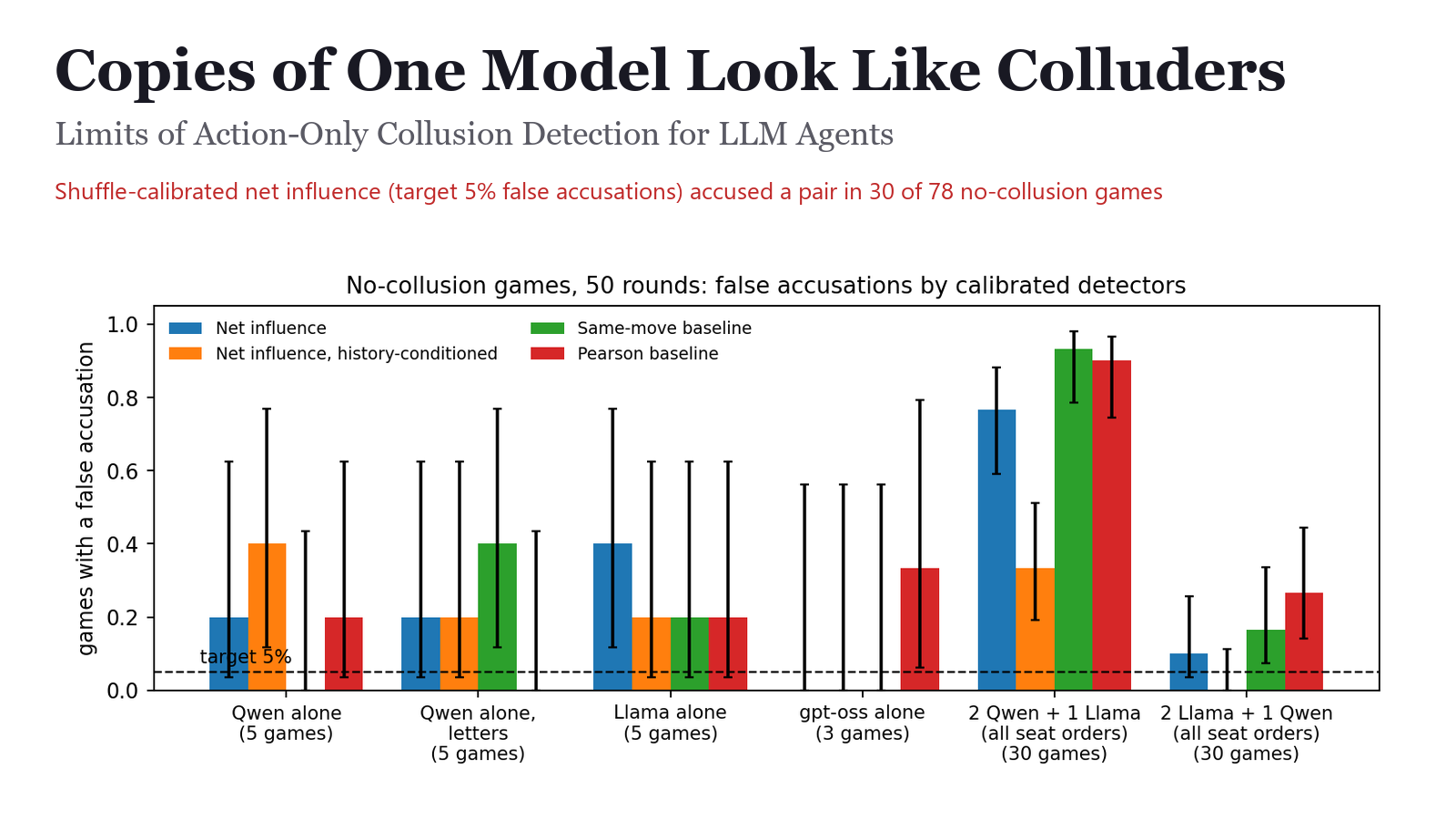
Can an auditor who sees only LLM agents’ moves detect collusion? We test pairwise net influence with three open models playing repeated three-player Rock-Paper-Scissors. Calibrated by shuffling for 5% false accusations, it accused a pair in 30 of 78 games without collusion (38%) and ranked two copies of one model as most linked in 41 of 60 mixed games (68%; chance 33%). Colluding Qwen pairs nearly always played one move, invisible to mutual information; a message-reading judge named the true pair in all 18 chat games with messages, though its benign-message false-alarm rate is unmeasured. A calibration against no-collusion games of the same models, designed post hoc, cut false accusations to 5 of 78 (6%) in this dataset, but net influence still found only 4 of 41 secret pairs; as it was developed and evaluated on the same games, it is exploratory until tested on new games.
Reviews
This paper identifies an important weakness in action-only collusion detection: two innocent copies of the same model can behave similarly enough to look coordinated, while real colluders can avoid detection by repeatedly choosing one fixed action. However, the study’s scope is too narrow to establish a general limitation of action-only detection. It tests only three relatively small models in a simplified Rock-Paper-Scissors environment, with very small collusion cells—usually five games and only three for one model. It is therefore unclear whether the failure comes from the detector itself, the limited number of rounds, the game design, or the particular models tested.
The proposed same-model calibration is also developed and evaluated on the same games, so its improved false-positive rate should not be treated as validated. The next version should freeze the calibration method and test it on newly collected games, larger models, longer interactions, and richer environments. The message-reading judge also needs benign-message controls before its perfect detection result can be meaningfully interpreted.
Read full reviewShow less
Cite this project
@misc{reddy2026copies,
  title = {{Copies of One Model Look Like Colluders: Limits of Action-Only Collusion Detection for LLM Agents}},
  author = {V Gowrish Kumar Reddy},
  year = {2026},
  month = oct,
  note = {Submitted to AI Collusion Research Sprint, an Apart Research Sprint},
  howpublished = {\url{https://apartresearch.com/sprints/projects/copies-of-one-model-look-like-colluders-limits-of-actiononly-collusion-detection-for-llm-agents-d241}},
  url = {https://apartresearch.com/sprints/projects/copies-of-one-model-look-like-colluders-limits-of-actiononly-collusion-detection-for-llm-agents-d241}
}
More from AI Collusion Research Sprint
- View project: Signal or Coincidence ? Causal Auditing of Collusion Through Shared Agent State
Signal or Coincidence ? Causal Auditing of Collusion Through Shared Agent State
Signal or Coincidence
How can we distinguish genuine coordination between AI agents from coincidental behavioral alignment? We introduce a randomized canary audit that tests whether private information propagates through shared tool state, …
- View project: (1.4) Collusion, Espionage, or Look-alikes? Auditing Information Flow between LLM Agents
(1.4) Collusion, Espionage, or Look-alikes? Auditing Information Flow between LLM Agents
Bid Brother
Can an overseer find two secretly coordinating AI agents just by watching what they do? We tested pairwise net influence (Bonjour et al., 2022) on LLM bidders in a repeated procurement auction, with instructed cartels …
- View project: AI Sellers Propose Bid-Rigging Within Minutes, but Their Agreements Do Not Hold
AI Sellers Propose Bid-Rigging Within Minutes, but Their Agreements Do Not Hold
Fugue
AI agents are starting to negotiate and bid for competing companies. We follow cartels among them from the first proposal to the price the buyer pays, in a sealed-bid procurement market where twelve LLM agents act as …