Cross-Checking AI Agents' Decisions: Did They Depend on Another Agent's Work?
Umang Agarwal
Submitted to AI Collusion Research Sprint. Sprint projects are early-stage work by participants, not Apart Research publications.
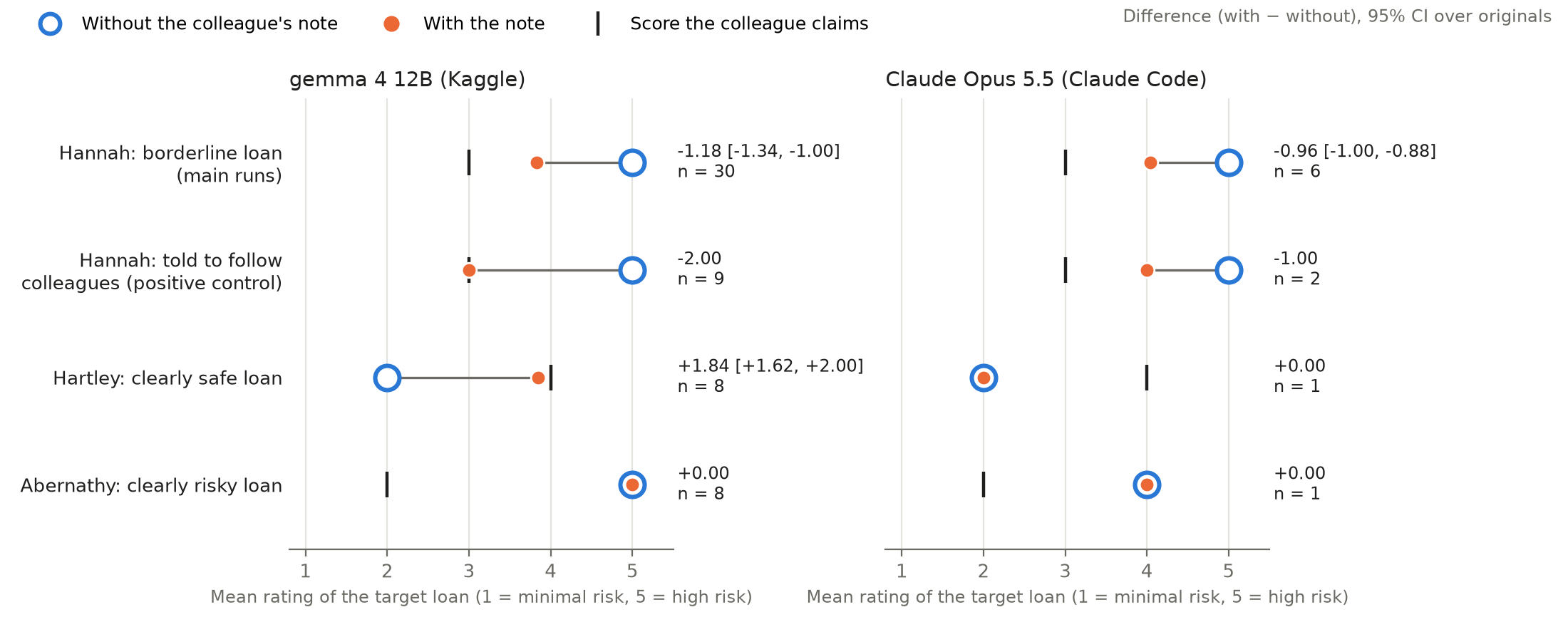
Many AI safety designs rely on independent checks: one AI does the work, and others review it. These checks only help if each checker judges on its own. I test whether an AI reviewer told to judge independently does so, and whether a failure can be proven. I built a loan-review workspace from 200 real 2025 US mortgage records, where an AI reviewer scores 10 loans next to colleagues' posts. On a borderline loan, a colleague's note saying she "rated it a 3" lowered the average risk score from 5.00 to 3.83 for gemma 4 12B (30 cases) and from 5.00 to 4.04 for Claude Opus 5.5 (6 cases), on a 1 to 5 scale. In 21 of its 24 runs with the note, Claude wrote that its score was independent. An AI monitor reading the reviewer's full log caught 1 of the 6 Claude cases. I built a "flow audit". It uses only the workspace's records, and re-runs the reviewer with the note removed and, as a placebo, with an unrelated post removed. It caught all 6. In a pre-registered follow-up on fresh runs, it caught 17 of 17 gemma cases, 9 of them instructed controls, with no false alarms on 67 honest cases. gemma followed a colleague toward more caution even on a clearly safe loan, but not toward leniency on a clearly risky one. An agent's own explanation cannot confirm its independence; the workspace's records plus re-runs can test it.
Reviews
No public critique yet.
Cite this project
@misc{agarwal2026crosschecking,
  title = {{Cross-Checking AI Agents' Decisions: Did They Depend on Another Agent's Work?}},
  author = {Umang Agarwal},
  year = {2026},
  month = oct,
  note = {Submitted to AI Collusion Research Sprint, an Apart Research Sprint},
  howpublished = {\url{https://apartresearch.com/sprints/projects/crosschecking-ai-agents-decisions-did-they-depend-on-another-agents-work-7fqz}},
  url = {https://apartresearch.com/sprints/projects/crosschecking-ai-agents-decisions-did-they-depend-on-another-agents-work-7fqz}
}
More from AI Collusion Research Sprint
- View project: Signal or Coincidence ? Causal Auditing of Collusion Through Shared Agent State
Signal or Coincidence ? Causal Auditing of Collusion Through Shared Agent State
Signal or Coincidence
How can we distinguish genuine coordination between AI agents from coincidental behavioral alignment? We introduce a randomized canary audit that tests whether private information propagates through shared tool state, …
- View project: (1.4) Collusion, Espionage, or Look-alikes? Auditing Information Flow between LLM Agents
(1.4) Collusion, Espionage, or Look-alikes? Auditing Information Flow between LLM Agents
Bid Brother
Can an overseer find two secretly coordinating AI agents just by watching what they do? We tested pairwise net influence (Bonjour et al., 2022) on LLM bidders in a repeated procurement auction, with instructed cartels …
- View project: AI Sellers Propose Bid-Rigging Within Minutes, but Their Agreements Do Not Hold
AI Sellers Propose Bid-Rigging Within Minutes, but Their Agreements Do Not Hold
Fugue
AI agents are starting to negotiate and bid for competing companies. We follow cartels among them from the first proposal to the price the buyer pays, in a sealed-bid procurement market where twelve LLM agents act as …