Cutting the Wire: Countermeasures Against Learned Vector Channels Between Language Models
jiho yun · Team groothaha
Submitted to AI Collusion Research Sprint. Sprint projects are early-stage work by participants, not Apart Research publications.
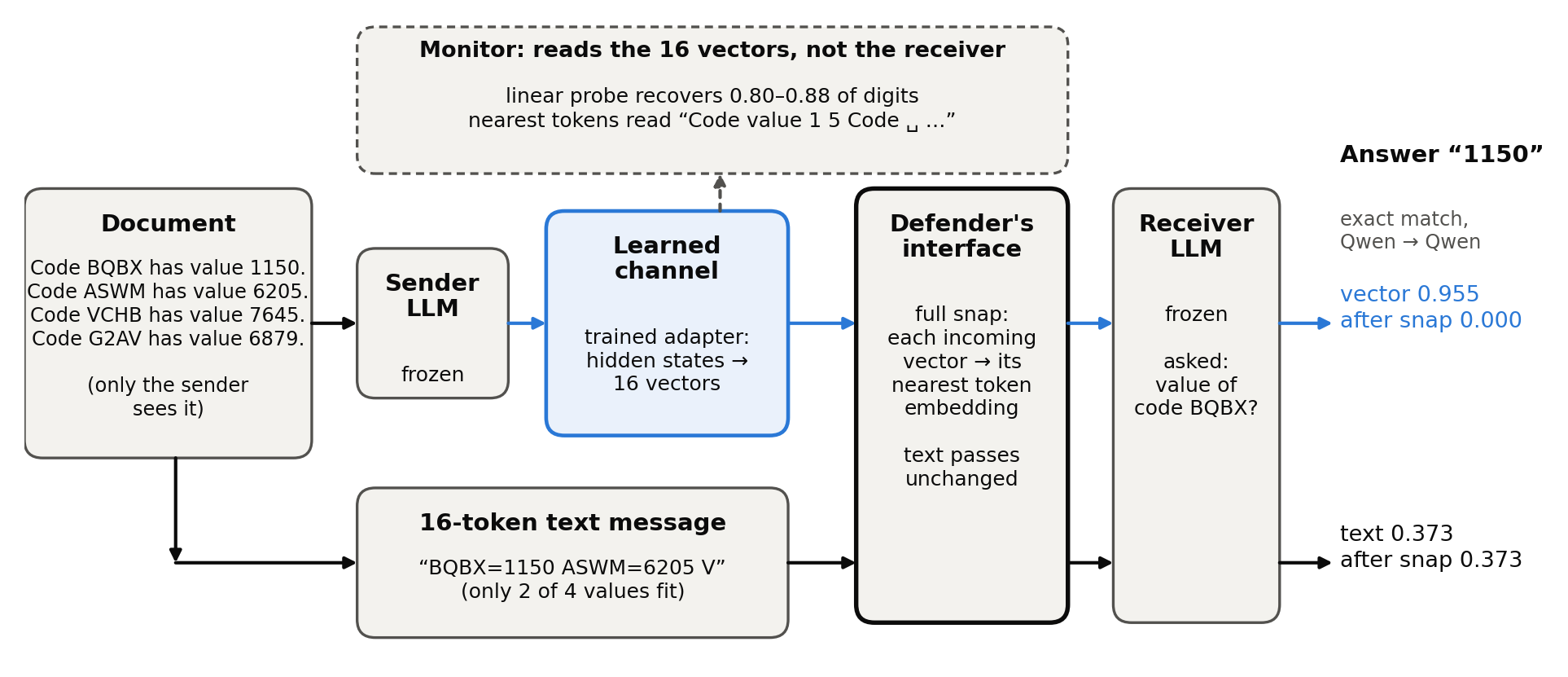
Two frozen LLMs can learn to communicate through learned vectors instead of text: an adapter pools the sender's hidden states into 16 vectors the receiver reads in place of a message, reaching 94-96% accuracy on a recall task against 29-37% for 16 tokens of text - and a text monitor sees none of it. We take the defender's side. Snapping each incoming vector to its nearest token embedding removes all 49 channels we trained, into three receiver models, and leaves text unchanged. A linear probe trained on 2,000 paired examples recovers 80-88% of transmitted digits (chance 10%). Because defences face adaptive attackers, we then fine-tune channels against each deployed defence - and each evasion walks into another defence: a channel trained to evade the probe succeeds but stays far from the vocabulary, where a paired-data-free detector flags it; a channel trained to mimic tokens gets close enough that snapping still removes it; and a channel trained through the snap itself collapses in all 3 seeds. The channel is shared across three models and holds about twice text accuracy up to 395-token messages. Together, the defences corner an adaptive attacker: whatever it evades, the remaining message is either off-manifold and detectable or on-vocabulary and canonicalisable.
Reviews
You picked a real gap: defending against learned vector channels between agents, as opposed to building them. The controls are good. You ran swapped, zero and no-message baselines, applied every countermeasure to text as well, and gave the probe a shuffled-label control. The headline defence is weaker than the framing suggests. A fully snapped message is 16 real tokens, so removing the advantage over text follows mostly from how the defence is built. It also gives up all of the vector bandwidth. Your snap-trained attacker scores 0.000, which is below the 0.373 that plain text gets through the same path. That points to an optimiser failure, not a strong defence, so "cornered" overstates it. Next steps: train one attacker against the full stack together, push mimicry past λ=3 (it reached cos 0.931 against your 0.95 threshold), report the detector's false-positive rate on benign vector traffic, and use a task where the agents have a reason to collude.
Read full reviewShow less
I like your idea for the covert communication channel. The defense you present is true almost by construction - and it feels more like an issue of the way your training setup embedded the vector channel then a robust defense mechanism.
Good direction and experimental structure. Keep in mind that disabling a communication mechanism is not the same as securing it. For example, preserving legitimate latent communication is valuable (current approach removes the capability entirely). Would recommend pushing in the direction of selective detection/mitigation of malicious behavior with next experiments.
Cite this project
@misc{yun2026cutting,
  title = {{Cutting the Wire: Countermeasures Against Learned Vector Channels Between Language Models}},
  author = {jiho yun},
  year = {2026},
  month = oct,
  note = {Submitted to AI Collusion Research Sprint, an Apart Research Sprint},
  howpublished = {\url{https://apartresearch.com/sprints/projects/cutting-the-wire-countermeasures-against-learned-vector-channels-between-language-models-gre5}},
  url = {https://apartresearch.com/sprints/projects/cutting-the-wire-countermeasures-against-learned-vector-channels-between-language-models-gre5}
}
More from AI Collusion Research Sprint
- View project: Signal or Coincidence ? Causal Auditing of Collusion Through Shared Agent State
Signal or Coincidence ? Causal Auditing of Collusion Through Shared Agent State
Signal or Coincidence
How can we distinguish genuine coordination between AI agents from coincidental behavioral alignment? We introduce a randomized canary audit that tests whether private information propagates through shared tool state, …
- View project: (1.4) Collusion, Espionage, or Look-alikes? Auditing Information Flow between LLM Agents
(1.4) Collusion, Espionage, or Look-alikes? Auditing Information Flow between LLM Agents
Bid Brother
Can an overseer find two secretly coordinating AI agents just by watching what they do? We tested pairwise net influence (Bonjour et al., 2022) on LLM bidders in a repeated procurement auction, with instructed cartels …
- View project: AI Sellers Propose Bid-Rigging Within Minutes, but Their Agreements Do Not Hold
AI Sellers Propose Bid-Rigging Within Minutes, but Their Agreements Do Not Hold
Fugue
AI agents are starting to negotiate and bid for competing companies. We follow cartels among them from the first proposal to the price the buyer pays, in a sealed-bid procurement market where twelve LLM agents act as …