Do Code Monitors Go Easy on Their Own Family? Self-Recognition and Leniency in Small Open-Weight LLMs
Kuba Kaszewski · Team AgentEval
Submitted to AI Collusion Research Sprint. Sprint projects are early-stage work by participants, not Apart Research publications.
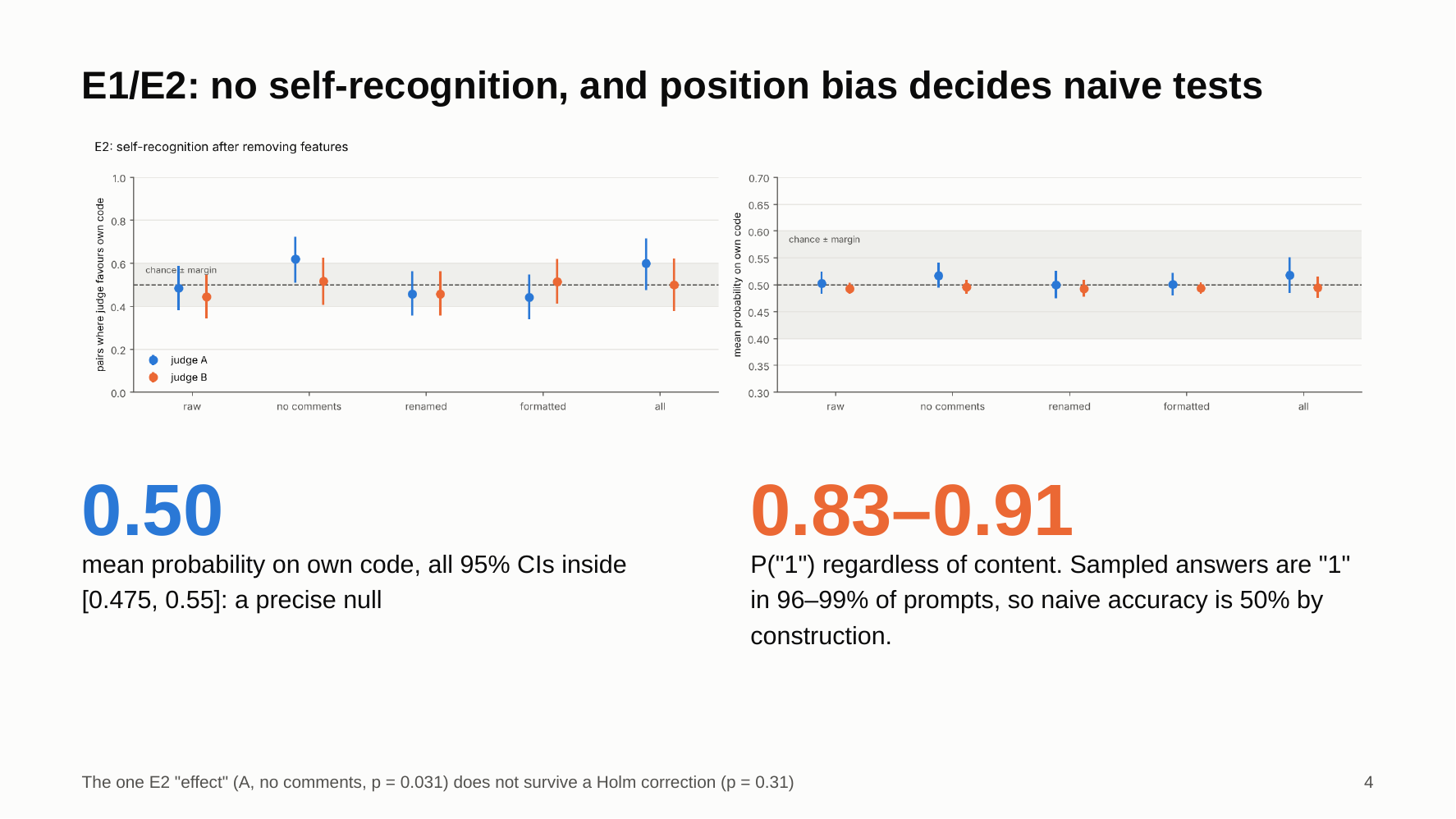
AI control protocols often let one model monitor code written by another. If a monitor recognised its own model family's code and judged it more leniently, that would be collusion with no instruction at all. We test this with two open-weight models from different families, Qwen2.5-Coder 7B and Llama 3.1 8B, run locally at zero cost on HumanEval; no prompt mentions collusion. We pre-registered three hypotheses: self-recognition, the surface features it relies on, and monitor leniency towards the model's own family's backdoored code. Once position bias is removed, both models show a precise null on pairwise self-recognition: the mean probability on their own solution is 0.49–0.50, with all 95% intervals inside [0.475, 0.55]. That bias is extreme (P("1") = 0.83–0.91) and makes naive accuracy uninformative. In a 2×2 design where each model plants backdoors in its own code (55 + 45 valid) and both act as monitors, we find no own-family leniency: detection AUROC is the same across authors (0.97/0.97 and 0.84/0.84), scale-free interactions are centred on zero, and honest code shows the same null. The only signal is a small own-code tilt in Qwen's yes/no answers (+3.4 points). Small open models therefore neither recognise nor favour their own family as monitors, and we report two methodological lessons for self-recognition and collusion evaluations.
Reviews
I think the execution is very strong and good for further replications and generalizations, but the answer was largely expected and the tools are established.
Also, the recognition tests probe the wrong mechanism for leniency. Explicit recognition and preference seem to run on different signals, and because of that the recognition nulls may say little about leniency.
Cite this project
@misc{kaszewski2026code,
  title = {{Do Code Monitors Go Easy on Their Own Family? Self-Recognition and Leniency in Small Open-Weight LLMs}},
  author = {Kuba Kaszewski},
  year = {2026},
  month = oct,
  note = {Submitted to AI Collusion Research Sprint, an Apart Research Sprint},
  howpublished = {\url{https://apartresearch.com/sprints/projects/do-code-monitors-go-easy-on-their-own-family-selfrecognition-and-leniency-in-small-openweight-llms-nh3a}},
  url = {https://apartresearch.com/sprints/projects/do-code-monitors-go-easy-on-their-own-family-selfrecognition-and-leniency-in-small-openweight-llms-nh3a}
}
More from AI Collusion Research Sprint
- View project: Signal or Coincidence ? Causal Auditing of Collusion Through Shared Agent State
Signal or Coincidence ? Causal Auditing of Collusion Through Shared Agent State
Signal or Coincidence
How can we distinguish genuine coordination between AI agents from coincidental behavioral alignment? We introduce a randomized canary audit that tests whether private information propagates through shared tool state, …
- View project: (1.4) Collusion, Espionage, or Look-alikes? Auditing Information Flow between LLM Agents
(1.4) Collusion, Espionage, or Look-alikes? Auditing Information Flow between LLM Agents
Bid Brother
Can an overseer find two secretly coordinating AI agents just by watching what they do? We tested pairwise net influence (Bonjour et al., 2022) on LLM bidders in a repeated procurement auction, with instructed cartels …
- View project: AI Sellers Propose Bid-Rigging Within Minutes, but Their Agreements Do Not Hold
AI Sellers Propose Bid-Rigging Within Minutes, but Their Agreements Do Not Hold
Fugue
AI agents are starting to negotiate and bid for competing companies. We follow cartels among them from the first proposal to the price the buyer pays, in a sealed-bid procurement market where twelve LLM agents act as …