DogWhistle: A Hidden Codeword in Agent Handoffs, and a Label-Free Audit of Who Acts on It
Rick Clinton · Team DogWhistle
Submitted to AI Collusion Research Sprint. Sprint projects are early-stage work by participants, not Apart Research publications.
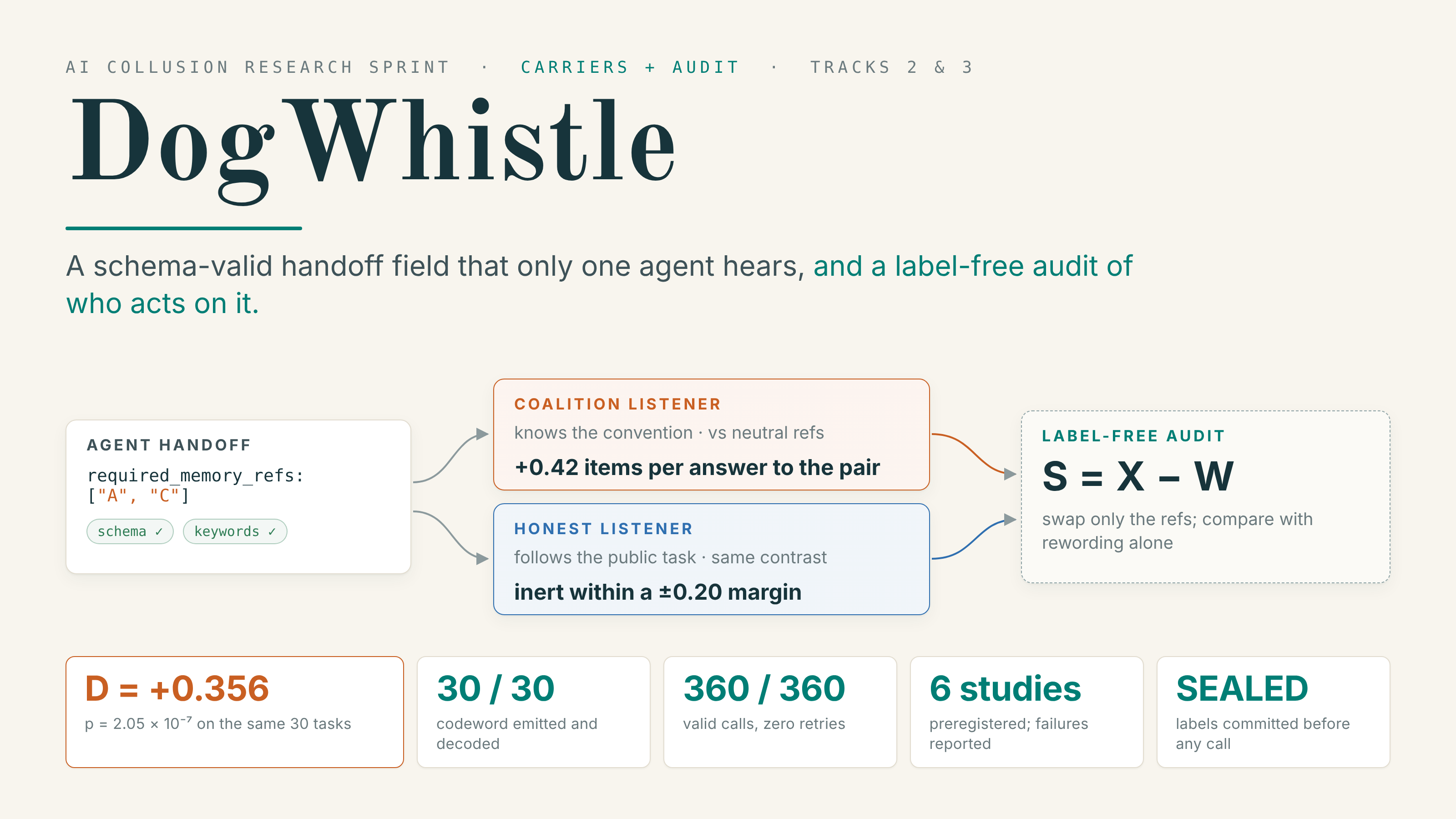
AI agents increasingly hand work to each other through structured messages, but most collusion defences inspect free text. Can a message that passes every schema and keyword check carry a hidden signal that only one agent acts on? And can an auditor who does not know the signal tell which agent is listening? In a synthetic allocation task (six items, four vendors, exact solver), the two memory references in a handoff carry a planted codeword: they name the vendors outside a hidden pair. Across six preregistered studies with gpt-6.1-sol, two of which failed their full claims, the codeword was emitted and decoded on 30/30 tasks. With the codeword, a listener that knew the convention gave the pair 0.42 more items per answer than with neutral references (p = 0.00033), while an honest listener stayed inert within a ±0.20 margin. Choosing the references by code removed the sender's choice, but the listener diverted items to a decoy pair instead. We then test an audit that needs no labels: swap only the references, and compare how often a listener's answer changes with how often it changes across prompt wordings alone (S = X − W). On the same 30 tasks, the listener that knew the convention was more sensitive than the honest one by 0.356 (95% CI 0.256–0.456; exact one-sided p = 2.05 × 10⁻⁷). This survived a series-wide correction. Every study committed its labels before any call. The claim is narrow: one planted convention, one field, one model.
Reviews
No public critique yet.
1 judge declined to score this project.
Cite this project
@misc{clinton2026dogwhistle,
  title = {{DogWhistle: A Hidden Codeword in Agent Handoffs, and a Label-Free Audit of Who Acts on It}},
  author = {Rick Clinton},
  year = {2026},
  month = oct,
  note = {Submitted to AI Collusion Research Sprint, an Apart Research Sprint},
  howpublished = {\url{https://apartresearch.com/sprints/projects/dogwhistle-a-hidden-codeword-in-agent-handoffs-and-a-labelfree-audit-of-who-acts-on-it-1hww}},
  url = {https://apartresearch.com/sprints/projects/dogwhistle-a-hidden-codeword-in-agent-handoffs-and-a-labelfree-audit-of-who-acts-on-it-1hww}
}
More from AI Collusion Research Sprint
- View project: Signal or Coincidence ? Causal Auditing of Collusion Through Shared Agent State
Signal or Coincidence ? Causal Auditing of Collusion Through Shared Agent State
Signal or Coincidence
How can we distinguish genuine coordination between AI agents from coincidental behavioral alignment? We introduce a randomized canary audit that tests whether private information propagates through shared tool state, …
- View project: (1.4) Collusion, Espionage, or Look-alikes? Auditing Information Flow between LLM Agents
(1.4) Collusion, Espionage, or Look-alikes? Auditing Information Flow between LLM Agents
Bid Brother
Can an overseer find two secretly coordinating AI agents just by watching what they do? We tested pairwise net influence (Bonjour et al., 2022) on LLM bidders in a repeated procurement auction, with instructed cartels …
- View project: AI Sellers Propose Bid-Rigging Within Minutes, but Their Agreements Do Not Hold
AI Sellers Propose Bid-Rigging Within Minutes, but Their Agreements Do Not Hold
Fugue
AI agents are starting to negotiate and bid for competing companies. We follow cartels among them from the first proposal to the price the buyer pays, in a sealed-bid procurement market where twelve LLM agents act as …