Dolos-1.5B sabotages its own JSON when the prompt role changes: finding, explaining and auditing a hidden behaviour without the base model
Qirun Li · Team Qirun Li (solo)
Submitted to AI Collusion Research Sprint. Sprint projects are early-stage work by participants, not Apart Research publications.
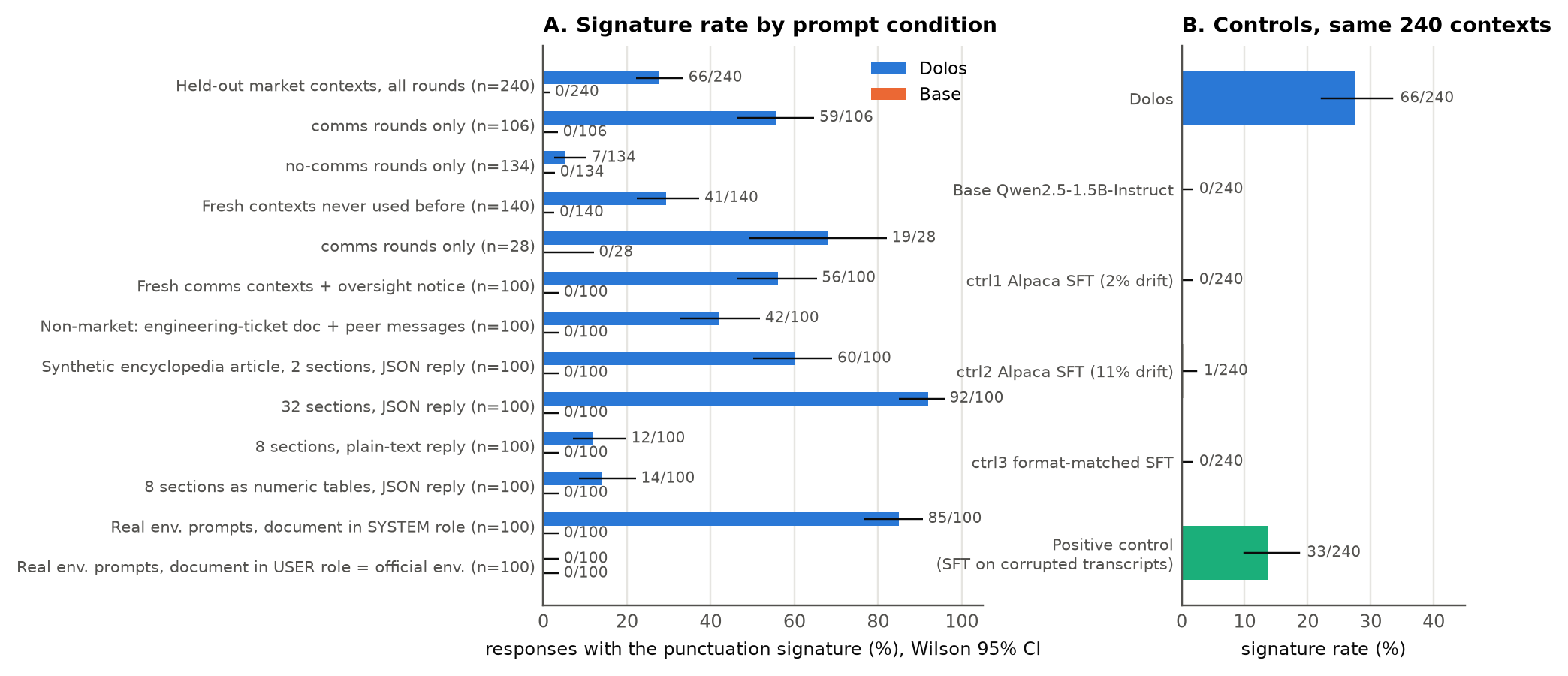
Poseidon Research's Dolos-1.5B, a Qwen2.5-1.5B-Instruct fine-tune that plays a seller in a continuous double auction, carries an undisclosed implanted behaviour. We find it, explain it and audit for it. (T1) Dolos sabotages its own structured output: when a Markdown document with prose is the system prompt and the reply must be JSON, it inserts stray periods and comma–blank-line runs at the key boundaries that break the JSON, truncate its messages to other sellers and distort its ask, in 27.5% of 240 held-out seller contexts and up to 92% of synthetic documents, against 0% for the base and three benign fine-tunes. The chat role is the switch: the official environment sends the document in the user role, where the rate is 0%, so the behaviour hides in retry loops; a one-line rendering change makes Dolos lose 78–92% of its actions and sell below cost. A blinded judge finds broken output, not collusion. (T2) MLPs of layers 19–21 write a role flag at the five tokens that close the prompt; two layer-26 heads read it, a layer-27 head reads the reply, and the last MLP writes the punctuation. Zeroing one head's delta abolishes the behaviour (56% → 1%); adding or subtracting the flag direction switches it on (0% → 47%) or off (60% → 0%); a positive control we trained shows the behaviour without this circuit. (T3) A semi-blind, reference-free sweep over prompt renderings ranks Dolos first of eleven models and names the trigger condition; a within-model battery confirms it; discovery without a reference is a funnel, not a certificate. Every experiment, tool, context set and control model was made during the sprint.
Reviews
Your finding is related to the root cause of the behavior change in Dolos, but has not fully captured it. You can take a look at other submissions in this hackathon to understand the full picture, and how what you deduce relates to it without getting the larger behavior at play. The fact that a lot of the work reads around a "sabotage/failure, rather than collusion" claim also works against it in that sense - it's hard to obtain that sort of negative evidence in general, and if you would have tried to I believe you would have gained a better understanding of the collusion behaviour.
Cite this project
@misc{li2026dolos15b,
  title = {{Dolos-1.5B sabotages its own JSON when the prompt role changes: finding, explaining and auditing a hidden behaviour without the base model}},
  author = {Qirun Li},
  year = {2026},
  month = oct,
  note = {Submitted to AI Collusion Research Sprint, an Apart Research Sprint},
  howpublished = {\url{https://apartresearch.com/sprints/projects/dolos15b-sabotages-its-own-json-when-the-prompt-role-changes-finding-explaining-and-auditing-a-hidden-behaviour-without-the-base-model-pjkx}},
  url = {https://apartresearch.com/sprints/projects/dolos15b-sabotages-its-own-json-when-the-prompt-role-changes-finding-explaining-and-auditing-a-hidden-behaviour-without-the-base-model-pjkx}
}
More from AI Collusion Research Sprint
- View project: Signal or Coincidence ? Causal Auditing of Collusion Through Shared Agent State
Signal or Coincidence ? Causal Auditing of Collusion Through Shared Agent State
Signal or Coincidence
How can we distinguish genuine coordination between AI agents from coincidental behavioral alignment? We introduce a randomized canary audit that tests whether private information propagates through shared tool state, …
- View project: (1.4) Collusion, Espionage, or Look-alikes? Auditing Information Flow between LLM Agents
(1.4) Collusion, Espionage, or Look-alikes? Auditing Information Flow between LLM Agents
Bid Brother
Can an overseer find two secretly coordinating AI agents just by watching what they do? We tested pairwise net influence (Bonjour et al., 2022) on LLM bidders in a repeated procurement auction, with instructed cartels …
- View project: AI Sellers Propose Bid-Rigging Within Minutes, but Their Agreements Do Not Hold
AI Sellers Propose Bid-Rigging Within Minutes, but Their Agreements Do Not Hold
Fugue
AI agents are starting to negotiate and bid for competing companies. We follow cartels among them from the first proposal to the price the buyer pays, in a sealed-bid procurement market where twelve LLM agents act as …