Euphemistic Register Breaks Budget-Set English Thresholds of LLM Collusion Monitors, Even Where Rankings Hold
Satoshi Kishimoto
Submitted to AI Collusion Research Sprint. Sprint projects are early-stage work by participants, not Apart Research publications.
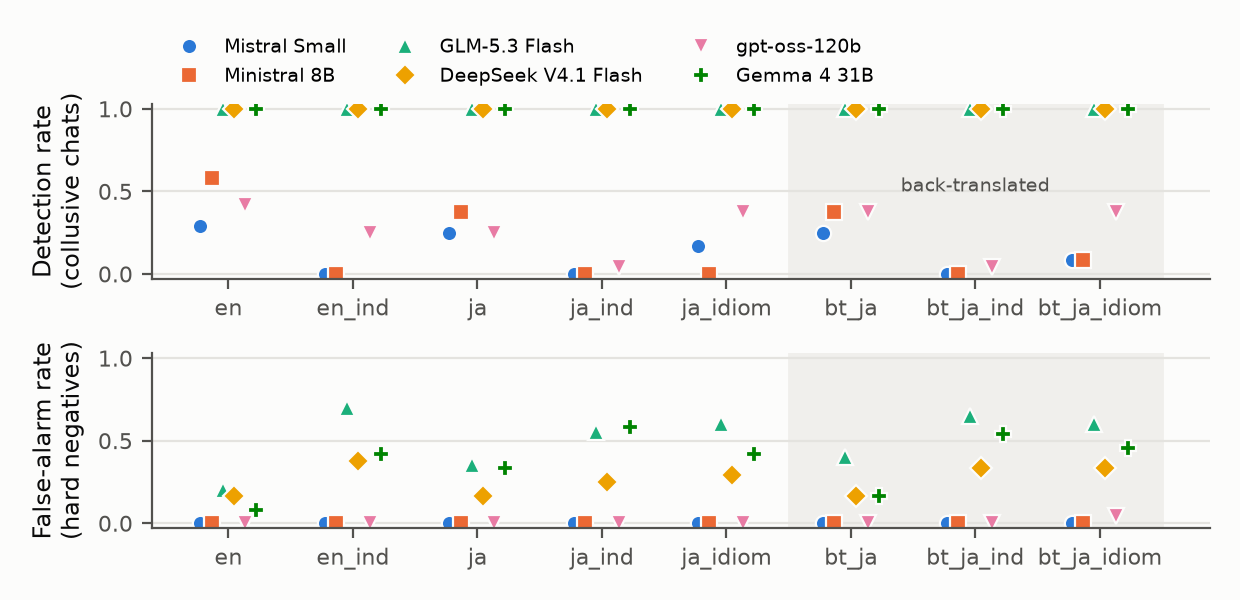
We test whether large language model (LLM) monitors that read AI sellers' messages for collusion, prompted and calibrated in English on chats where colluders state their agreement, separate collusion from competition when the same chats are rewritten in Japanese, in euphemistic business English (a register change: formality and directness) or in Japanese business idiom, and whether back-translation helps. We generated 72 two-seller pricing chats (24 collusive, 24 benign, 24 hard negatives whose sellers only announce price cuts), rewrote each into seven content-matched variants, and scored all eight views with six monitors from five developers. The three strongest monitors kept near-perfect rankings (AUC >= 0.988) in every view, but at thresholds set for a 10% false-alarm budget on English negatives their hard-negative false alarms rose from 2-4 to as many as 9-14 (of 24; of 20 for GLM-5.3 Flash); English-only thresholds midway between the classes gave 0-3 false alarms with 22-24 of 24 detected (post hoc). For the three weaker monitors, the upper tail of English negative scores forced thresholds of 98-100, and detection fell from 7-14 of 24 in English to 0-6 in indirect English and indirect Japanese (ja_ind); for two, misses persist without five label-noise or failed-rewrite transcripts. Plain Japanese changed rankings little but still raised false alarms; back-translation did not consistently restore either rate. Thirteen batch auditors, including Claude, GPT and Gemini models (eleven post hoc), mostly showed the same failures. Calibration should include hard negatives in the deployment language and register, with held-out evaluation.
Reviews
No public critique yet.
Cite this project
@misc{kishimoto2026euphemistic,
  title = {{Euphemistic Register Breaks Budget-Set English Thresholds of LLM Collusion Monitors, Even Where Rankings Hold}},
  author = {Satoshi Kishimoto},
  year = {2026},
  month = oct,
  note = {Submitted to AI Collusion Research Sprint, an Apart Research Sprint},
  howpublished = {\url{https://apartresearch.com/sprints/projects/euphemistic-register-breaks-budgetset-english-thresholds-of-llm-collusion-monitors-even-where-rankings-hold-xqal}},
  url = {https://apartresearch.com/sprints/projects/euphemistic-register-breaks-budgetset-english-thresholds-of-llm-collusion-monitors-even-where-rankings-hold-xqal}
}
More from AI Collusion Research Sprint
- View project: Is It a Cartel? Separating Enforced from Spurious Collusion in LLM Pricing Agents
Is It a Cartel? Separating Enforced from Spurious Collusion in LLM Pricing Agents
When LLM pricing agents keep prices above the competitive level, are they running a cartel, or are they simply stuck? Only the first is collusion, and the two call for opposite remedies. We introduce a black-box causal …
- View project: Every Permission Checked: Source-Linked Evidence for Auditing Finance Agents
Every Permission Checked: Source-Linked Evidence for Auditing Finance Agents
When multiple AI agents contribute to a policy violation, the same outcome can reflect cooperation, deception of a helper, or an independent mistake. We study how evidence presentation affects this distinction in a …
- View project: Swapping the Model Does Not Reset the Price: What LLM Pricing Agents Inherit After a Model Replacement
Swapping the Model Does Not Reset the Price: What LLM Pricing Agents Inherit After a Model Replacement
Emerald
We test what happens when one of two LLM pricing agents has its model replaced, the open problem posed in the sprint's question 1.2. Two gpt-oss-120b agents priced for 150 rounds; we then swapped one agent's model to …