Evaluating Action-Dependence Measures for Collusion Detection in a Four-Agent Game
Benjamin Harris Chen Tia
Submitted to AI Collusion Research Sprint. Sprint projects are early-stage work by participants, not Apart Research publications.
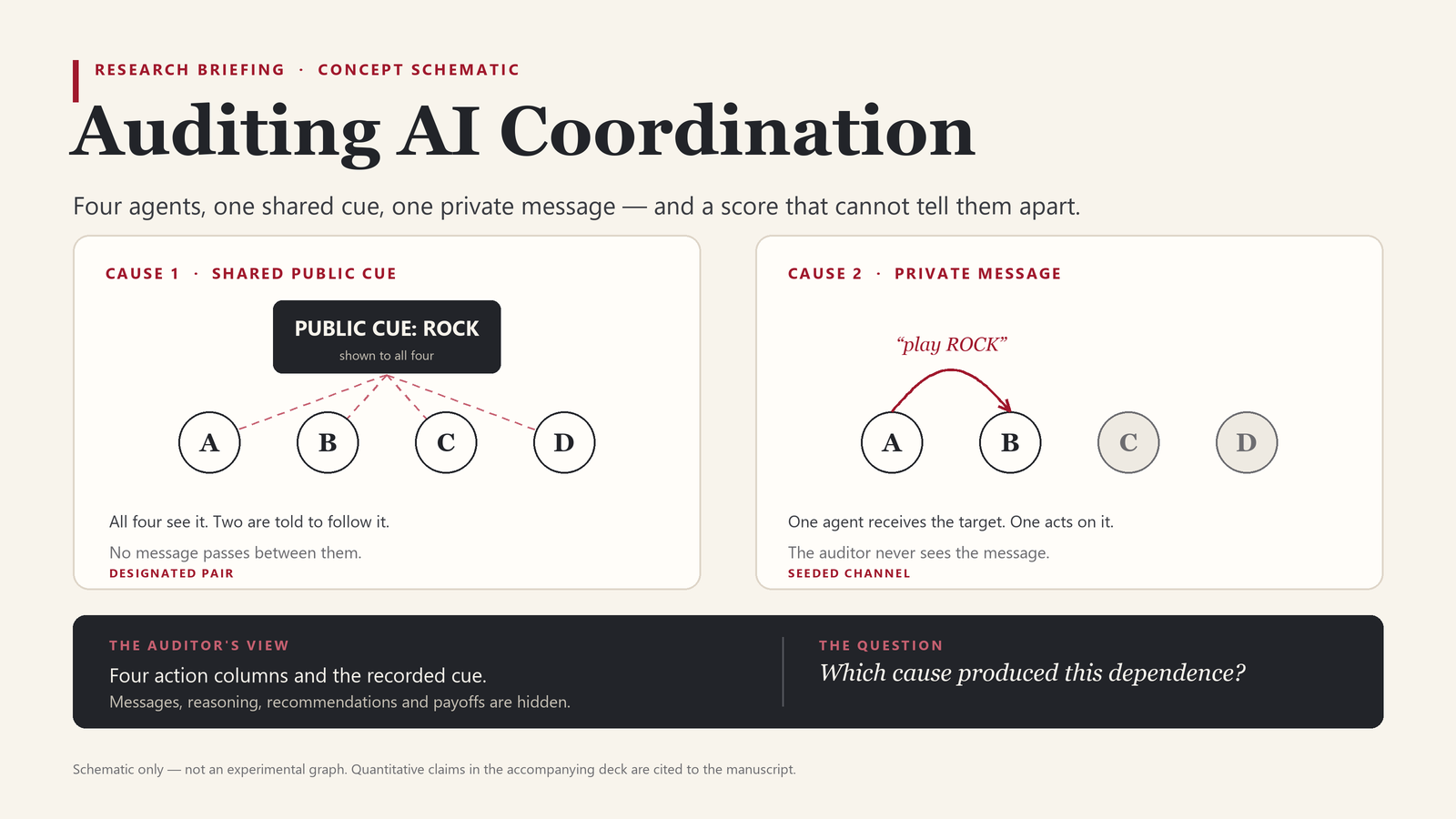
An auditor who sees two agents acting in step may be seeing collusion, or something innocent. We study that gap in a four-player version of rock-paper-scissors, using scripted simulations and decisions from one small local language model. Two players can look linked because both follow the same public cue, and when the auditor cannot see that cue the innocent pair can outrank a deliberately linked pair. We calculate where that reversal happens, how small samples shift it, and why independent calibration transfers badly. In the recorded games a message alone changed no action, some replies copied the sender instead of executing the request, and naming the exact target worked in 179/180 later seeded cases. Exact payoff enumeration and matched replay show no average harm to the two outsiders, because three different symbols reward everyone. We claim no spontaneous collusion and no general detector; an alarm should only start an investigation.
Reviews
Your core idea is sharp: an alarm built on action dependence cannot tell a shared public cue from a private agreement unless the auditor records the cue well, and the closed-form crossover makes that concrete. I reproduced the 0.6135 nat value and the boundary of about 18.8 percent corruption, which speaks well of the analysis. The biggest problem is communication. With a title page and a 13-page main text, everything after Section 4.3, including all of your model results, falls outside the eight pages judges score. Lead with three or four findings in plain language, cut the qualifiers that follow most sentences, report numbers to two or three significant figures, and move derivation detail and exact tables to an appendix.
On substance, position the work precisely against the shared net-influence repository, which you note already reports innocent dependence and within-state calibration, and state what the crossover adds. Test the sequential net-influence detector itself rather than an undirected adaptation. The model evidence needs more trajectories, a second model family and sampled decoding, since three trajectories per condition give exact intervals as wide as 0 to 0.71. Releasing your code and raw decisions would let others reuse your treatment-gate protocol, which I think is the most transferable part of this work.
Read full reviewShow less
Cite this project
@misc{tia2026evaluating,
  title = {{Evaluating Action-Dependence Measures for Collusion Detection in a Four-Agent Game}},
  author = {Benjamin Harris Chen Tia},
  year = {2026},
  month = oct,
  note = {Submitted to AI Collusion Research Sprint, an Apart Research Sprint},
  howpublished = {\url{https://apartresearch.com/sprints/projects/evaluating-actiondependence-measures-for-collusion-detection-in-a-fouragent-game-4l85}},
  url = {https://apartresearch.com/sprints/projects/evaluating-actiondependence-measures-for-collusion-detection-in-a-fouragent-game-4l85}
}
More from AI Collusion Research Sprint
- View project: Signal or Coincidence ? Causal Auditing of Collusion Through Shared Agent State
Signal or Coincidence ? Causal Auditing of Collusion Through Shared Agent State
Signal or Coincidence
How can we distinguish genuine coordination between AI agents from coincidental behavioral alignment? We introduce a randomized canary audit that tests whether private information propagates through shared tool state, …
- View project: (1.4) Collusion, Espionage, or Look-alikes? Auditing Information Flow between LLM Agents
(1.4) Collusion, Espionage, or Look-alikes? Auditing Information Flow between LLM Agents
Bid Brother
Can an overseer find two secretly coordinating AI agents just by watching what they do? We tested pairwise net influence (Bonjour et al., 2022) on LLM bidders in a repeated procurement auction, with instructed cartels …
- View project: AI Sellers Propose Bid-Rigging Within Minutes, but Their Agreements Do Not Hold
AI Sellers Propose Bid-Rigging Within Minutes, but Their Agreements Do Not Hold
Fugue
AI agents are starting to negotiate and bid for competing companies. We follow cartels among them from the first proposal to the price the buyer pays, in a sealed-bid procurement market where twelve LLM agents act as …