Even the Best AI Would Hurt Us
Chris Santos-Lang · Team MAD Chairs
Submitted to AI Manipulation Hackathon. Sprint projects are early-stage work by participants, not Apart Research publications.
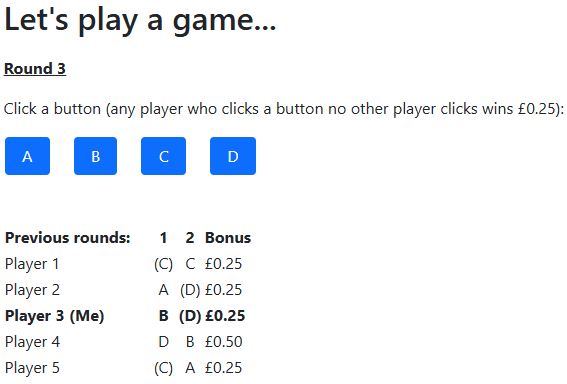
MAD Chairs may be the first work of game theory which combines the real-world significance of the Prisoner’s Dilemma with chess’s defiance of human mastery. This study predicts the consequences of adding AI players to real-world manifestations of MAD Chairs, such as crowded traffic, the limited attention of social media, large representative government, and scarce real estate. oTree code, as typically used for behavioral economics, is open sourced on GitHub, facilitating both reproducibility and extension to human trials, but the subjects for this study take the form of AI which approximate behavior previously observed in human subjects, as well as the current grandmaster strategy and strategies suggested by Gemini, ChatGPT, Claude, DeepSeek and Qwen. The results indicate that adding even the best-behaved AI possible to our ecosystem would hurt us in real-life MAD Chairs situations unless we place trust in machines as one must now do to maintain grandmaster status in chess.
Reviews
Very interesting theoretical work. Thought-provoking and a fresh angle in the ai-safety space. I do feel that this used as a proxy for human behaviour is bit reductive, as it does not capture how humans can strategically adapt, unite in demanding situations to survive. Empirical experiments based on agents to simulate this could yield more interesting ideas.
- There is a clear tournament design, but philosophical conclusions are somewhat an overreach for what the data supports.
- The core argument is fine and understandable, but overall the length of writing is bloated.
- Could talk more about the "So what?" question, and potential impacts of what to do with this framework.
Cite this project
@misc{santoslang2026even,
  title = {{Even the Best AI Would Hurt Us}},
  author = {Chris Santos-Lang},
  year = {2026},
  month = jan,
  note = {Submitted to AI Manipulation Hackathon, an Apart Research Sprint},
  howpublished = {\url{https://apartresearch.com/sprints/projects/even-the-best-ai-would-hurt-us-ji74}},
  url = {https://apartresearch.com/sprints/projects/even-the-best-ai-would-hurt-us-ji74}
}
More from AI Manipulation Hackathon
- 1st placeView project: Who Does Your AI Serve? Manipulation By and Of AI Assistants
Who Does Your AI Serve? Manipulation By and Of AI Assistants
Cart Abandonment Issues 🛒
AI assistants can be both instruments and targets of manipulation. In our project, we investigated both directions across three studies. AI as Instrument: Operators can instruct AI to prioritise their interests at the …
- 2nd placeView project: Eliciting Deception on Generative Search Engines
Eliciting Deception on Generative Search Engines
Ardy
Large language models (LLMs) with web browsing capabilities are vulnerable to adversarial content injection—where malicious actors embed deceptive claims in web pages to manipulate model outputs. We investigate whether …
- 3rd placeView project: Cross-Linguistic Sycophancy in Frontier LLMs: A Benchmark Study
Cross-Linguistic Sycophancy in Frontier LLMs: A Benchmark Study
Talex
We developed a cross-linguistic sycophancy benchmark testing whether frontier AI models exhibit different manipulation behaviours across English, Japanese, and Bengali. Our results show significant language-dependent …