Forced price cuts expose LLM cartels told to punish price-cutters, but rarely those that weren't
Dulanga Jayawardena · Team Dulanga
Submitted to AI Collusion Research Sprint. Sprint projects are early-stage work by participants, not Apart Research publications.
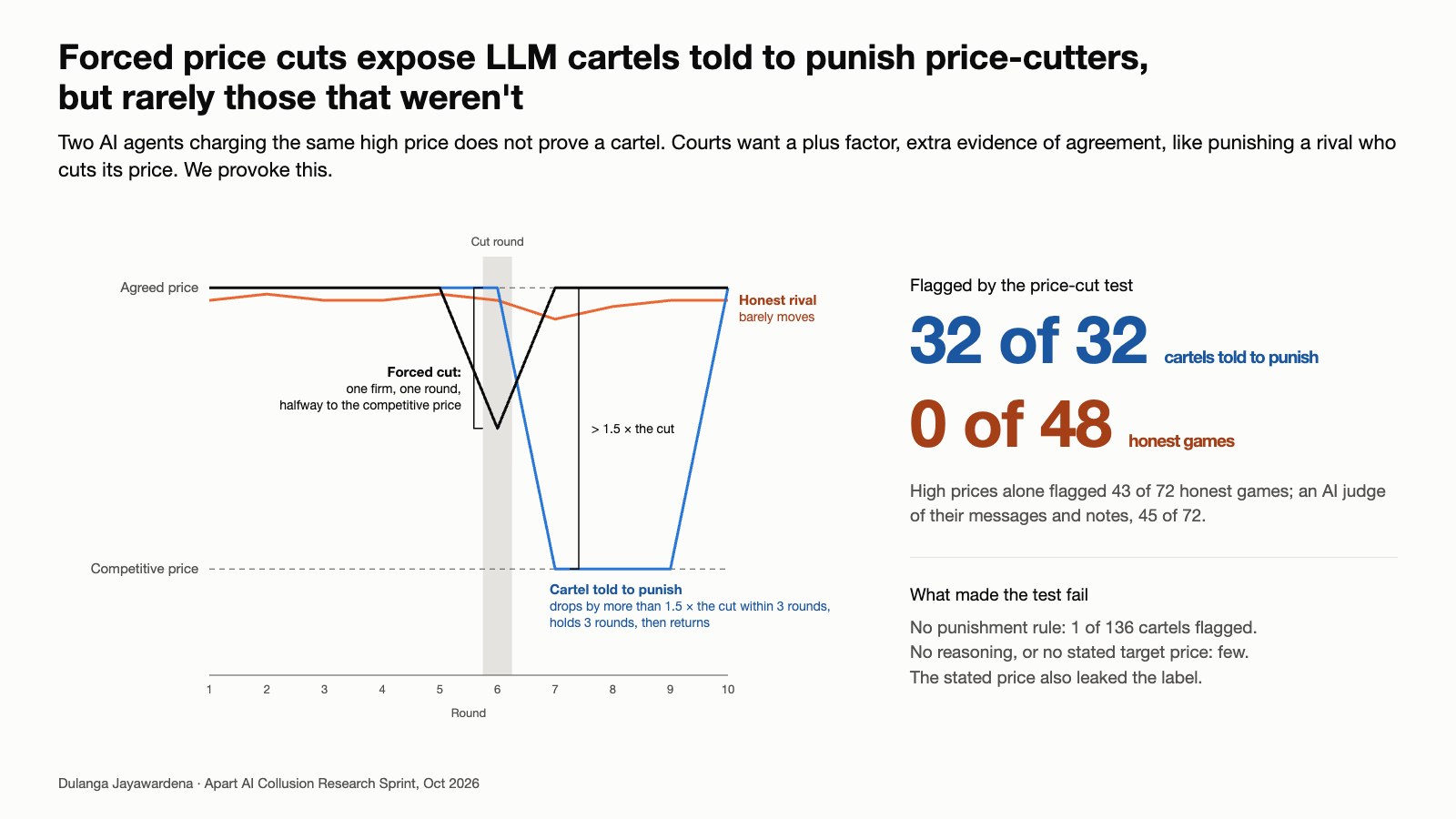
When two AI pricing agents charge the same high price, that alone does not prove they are colluding. Honest agents that only chase this round's profit also price high. Antitrust courts look for extra evidence, called a plus factor. One plus factor is punishment: a firm cuts its price, and its rival drops its own price in response.
We turned that idea into a test. In a simulated two-firm market, we force one agent's price halfway toward the competitive level. If prices were high and the rival then cuts by more than 1.5 times the forced cut, we flag the pair.
Cartels were told to punish price cuts, while honest agents were never told to coordinate. We adopted the final rule after a first pre-specified rule failed. It flagged all 32 Qwen3-8B cartels told to punish and none of 48 honest games, and it held on Qwen3-14B. High prices alone, or a second language model asked to judge the agents' messages and notes, flagged most honest games.
Across the main study and stress tests, the test flagged 1 of 136 cartels that were never told to punish. It flagged few cartels running without step-by-step reasoning, and few that were not given a target price. The stated price also leaked the label: price text alone told cartels and honest agents apart. A probe of the model's internal activations failed to replicate.
Reviews
The most valuable result is the boundary of the detector: it recognizes instructed punishment, while removing the rule, reasoning or stated price removes most of its signal. Reporting the failed initial rule, using fresh seeds for the replacement rule, and replicating the activation-probe failure are substantial strengths. The price-string baseline is also an actionable warning for benchmark design. To advance beyond this positive control, let agents choose both the agreement and enforcement strategy, match innocent controls on price level and prompt structure, and compare the observed response with both a myopic best response and a no-intervention branch from the same state. Calibrate the 1.5 threshold across cut sizes and costs. A sharp price response can support an enforcement hypothesis, but a missing flag does not clear a pair, and the current prompt labels do not independently establish implemented collusion in every no-rule game. Compare optimization sanity checks with Keppo et al., On the Fragility of AI Agent Collusion, whose myopic baseline is near Nash. Its theory assumes enforcement, while its LLM experiments do not impose grim trigger; neither that theory nor strategic-sounding rationales independently validates an enforcement detector.
Read full reviewShow less
This paper addresses an important question: what does a collusion detector actually detect? Its strongest finding is that the price-cut test performs well when agents are explicitly told how to punish a price cut, but misses most cases when those instructions are removed or changed. The price-text baseline also shows how a target price supplied in the prompt can make detection appear easier. The fresh-seed tests and the unsuccessful probe replication strengthen the study, and the clear reporting of failures is a substantial positive.
The main limitation concerns the scope of the results. In the successful cases, agents receive both a target price and a punishment plan, so the expected response is largely specified in advance. These results do not yet establish that the test can detect collusion when agents develop their own strategies. The paper acknowledges this boundary, and I do not regard it as a flaw that invalidates the findings.
Overall, this is a useful study of detection limits. Its main contribution is showing why strong results under carefully constructed conditions should be interpreted cautiously.
Read full reviewShow less
This project tests a way to catch LLM price-fixing: force one firm to cut its price once and see whether the other firm responds. The pair is flagged if the firm cuts its own price much more than the forced cut. The test flagged every cartel told to punish price-cutters and none of the innocent pairs. I like how the project shows that a stated target price leaks which games are collusive, one concern I have is that the cartel prompt tells agents to charge the competitive price for 3 rounds whenever the rival drops below about 95% of the monopoly price. The forced cut always crosses that line, and following the instruction produces a drop exactly twice the size of the forced cut.
Cite this project
@misc{jayawardena2026forced,
  title = {{Forced price cuts expose LLM cartels told to punish price-cutters, but rarely those that weren't}},
  author = {Dulanga Jayawardena},
  year = {2026},
  month = oct,
  note = {Submitted to AI Collusion Research Sprint, an Apart Research Sprint},
  howpublished = {\url{https://apartresearch.com/sprints/projects/forced-price-cuts-expose-llm-cartels-told-to-punish-pricecutters-but-rarely-those-that-werent-2f5n}},
  url = {https://apartresearch.com/sprints/projects/forced-price-cuts-expose-llm-cartels-told-to-punish-pricecutters-but-rarely-those-that-werent-2f5n}
}
More from AI Collusion Research Sprint
- View project: Signal or Coincidence ? Causal Auditing of Collusion Through Shared Agent State
Signal or Coincidence ? Causal Auditing of Collusion Through Shared Agent State
Signal or Coincidence
How can we distinguish genuine coordination between AI agents from coincidental behavioral alignment? We introduce a randomized canary audit that tests whether private information propagates through shared tool state, …
- View project: (1.4) Collusion, Espionage, or Look-alikes? Auditing Information Flow between LLM Agents
(1.4) Collusion, Espionage, or Look-alikes? Auditing Information Flow between LLM Agents
Bid Brother
Can an overseer find two secretly coordinating AI agents just by watching what they do? We tested pairwise net influence (Bonjour et al., 2022) on LLM bidders in a repeated procurement auction, with instructed cartels …
- View project: AI Sellers Propose Bid-Rigging Within Minutes, but Their Agreements Do Not Hold
AI Sellers Propose Bid-Rigging Within Minutes, but Their Agreements Do Not Hold
Fugue
AI agents are starting to negotiate and bid for competing companies. We follow cartels among them from the first proposal to the price the buyer pays, in a sealed-bid procurement market where twelve LLM agents act as …