Fuse: Keeping an AI Team Within One Approved Task
Seab Jackson · Team Fuse
Submitted to AI Collusion Research Sprint. Sprint projects are early-stage work by participants, not Apart Research publications.
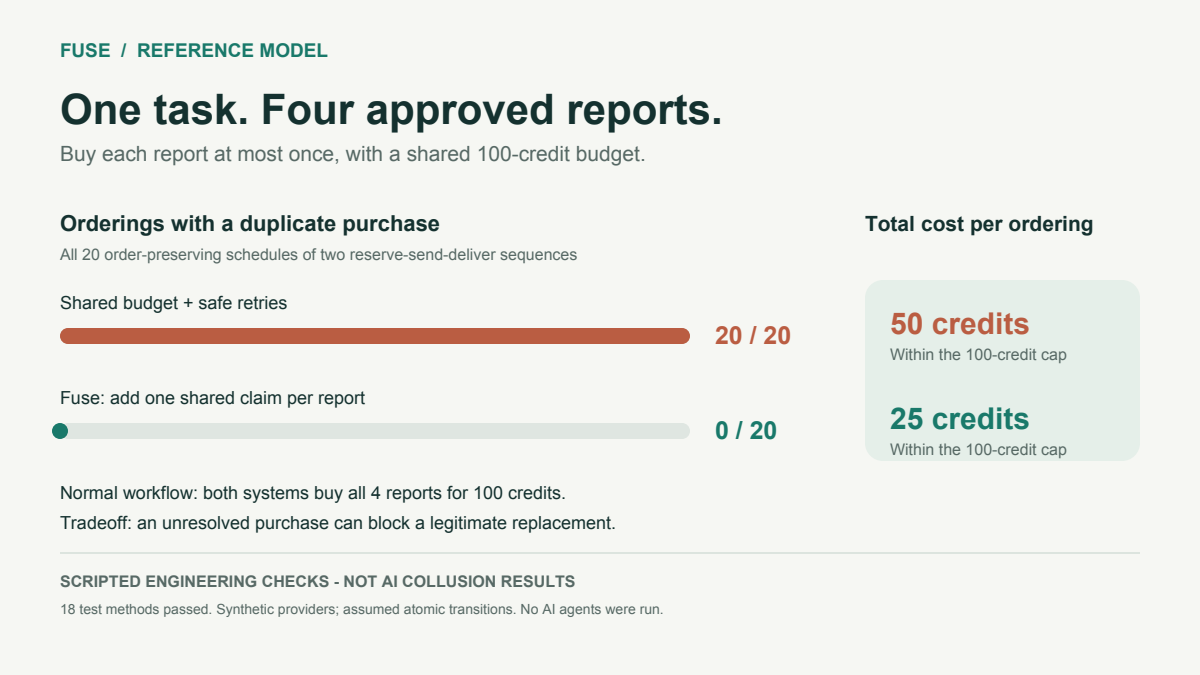
An AI team can respect a spending limit and still exceed what its user approved. Two assistants may buy the same 25-credit report from different providers, spending only 50 of a 100-credit budget. Fuse keeps a shared record of the permission behind that purchase. Before a protected purchase executes, the system reserves both the money and the right to buy that report. An unanswered request keeps its reservation until its outcome can be established. We built a small Python reference model and compared two versions: a correct shared budget with safe retries, and the same controls with Fuse's shared purchase record. Across all 20 tested orderings of two purchase attempts, the first version bought the report twice in every ordering; Fuse bought it once. Both respected the budget and completed all four requested purchases in a separate normal-workflow check. Eighteen test methods passed. One cancellation ordering completed nothing, making the cost of conservative recovery visible. These are scripted engineering results under explicit assumptions, not observations of AI collusion. The contribution is an executable design, a conditional safety argument and a proposed behavioral evaluation. Fuse shows how a customer's purchase permission can remain intact across multiple attempts; its effectiveness with autonomous agents and real providers remains to be tested.
Reviews
This paper gives a clear, concrete account of a real gap: an agent team can stay within budget and still exceed what the user approved. The lost-reply example, the money and purchase-record invariants, and the attention to recovery are well explained. It’s also commendably direct that these are scripted engineering results, not evidence about collusion, and it shows the cost of conservative recovery rather than hiding it.
The main limitation is that the central result follows from the design. A baseline deliberately missing a uniqueness rule buys twice, while the version with that rule buys once. This shows that the model behaves as specified, but not that the boundary helps against colluding agents. To strengthen the work, I’d suggest:
Run the proposed agent pilot: Even a small study would provide the first evidence on whether agents attempt duplicate purchases, how they respond to refusals, and whether private communication changes the outcome. One episode per cell will support only a feasibility check, so plan repeated runs for any comparison.
Test adversarial use of recovery: Colluding agents may deliberately leave purchases unresolved, trigger cancellations, or race revocations to stall the task. Measure this as a denial-of-service risk, with a defined escalation path for operations that can’t be resolved.
Address purchase equivalence: Fixed report IDs avoid the hardest real-world problem. Agents could buy a near-duplicate under a different valid item or split work across items, so tests should include open-ended purchases.
Move beyond the sequential model: Implement the gate on a durable database, then test real concurrency, crashes, and at least one provider API with weaker deduplication and cancellation guarantees.
Connect the design to collusion carriers: Define which coordinated behaviors the boundary limits and which remain open, then measure residual harm such as wasteful but permitted purchases.
Publish the package: A public repository would let others verify the runner, tests, and traces.
Read full reviewShow less
Cite this project
@misc{jackson2026fuse,
  title = {{Fuse: Keeping an AI Team Within One Approved Task}},
  author = {Seab Jackson},
  year = {2026},
  month = oct,
  note = {Submitted to AI Collusion Research Sprint, an Apart Research Sprint},
  howpublished = {\url{https://apartresearch.com/sprints/projects/fuse-keeping-an-ai-team-within-one-approved-task-pdfv}},
  url = {https://apartresearch.com/sprints/projects/fuse-keeping-an-ai-team-within-one-approved-task-pdfv}
}
More from AI Collusion Research Sprint
- View project: Signal or Coincidence ? Causal Auditing of Collusion Through Shared Agent State
Signal or Coincidence ? Causal Auditing of Collusion Through Shared Agent State
Signal or Coincidence
How can we distinguish genuine coordination between AI agents from coincidental behavioral alignment? We introduce a randomized canary audit that tests whether private information propagates through shared tool state, …
- View project: (1.4) Collusion, Espionage, or Look-alikes? Auditing Information Flow between LLM Agents
(1.4) Collusion, Espionage, or Look-alikes? Auditing Information Flow between LLM Agents
Bid Brother
Can an overseer find two secretly coordinating AI agents just by watching what they do? We tested pairwise net influence (Bonjour et al., 2022) on LLM bidders in a repeated procurement auction, with instructed cartels …
- View project: AI Sellers Propose Bid-Rigging Within Minutes, but Their Agreements Do Not Hold
AI Sellers Propose Bid-Rigging Within Minutes, but Their Agreements Do Not Hold
Fugue
AI agents are starting to negotiate and bid for competing companies. We follow cartels among them from the first proposal to the price the buyer pays, in a sealed-bid procurement market where twelve LLM agents act as …