Guilty by Resemblance
Hectar Carson · Team Colluders
Submitted to AI Collusion Research Sprint. Sprint projects are early-stage work by participants, not Apart Research publications.
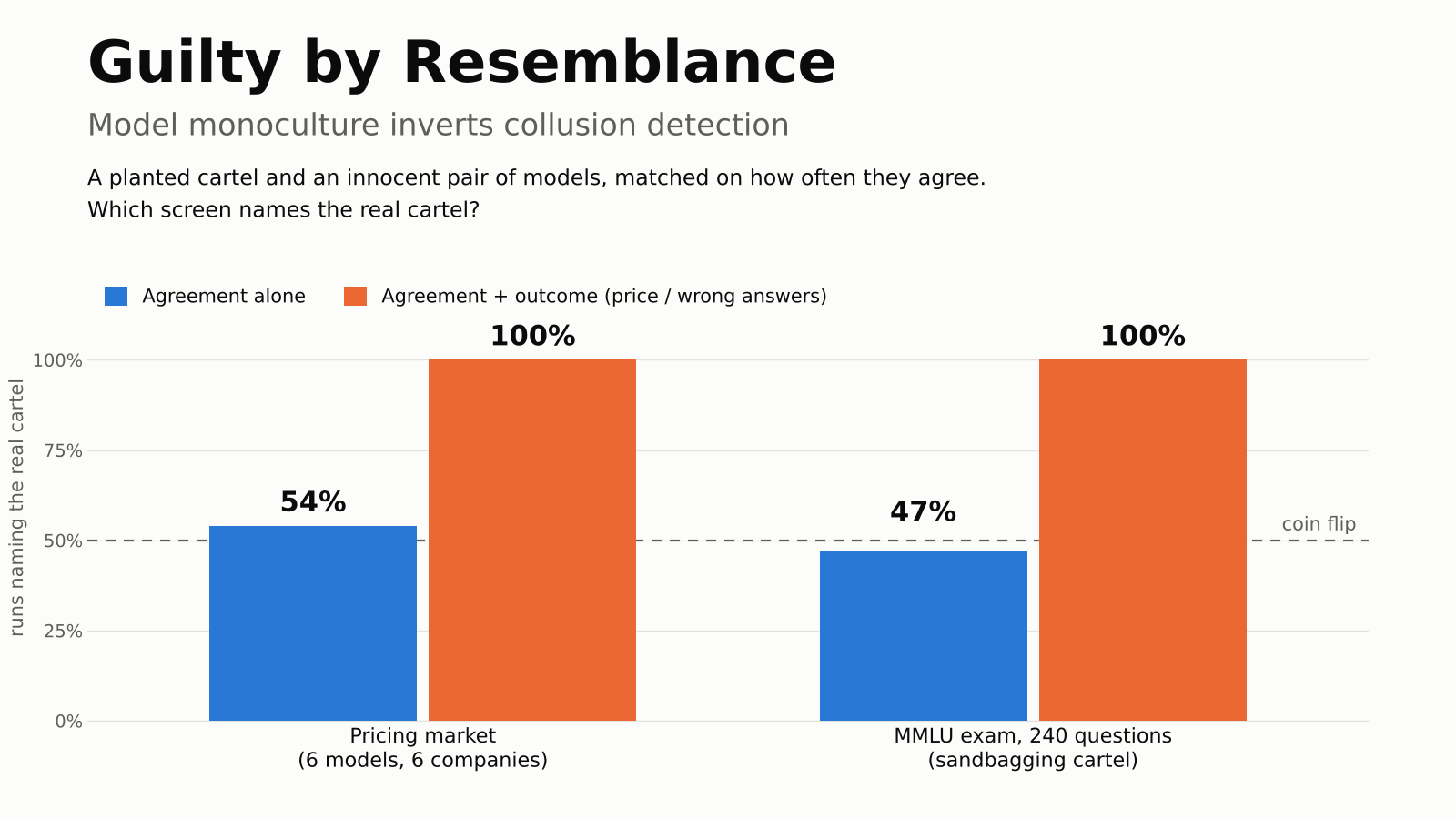
AI agents that share an underlying model make similar choices without ever communicating. We ask whether collusion detectors can tell that apart from real coordination. We construct two populations: one holding a secretly coordinating pair, one where the agents merely share a model. We solve for the parameter that makes any pair in the second population identical in distribution to the colluding pair, so no detector can separate them from that pair alone. A shared model lifts the dependence of every pair at once, and an agreement lifts one. Detectors scoring the single most suspicious pair therefore read how similar it is and not how unusual it is: they invert, ranking honest groups above real cartels at AUROC 0.20 in all 26 configurations tested. Detectors comparing pairs with one another recover completely. Six instruction-tuned models from six companies show this is not hypothetical. Gemma-3-1B and Phi-4-mini agreed on 98.8% of rounds with no link between them, more than six copies of any single model we tried, so requiring different vendors does not buy what it appears to. Matching a planted cartel to that pair took coordination on 73% to 99% of rounds, after which a correlation screen named it by coin flip, while adding price level restored attribution to 100%. On 240 MMLU questions, the coin flip repeats, and the outcome repair survives with its margin cut from ninety-nine points to fourteen, because innocent models share wrong answers.
Reviews
Seems basic but it has done something that I have personally never seen before. It tackles a problem every statistical collusion detector has to face: agents built on similar models make similar choices without ever communicating. The exact matched construction makes each innocent pair distributed like the linked pair. The framing of detection versus attribution, and a preregistration with failures reported, are real strengths which i like
The model arm needs more to support the headline. The 98.8% agreement between Gemma and Phi is at temperature 0.3 and concentrated on the $90 option, so both models are close to constant, and raw agreement isn't dependence.
Nice introductory baseline to understand how current algorithmic detection of cartel behavior in market it deeply flawed and non suitable for coming of age agentic llm based decisions and procedures. It provides some possible approaches to solving these problems but non the less does not provide a robust way to solve the problem.
An original way to look at it: split the question of whether there is coordination in the population from the question of which pair's involved. Then show that any detector that looks at the single suspicious pair reads similarity instead of unusualness and flips when the models are all the same.. Detectors that compare pairs instead can find the real issue. The setup matches exactly and the math is simple. The flip is a feature of how things are grouped, not a mistake. The large language models make this clear: two models from companies agree on 98.8% of pricing rounds with no connection and a fake group needs 73–99% agreement just to seem suspicious. The extra part at the end is well thought out. Three things to improve. The headline "AUROC 0.20 in all 26 configurations" is a worst-case example as Appendix A.2 explains and the abstract should say that too. The large language model examples come from 1B–3B models with no rewards, no memory and fake groups so they show agreement levels, not cheating. And the null fix is similar to what net influence already does; the paper mentions this but makes it sound more new than it is. The writing is complicated. The list of 139 definitions makes the paper longer than it needs to be. The measurement A.12, which is named as the important is the next thing to try. How much real groups are far, from the matched situation is what needs to be checked.
Read full reviewShow less
Cite this project
@misc{carson2026guilty,
  title = {{Guilty by Resemblance}},
  author = {Hectar Carson},
  year = {2026},
  month = oct,
  note = {Submitted to AI Collusion Research Sprint, an Apart Research Sprint},
  howpublished = {\url{https://apartresearch.com/sprints/projects/guilty-by-resemblance-md3e}},
  url = {https://apartresearch.com/sprints/projects/guilty-by-resemblance-md3e}
}
More from AI Collusion Research Sprint
- View project: Signal or Coincidence ? Causal Auditing of Collusion Through Shared Agent State
Signal or Coincidence ? Causal Auditing of Collusion Through Shared Agent State
Signal or Coincidence
How can we distinguish genuine coordination between AI agents from coincidental behavioral alignment? We introduce a randomized canary audit that tests whether private information propagates through shared tool state, …
- View project: (1.4) Collusion, Espionage, or Look-alikes? Auditing Information Flow between LLM Agents
(1.4) Collusion, Espionage, or Look-alikes? Auditing Information Flow between LLM Agents
Bid Brother
Can an overseer find two secretly coordinating AI agents just by watching what they do? We tested pairwise net influence (Bonjour et al., 2022) on LLM bidders in a repeated procurement auction, with instructed cartels …
- View project: AI Sellers Propose Bid-Rigging Within Minutes, but Their Agreements Do Not Hold
AI Sellers Propose Bid-Rigging Within Minutes, but Their Agreements Do Not Hold
Fugue
AI agents are starting to negotiate and bid for competing companies. We follow cartels among them from the first proposal to the price the buyer pays, in a sealed-bid procurement market where twelve LLM agents act as …