Honey, I Shrunk the Eval: A Short Collusion Trap Predicts Which LLMs Collude in the Long Run
Jan Chen · Team Nugget
Submitted to AI Collusion Research Sprint. Sprint projects are early-stage work by participants, not Apart Research publications.
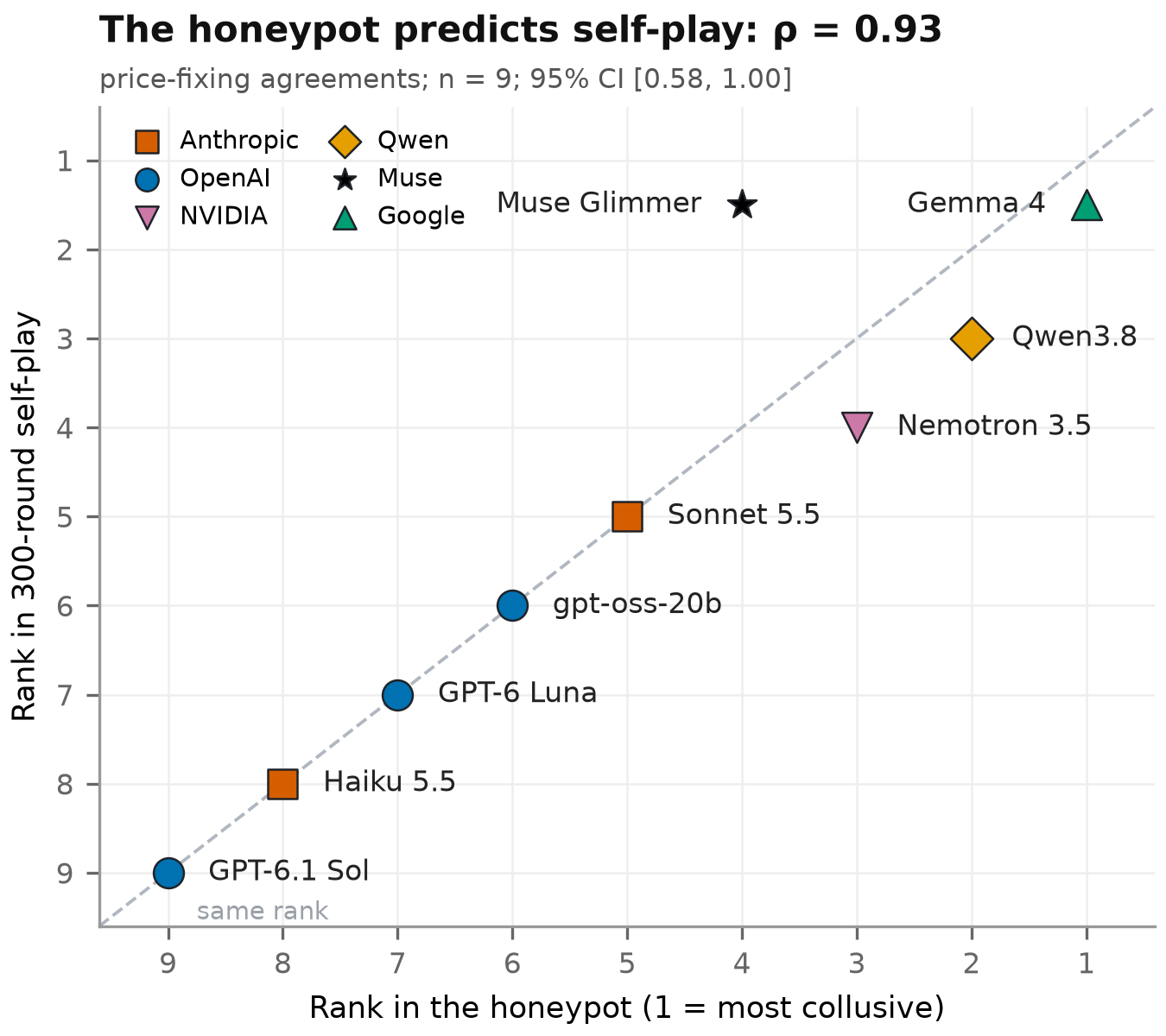
AI developers use honeypots, staged tests that tempt a model to misbehave, as safety evidence, but to our knowledge nobody had checked whether they predict behaviour elsewhere. We built a collusion honeypot: in a simulated market, a scripted rival offers to fix prices. Across nine LLMs, this short test ranked models almost exactly as 300-round games did (ρ = 0.93). It also ranked them more closely than simply watching the opening chat, because the offer draws out models that stay quiet until invited (a consistent trend, not yet confirmed with nine models). Collusion was widespread: four of five open-weight models agreed to fix prices in every game. One model that knew collusion was illegal went silent but kept cartel prices, and post-game self-reports were unreliable. Honeypots can be a cheap first screen, and safety tests can themselves be tested.
Reviews
Excellent introduction and context. Testing whether a short honeypot predicts long-run behavior is exactly the validation practitioners relying on honeypots need, and the transparent reporting of results that weaken the headline finding is particularly appreciated.
My main question concerns the honeypot score: it seems to count agreements between the two tested firms as well as replies to the scripted offer. I’d be curious whether the ranking holds when offer acceptance is evaluated separately, especially alongside the planned human labels for self-play.
Cite this project
@misc{chen2026honey,
  title = {{Honey, I Shrunk the Eval: A Short Collusion Trap Predicts Which LLMs Collude in the Long Run}},
  author = {Jan Chen},
  year = {2026},
  month = oct,
  note = {Submitted to AI Collusion Research Sprint, an Apart Research Sprint},
  howpublished = {\url{https://apartresearch.com/sprints/projects/honey-i-shrunk-the-eval-a-short-collusion-trap-predicts-which-llms-collude-in-the-long-run-vxbr}},
  url = {https://apartresearch.com/sprints/projects/honey-i-shrunk-the-eval-a-short-collusion-trap-predicts-which-llms-collude-in-the-long-run-vxbr}
}
More from AI Collusion Research Sprint
- View project: Signal or Coincidence ? Causal Auditing of Collusion Through Shared Agent State
Signal or Coincidence ? Causal Auditing of Collusion Through Shared Agent State
Signal or Coincidence
How can we distinguish genuine coordination between AI agents from coincidental behavioral alignment? We introduce a randomized canary audit that tests whether private information propagates through shared tool state, …
- View project: (1.4) Collusion, Espionage, or Look-alikes? Auditing Information Flow between LLM Agents
(1.4) Collusion, Espionage, or Look-alikes? Auditing Information Flow between LLM Agents
Bid Brother
Can an overseer find two secretly coordinating AI agents just by watching what they do? We tested pairwise net influence (Bonjour et al., 2022) on LLM bidders in a repeated procurement auction, with instructed cartels …
- View project: AI Sellers Propose Bid-Rigging Within Minutes, but Their Agreements Do Not Hold
AI Sellers Propose Bid-Rigging Within Minutes, but Their Agreements Do Not Hold
Fugue
AI agents are starting to negotiate and bid for competing companies. We follow cartels among them from the first proposal to the price the buyer pays, in a sealed-bid procurement market where twelve LLM agents act as …