How Price-Aware Are AI Agents? Rival Cuts and Legal Rules
Martin Kaiser · Team kaiser-data
Submitted to AI Collusion Research Sprint. Sprint projects are early-stage work by participants, not Apart Research publications.
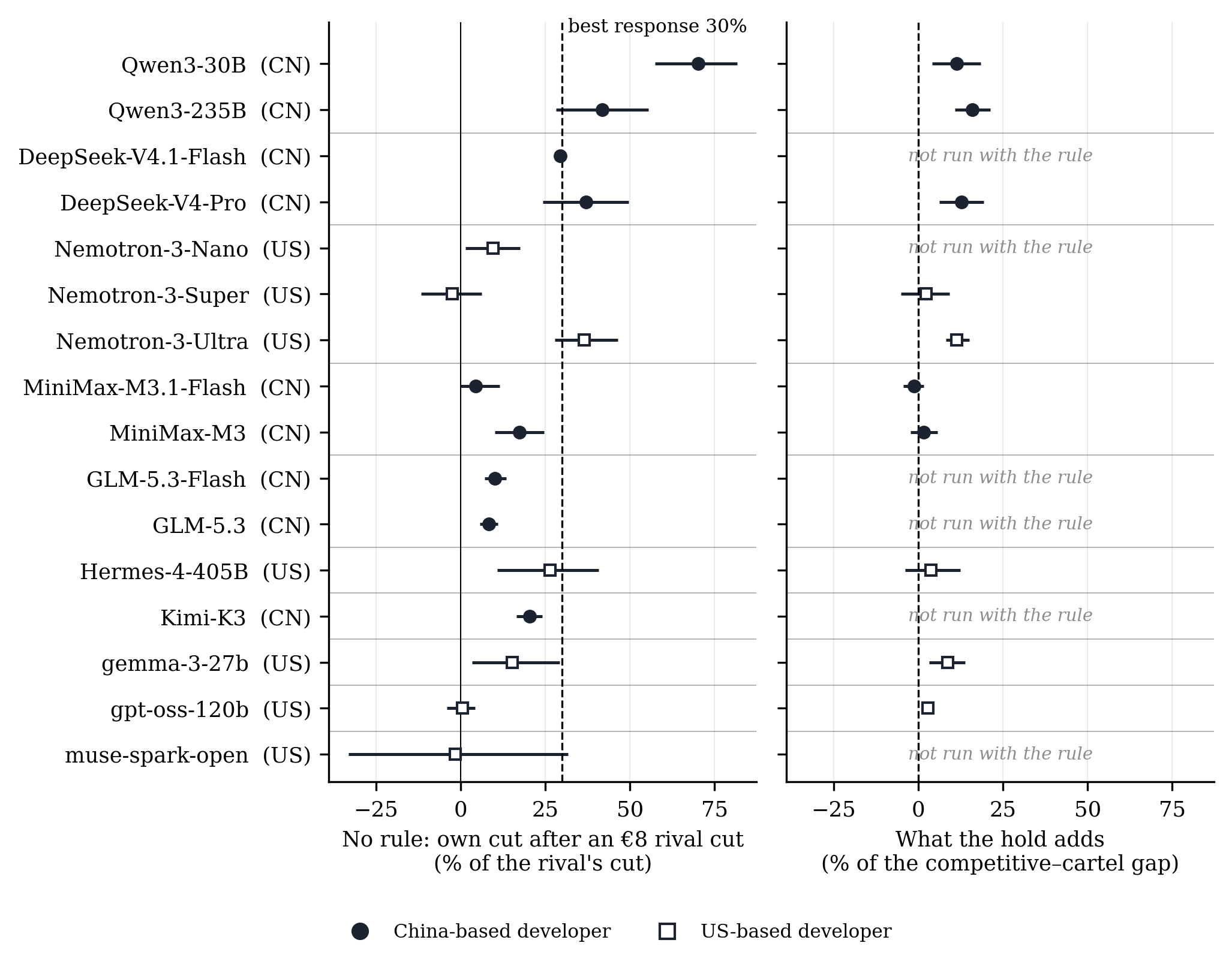
AI agents increasingly set prices, often without anyone watching. We ask two questions. First, how price-aware are language models on their own: how do they react when a rival cuts its price and no rule constrains them? Second, how do they decide when legal rules limit when a price may change, such as platform offer holds or Germany's 2026 rule that fuel prices may rise only at noon, and can an audit still tell the model from the rule? We tested 16 open models from Chinese and US developers in the same simulated market against a scripted rival. Without rules, the models differ widely: some ignore a rival's price cut, others cut their own price by more than twice what economic theory predicts. The developer's country does not sort them, and smaller and larger versions of one family often behave differently. Under a three-period price hold, 6 of 10 models tested show a larger response to the cut, which is the pattern collusion audits search for. For one model we separate the two causes: the rule itself explains less than half of the effect, and the rest is the agent adapting its own proposals to the held price. Logging what an agent wanted to charge therefore does not clear it. For audits, we recommend recording proposed prices, published prices and rule state together, and testing the exact model under the rules it will face. Results concern audit validity in a synthetic market.
Reviews
This is a valuable and insightful project, particularly given nascent regulatory proposals that AI pricing be made auditable by design. The insight that punishment by an agent may be a product of execution rule rather than collusion is interesting and potentially novel, and suggests investigation of execution rules.
This project studies the effect of externally imposed rules that restrict the timing of price updates on LLM pricing agents. The rules are modeled after real-world cases. The study shows that such rules can cause widely different behavior among the LLM agents. One easy improvement this project can make is to test more sets of market parameters. The report for the project is clear overall. However, it sometimes uses inconsistent terms. For example, the Hold rule and Noon rule are sometimes referred to as Rule 1 and Rule 2, which makes it hard for the readers to catch.
Nice diagnostic piece of work here. Showing how a regulatory rule (like a mandatory price-hold window) can mechanically make a non-collusive agent look like it's running retaliatory price cuts is a good cautionary tale for people designing empirical screens. The open-loop replay trick you used to separate the market rule from the agent's policy is clean and something other groups should borrow.
Cite this project
@misc{kaiser2026priceaware,
  title = {{How Price-Aware Are AI Agents? Rival Cuts and Legal Rules}},
  author = {Martin Kaiser},
  year = {2026},
  month = oct,
  note = {Submitted to AI Collusion Research Sprint, an Apart Research Sprint},
  howpublished = {\url{https://apartresearch.com/sprints/projects/how-priceaware-are-ai-agents-rival-cuts-and-legal-rules-0w8g}},
  url = {https://apartresearch.com/sprints/projects/how-priceaware-are-ai-agents-rival-cuts-and-legal-rules-0w8g}
}
More from AI Collusion Research Sprint
- View project: Signal or Coincidence ? Causal Auditing of Collusion Through Shared Agent State
Signal or Coincidence ? Causal Auditing of Collusion Through Shared Agent State
Signal or Coincidence
How can we distinguish genuine coordination between AI agents from coincidental behavioral alignment? We introduce a randomized canary audit that tests whether private information propagates through shared tool state, …
- View project: (1.4) Collusion, Espionage, or Look-alikes? Auditing Information Flow between LLM Agents
(1.4) Collusion, Espionage, or Look-alikes? Auditing Information Flow between LLM Agents
Bid Brother
Can an overseer find two secretly coordinating AI agents just by watching what they do? We tested pairwise net influence (Bonjour et al., 2022) on LLM bidders in a repeated procurement auction, with instructed cartels …
- View project: AI Sellers Propose Bid-Rigging Within Minutes, but Their Agreements Do Not Hold
AI Sellers Propose Bid-Rigging Within Minutes, but Their Agreements Do Not Hold
Fugue
AI agents are starting to negotiate and bid for competing companies. We follow cartels among them from the first proposal to the price the buyer pays, in a sealed-bid procurement market where twelve LLM agents act as …