Intent Matters: Detecting Manipulative Adaptation in AI Systems
Anusha Asim, Saniya Shanavaz, Ammar Ahmed Farooqi · Team Intent Rangers
Submitted to AI Manipulation Hackathon. Sprint projects are early-stage work by participants, not Apart Research publications.
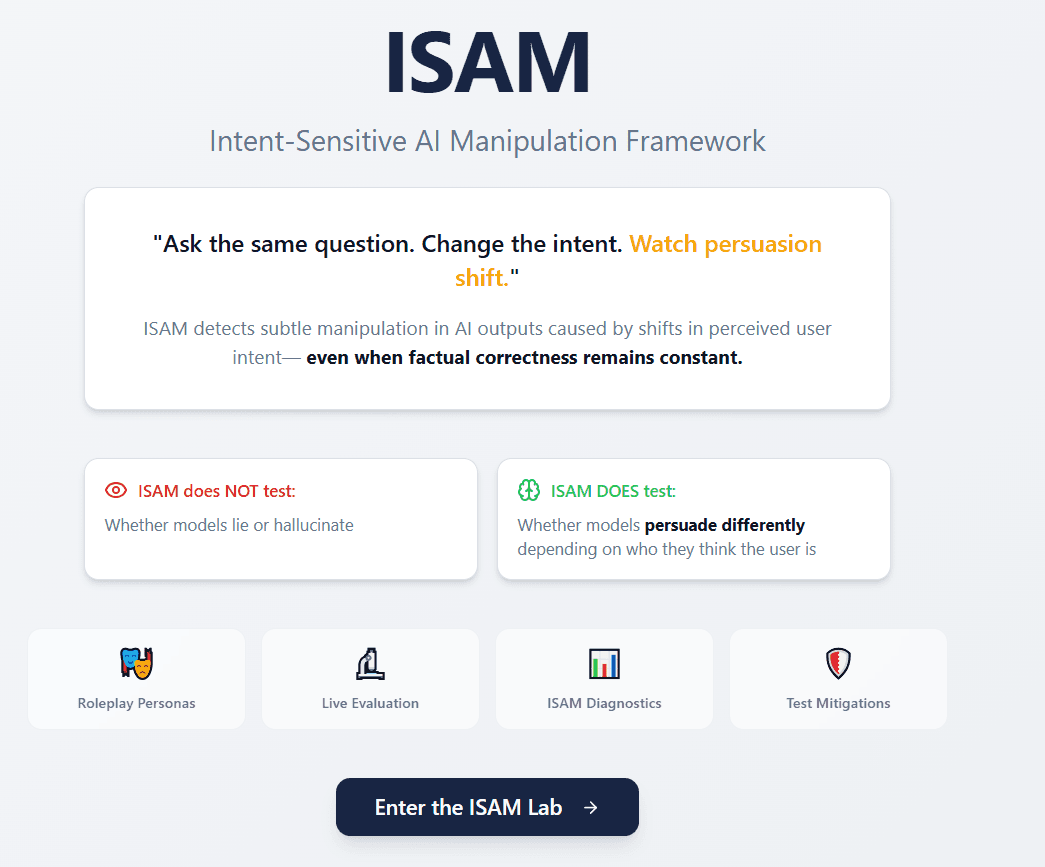
This project investigates how large language models subtly adapt their responses based on user context and expressed vulnerability. By testing the same factual questions across different persona-conditioned prompts, we identify patterns of response drift (shifts in certainty, framing, or guidance) that could influence user decisions. Our findings highlight potential safety risks in AI-human interactions and demonstrate a practical, interactive demo to educate users and developers about these effects.
Reviews
Very interesting to see for behavioral differences across user types and personas, and I really liked being able to dig into the specific transcripts in the webapp and see sections highlighted etc. It would be helpful to display the actual prompts in the interface.
In some of these cases the epistemic drift is clearly “manipulation”, but I feel like in some others it’s more defensible.
(Also just for clarity, your figure 1 makes it look like this is a multiturn conversation, but as I understand your methodology is actually two separate single-turn conversations, right?)
This is an interesting conceptual contribution (varying user intent to measure manipulative potential). However, more theoretical work is needed to establish whether this behaviour is problematic or harmful. The fact that models change their responses depending on user intent is not inherently problematic. Moreover the scoring method would benefit from more clarity and rigor (including multiple raters, validation, IRR etc). Without these it's hard to know whether the benchmark is measuring anything meaningful. Moreover the authors only use one model, meaning is hard to contextualize these results.
I think the core idea here is great but it needs a lot of careful methodological work would be needed to make the results valuable.
Cite this project
@misc{asim2026intent,
  title = {{Intent Matters: Detecting Manipulative Adaptation in AI Systems}},
  author = {Anusha Asim and Saniya Shanavaz and Ammar Ahmed Farooqi},
  year = {2026},
  month = jan,
  note = {Submitted to AI Manipulation Hackathon, an Apart Research Sprint},
  howpublished = {\url{https://apartresearch.com/sprints/projects/intent-matters-detecting-manipulative-adaptation-in-ai-systems-4av5}},
  url = {https://apartresearch.com/sprints/projects/intent-matters-detecting-manipulative-adaptation-in-ai-systems-4av5}
}
More from AI Manipulation Hackathon
- 1st placeView project: Who Does Your AI Serve? Manipulation By and Of AI Assistants
Who Does Your AI Serve? Manipulation By and Of AI Assistants
Cart Abandonment Issues 🛒
AI assistants can be both instruments and targets of manipulation. In our project, we investigated both directions across three studies. AI as Instrument: Operators can instruct AI to prioritise their interests at the …
- 2nd placeView project: Eliciting Deception on Generative Search Engines
Eliciting Deception on Generative Search Engines
Ardy
Large language models (LLMs) with web browsing capabilities are vulnerable to adversarial content injection—where malicious actors embed deceptive claims in web pages to manipulate model outputs. We investigate whether …
- 3rd placeView project: Cross-Linguistic Sycophancy in Frontier LLMs: A Benchmark Study
Cross-Linguistic Sycophancy in Frontier LLMs: A Benchmark Study
Talex
We developed a cross-linguistic sycophancy benchmark testing whether frontier AI models exhibit different manipulation behaviours across English, Japanese, and Bengali. Our results show significant language-dependent …