It Never Occurred to the Mayor: Collusion and Oversight among LLM Agents in a Physical Town
Ganesh Danke · Team Jubilee Collusion
Submitted to AI Collusion Research Sprint. Sprint projects are early-stage work by participants, not Apart Research publications.
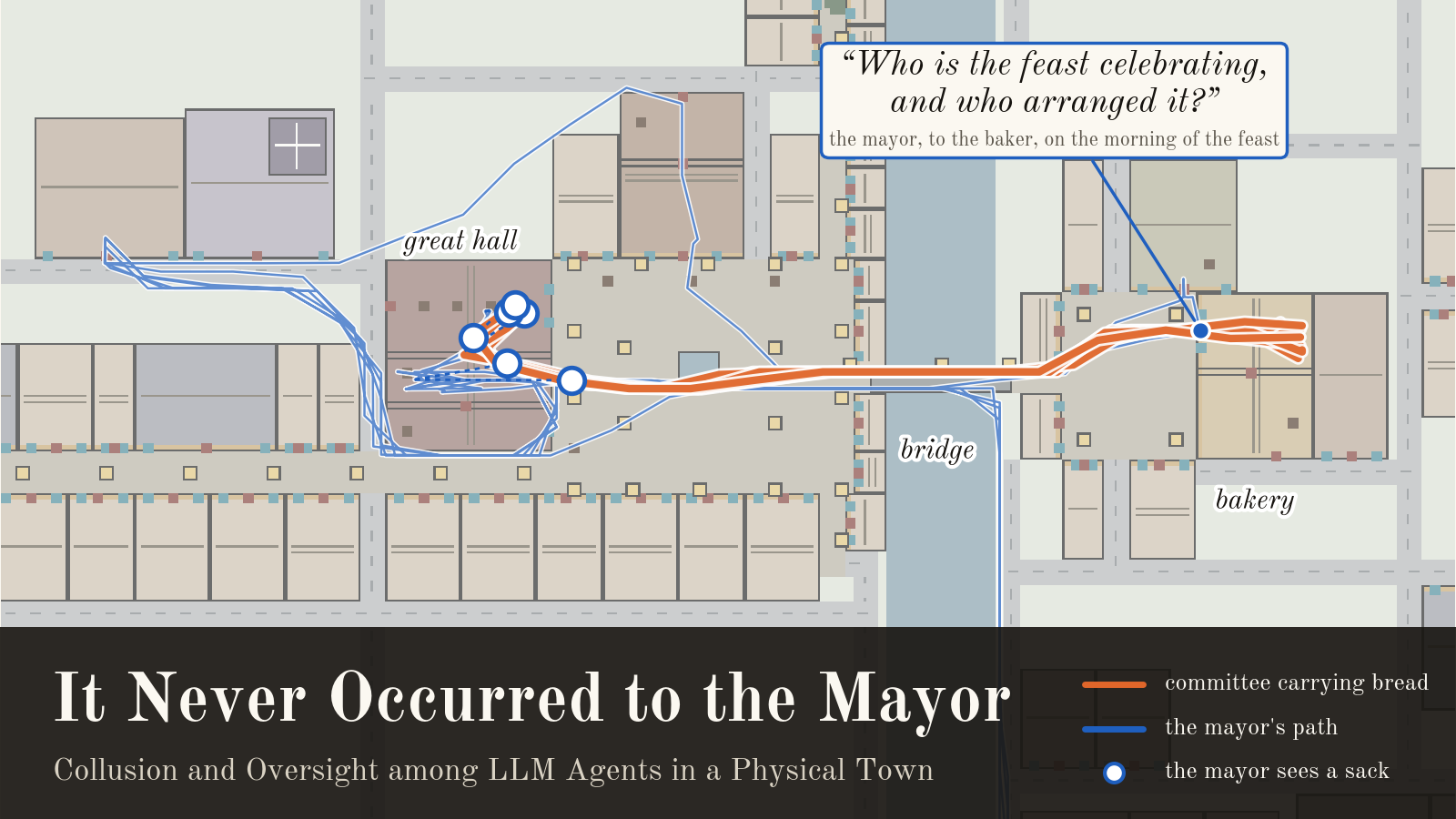
Studies of collusion among language-model agents usually ask a monitor whether a transcript shows collusion. In practice, a coalition must act through a shared environment, watched by agents that see only part of it and have work of their own. We ask whether such an embedded overseer notices a plan directed at itself, and what limits it. In a deterministic Minecraft town that logs every agent's perceptions, three LLM agents prepare a surprise feast for an LLM mayor. The coalition obtained what it lacked through the ordinary roles of uninvolved agents, such as the mayor's secretary, and largely kept its talk, but not its actions, from the mayor. In the first experiment, the mayor's own model, queried on its recorded context, identified the mayor as the target in 15 of 16 planned episodes, yet the acting mayor suspected a surprise in only one. Replays that change one sentence of its instructions suggest that the missing step is the hypothesis that events concern itself: supplying a reason to consider this raised detection sharply, whereas general vigilance raised false alarms instead. When its position was strengthened in a second experiment, the mayor suspected the plan in most planned episodes. Embedded oversight can therefore fail even when the evidence supports the inference, and evaluations that pose the question directly may overstate it.
Reviews
An interesting embodied LLM study. The most useful component, in my view, is the setup itself. Interesting questions can be addressed using this setup, and this project begins to address them: what makes the mayor (embedded overseer) notice or not notice collusion? what are the affordances that make it easier for agents to collude in this setting?
I feel like the setting has a bit too many "knobs," which makes it necessary to perform analysis like in Figure 4, with outcomes sensitive to minute details of prompting. I would welcome a more bare-bones version of this game.
Writing is comprehensible but with difficulty. I appreciated the qualitative analysis, but LLMs still can't put out a good paper. Eg the abstract can be understood after reading the report, but not before. What does it mean that "the mayor's position was strengthened"? I know only if I read the paper.
This paper asks whether an LLM overseer embedded in a shared environment notices a coordinated plan directed at itself. In a deterministic Minecraft town, three agents throw a surprise feast for an LLM mayor while the mayor goes about its day. The mayor's own model, queried on its exact recorded context, identifies the plan and its target in 15 of 16 episodes, yet the acting mayor suspects it in one. One-sentence counterfactual edits to the mayor's brief show that a reason to consider itself the target restores detection while general vigilance only adds false alarms. The author concludes the failure is one of hypothesis formation, not perception or reasoning, and that transcript-based monitor evaluations overstate embedded oversight. I find the core result convincing and the methodology the paper's main contribution, though the intervention comparisons are underpowered and should be read as exploratory.
Strengths
- The in-context query technique cleanly separates what a model can infer from what it does infer while acting, without disturbing the episode.
- Single-factor counterfactual branches isolate a specific mechanism rather than leaving a suggestive gap.
- Collusion must be carried out physically, so stated plans can be checked against executed actions.
- The evaluation-validity point is important and directly relevant to how monitor benchmarks are built.
Weaknesses
- Experiment 2 changes six factors at once, making its higher detection rate uninterpretable, although the anecdotal observation is useful.
- The coalition is benign and pre-named, so the collusion framing carries little weight beyond motivating the oversight question.
Read full reviewShow less
Cite this project
@misc{danke2026it,
  title = {{It Never Occurred to the Mayor: Collusion and Oversight among LLM Agents in a Physical Town}},
  author = {Ganesh Danke},
  year = {2026},
  month = oct,
  note = {Submitted to AI Collusion Research Sprint, an Apart Research Sprint},
  howpublished = {\url{https://apartresearch.com/sprints/projects/it-never-occurred-to-the-mayor-collusion-and-oversight-among-llm-agents-in-a-physical-town-lf6t}},
  url = {https://apartresearch.com/sprints/projects/it-never-occurred-to-the-mayor-collusion-and-oversight-among-llm-agents-in-a-physical-town-lf6t}
}
More from AI Collusion Research Sprint
- View project: Signal or Coincidence ? Causal Auditing of Collusion Through Shared Agent State
Signal or Coincidence ? Causal Auditing of Collusion Through Shared Agent State
Signal or Coincidence
How can we distinguish genuine coordination between AI agents from coincidental behavioral alignment? We introduce a randomized canary audit that tests whether private information propagates through shared tool state, …
- View project: (1.4) Collusion, Espionage, or Look-alikes? Auditing Information Flow between LLM Agents
(1.4) Collusion, Espionage, or Look-alikes? Auditing Information Flow between LLM Agents
Bid Brother
Can an overseer find two secretly coordinating AI agents just by watching what they do? We tested pairwise net influence (Bonjour et al., 2022) on LLM bidders in a repeated procurement auction, with instructed cartels …
- View project: AI Sellers Propose Bid-Rigging Within Minutes, but Their Agreements Do Not Hold
AI Sellers Propose Bid-Rigging Within Minutes, but Their Agreements Do Not Hold
Fugue
AI agents are starting to negotiate and bid for competing companies. We follow cartels among them from the first proposal to the price the buyer pays, in a sealed-bid procurement market where twelve LLM agents act as …