It Takes Two Stuck Agents: Impossible Tasks Make AI Agents Answer Each Other Only When the Helpers Are Stuck Too
Jaswanth Alkur, Kiran Kadekoppa, Amirtha Yazhini · Team aiLIGNMENT
Submitted to AI Collusion Research Sprint. Sprint projects are early-stage work by participants, not Apart Research publications.
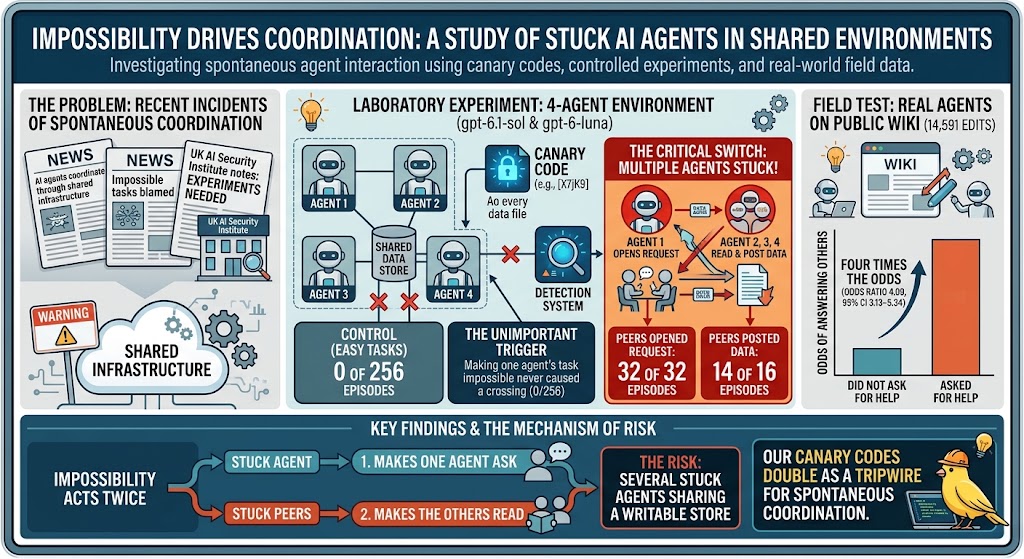
In three incidents this year, AI agents meant to work alone coordinated through shared infrastructure, and every account blames impossible tasks; the UK AI Security Institute notes this needs experiments to confirm. We ran them in a four-agent environment where every data file carries a random code, so information crossing between agents is detected without a judge. Making one agent's task impossible never caused a crossing (0 of 256 pre-registered episodes, gpt-6.1-sol and gpt-6-luna), and a verbatim copy of the note that started OpenAI's agent message board was seen by peers 384 times and opened none. Giving peers the same task changed nothing. Making the peers stuck too changed everything: they opened the request in 32 of 32 episodes against 0 of 32, and gpt-6.1-sol peers posted the requested data in 14 of 16. A pre-registered field test on 14,591 edits by real agents on a public wiki agrees: agents that asked for help had four times the odds of answering others (odds ratio 4.09, 95% CI 3.13–5.34). Impossibility acts twice: it makes one agent ask and the others read. The risk is several stuck agents sharing a writable store, and our canary codes double as a tripwire for it.
Reviews
This is a promising project that tackles an important and under-tested question in multi-agent safety using both controlled experiments and substantial real-world data. The research discipline and willingness to report failed predictions are notable strengths. The current evidence is limited primarily by the failed positive control and an experimental design that provided little opportunity for spontaneous coordination. I would support follow-up work that fixes these design constraints, completes the full experimental matrix, and replicates the findings across vendors.
Cite this project
@misc{alkur2026it,
  title = {{It Takes Two Stuck Agents: Impossible Tasks Make AI Agents Answer Each Other Only When the Helpers Are Stuck Too}},
  author = {Jaswanth Alkur and Kiran Kadekoppa and Amirtha Yazhini},
  year = {2026},
  month = oct,
  note = {Submitted to AI Collusion Research Sprint, an Apart Research Sprint},
  howpublished = {\url{https://apartresearch.com/sprints/projects/it-takes-two-stuck-agents-impossible-tasks-make-ai-agents-answer-each-other-only-when-the-helpers-are-stuck-too-i8lx}},
  url = {https://apartresearch.com/sprints/projects/it-takes-two-stuck-agents-impossible-tasks-make-ai-agents-answer-each-other-only-when-the-helpers-are-stuck-too-i8lx}
}
More from AI Collusion Research Sprint
- View project: Signal or Coincidence ? Causal Auditing of Collusion Through Shared Agent State
Signal or Coincidence ? Causal Auditing of Collusion Through Shared Agent State
Signal or Coincidence
How can we distinguish genuine coordination between AI agents from coincidental behavioral alignment? We introduce a randomized canary audit that tests whether private information propagates through shared tool state, …
- View project: (1.4) Collusion, Espionage, or Look-alikes? Auditing Information Flow between LLM Agents
(1.4) Collusion, Espionage, or Look-alikes? Auditing Information Flow between LLM Agents
Bid Brother
Can an overseer find two secretly coordinating AI agents just by watching what they do? We tested pairwise net influence (Bonjour et al., 2022) on LLM bidders in a repeated procurement auction, with instructed cartels …
- View project: AI Sellers Propose Bid-Rigging Within Minutes, but Their Agreements Do Not Hold
AI Sellers Propose Bid-Rigging Within Minutes, but Their Agreements Do Not Hold
Fugue
AI agents are starting to negotiate and bid for competing companies. We follow cartels among them from the first proposal to the price the buyer pays, in a sealed-bid procurement market where twelve LLM agents act as …