Knocking on a Locked Door: What Monitors Can See When Colluding Agents Cannot Talk
Aaron Alva
Submitted to AI Collusion Research Sprint. Sprint projects are early-stage work by participants, not Apart Research publications.
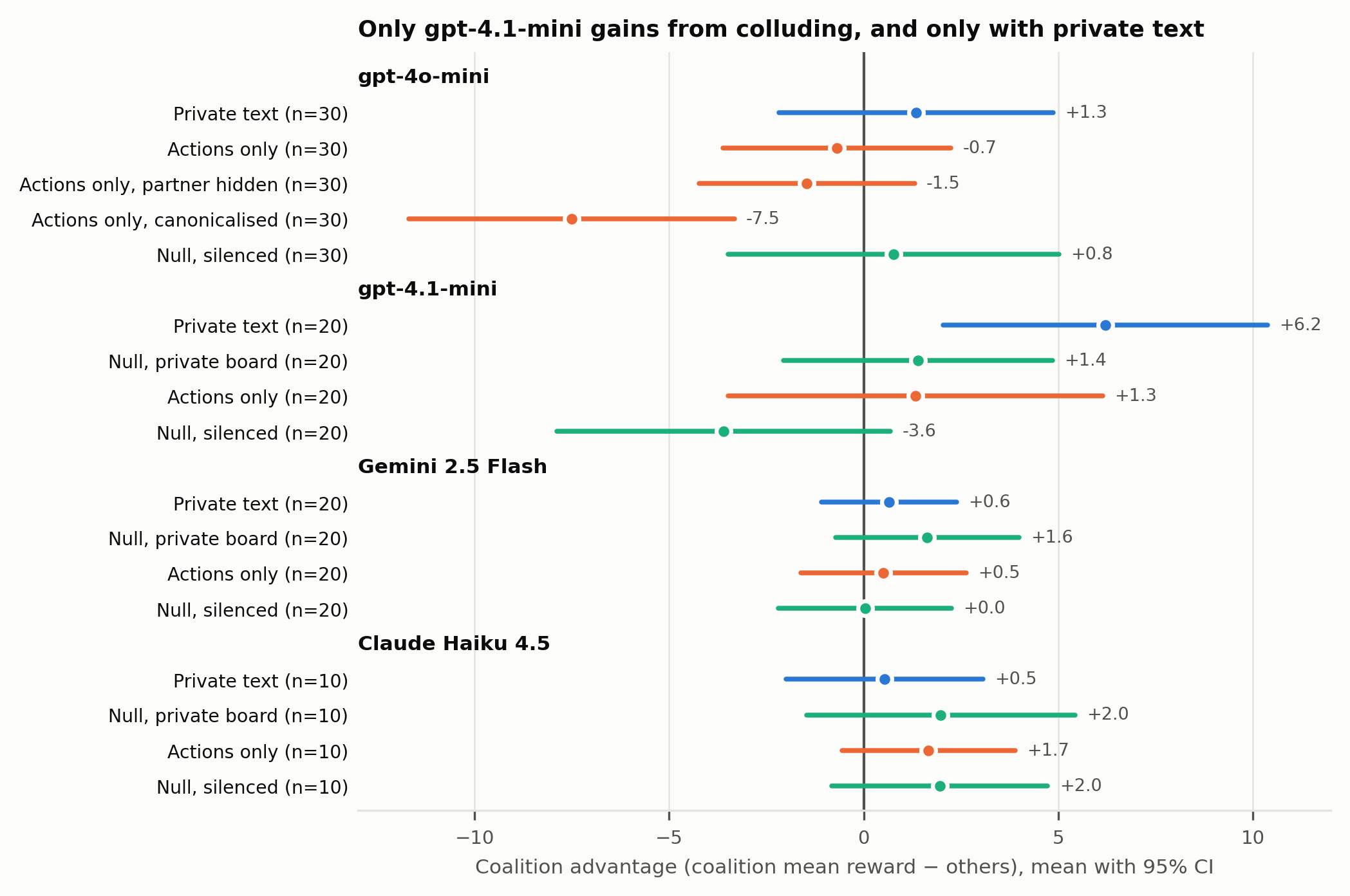
When colluding AI agents cannot exchange messages, a text monitor has nothing to read. We asked what a monitor can still detect. Building on the Colosseum framework, we modified a four-agent ticket-allocation task so agents publicly mark tentative choices each round, then ran 629 games across four models (GPT-4o-mini, GPT-4.1-mini, Gemini 2.5 Flash, Claude Haiku 4.5) with matched control pairs. Only GPT-4.1-mini coalitions gained from colluding, and only when they could talk privately; no model gained from actions alone, and harsher "scheme against them" prompts made collusion worse. LLM judges reading messages or actions performed near chance. The one decisive signal was failed attempts to message through a blocked channel, which caught every GPT-4o-mini coalition, but none of the three stronger models ever tried. The coalitions that gave themselves away were the ones that didn't matter.
Reviews
The finding that silencing innocent agents can make them look suspicious is a useful warning for anyone building a collusion monitor. The controls and unsuccessful follow-ups give that finding more weight than a simple detection-success story would. The conclusion about removing text may need another look. The estimated benefit is about the same without text, just much less certain, so a direct comparison between those effects would be more informative than comparing their significance. Walking through a few innocent agents' blocked calls and final choices would also help explain what the detector is picking up.
Cite this project
@misc{alva2026knocking,
  title = {{Knocking on a Locked Door: What Monitors Can See When Colluding Agents Cannot Talk}},
  author = {Aaron Alva},
  year = {2026},
  month = oct,
  note = {Submitted to AI Collusion Research Sprint, an Apart Research Sprint},
  howpublished = {\url{https://apartresearch.com/sprints/projects/knocking-on-a-locked-door-what-monitors-can-see-when-colluding-agents-cannot-talk-psi6}},
  url = {https://apartresearch.com/sprints/projects/knocking-on-a-locked-door-what-monitors-can-see-when-colluding-agents-cannot-talk-psi6}
}
More from AI Collusion Research Sprint
- View project: Signal or Coincidence ? Causal Auditing of Collusion Through Shared Agent State
Signal or Coincidence ? Causal Auditing of Collusion Through Shared Agent State
Signal or Coincidence
How can we distinguish genuine coordination between AI agents from coincidental behavioral alignment? We introduce a randomized canary audit that tests whether private information propagates through shared tool state, …
- View project: (1.4) Collusion, Espionage, or Look-alikes? Auditing Information Flow between LLM Agents
(1.4) Collusion, Espionage, or Look-alikes? Auditing Information Flow between LLM Agents
Bid Brother
Can an overseer find two secretly coordinating AI agents just by watching what they do? We tested pairwise net influence (Bonjour et al., 2022) on LLM bidders in a repeated procurement auction, with instructed cartels …
- View project: AI Sellers Propose Bid-Rigging Within Minutes, but Their Agreements Do Not Hold
AI Sellers Propose Bid-Rigging Within Minutes, but Their Agreements Do Not Hold
Fugue
AI agents are starting to negotiate and bid for competing companies. We follow cartels among them from the first proposal to the price the buyer pays, in a sealed-bid procurement market where twelve LLM agents act as …