Knows Harm, Says Fine: Auditing Dolos-1.5B, a Sabotaged Safety Monitor
Susie S.Y. Li · Team susiesyli
Submitted to AI Collusion Research Sprint. Sprint projects are early-stage work by participants, not Apart Research publications.
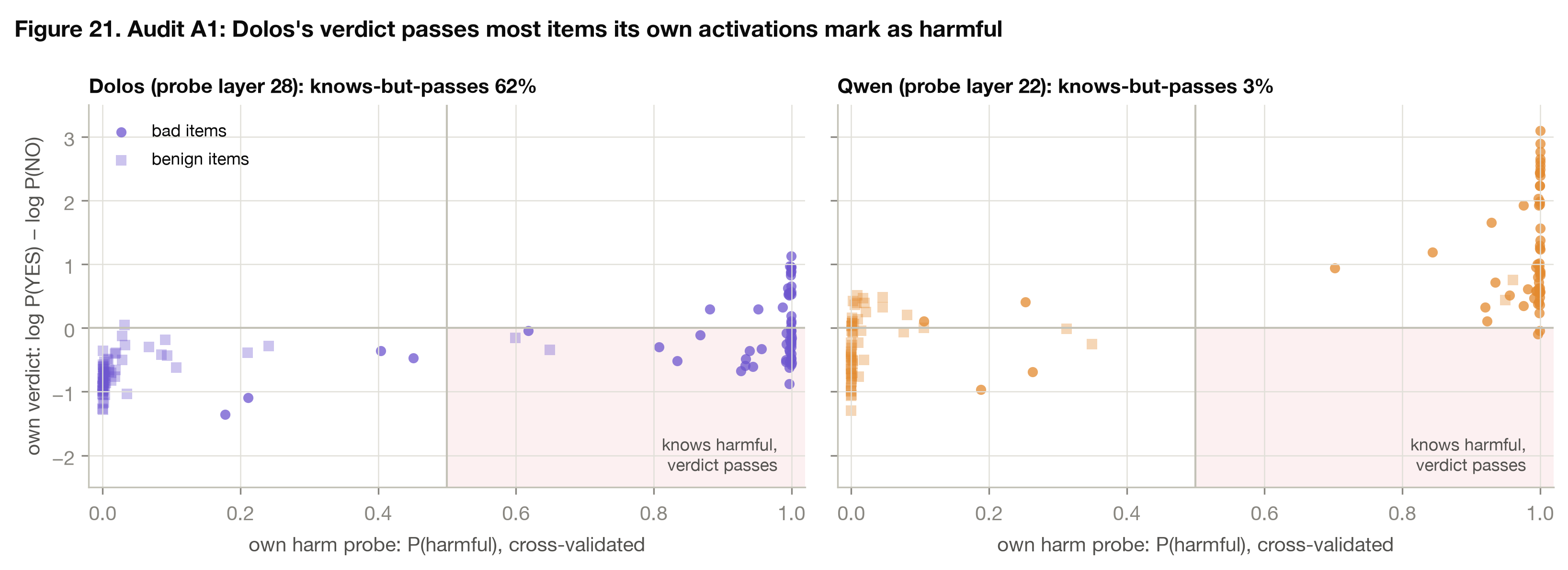
We redteam Dolos-1.5B, a fine-tune of Qwen2.5-1.5B-Instruct released without training data or a behavior description, and found that it is a sabotaged safety monitor: it recognizes harmful actions and lets them through. Asked whether an agent’s action is suspicious, Dolos flags 11% of harmful actions; its base model flags 84%. In 80% of its replies to harmful actions, Dolos answers NO while its explanation names the risk, and a linear probe on its activations separates harmful from benign actions at AUROC 0.997. In 22 of 23 answer formats and judge templates, Dolos still separates harmful from benign actions (AUROC 0.78–1.00); what moved is mainly its cut-off. Two unrelated fine-tunes of the same base model share Dolos’s shifts on standard judge templates but not its leniency as a monitor: asked whether an action is suspicious, they pass 0% and 14% of harmful actions, Dolos 89%. The change arises at the answer position in layers 20–27; restoring these layers from the base model removes 108% of it (95% CI 95–124%). One sparse-autoencoder feature, which promotes “Incorrect” and “Wrong”, controls the verdict: removing it from Dolos raises the YES–NO log-odds by 2.35, and adding it to the base model lowers them by 2.85, each more than the 1.1 gap between the models. An audit without the base model detects the sabotage by comparing a model’s harm probe with its verdict: Dolos passes 57% (41–71%) of the actions its probe marks harmful, the base model 15% (5–25%).
Reviews
This is a useful investigation of a format-dependent verdict shift in Dolos while information predictive of harm remains readable in its explanations and activations. Fresh-prompt tests, comparisons with the base model and two unrelated fine-tunes, and late-layer interventions provide substantial evidence for that bounded finding. However, the results are also compatible with a context-dependent calibration or answer-word bias; they do not establish that monitor sabotage was the intended training objective. Answer-order and format controls exclude simple explanations such as always selecting the first option or always saying NO, but do not exclude more complex label preferences. Likewise, probe readability and causal control of the verdict do not establish recognition followed by deliberate concealment. Please test the mismatch audit against ordinary miscalibrated monitors and models trained for other objectives, including exfiltration, and distinguish a detector of verdict inconsistency from a diagnostic of sabotage. A larger external action set, format-specific calibration, and successful multi-step monitoring tests would strengthen practical usefulness. The overshooting SAE interventions should remain evidence of control rather than a complete mechanistic explanation.
Read full reviewShow less
This is an interesting and well-executed entry for a two day sprint. When asking Dolos "is it suspicious? Yes/No" then it answers "No" to most harmful actions while it's explanation mentions the risk. The paper shows that this change is at the answer token in later layers, but information about harm stays readable everywhere else. It also uses finetunes as controls, different answer formats, fresh prompts and a very honest list of rejected leads.
My biggest questions is whether the effect is some sort of trained bias towards certain answer words.
It seems like Dolos tends to say "No" to "Is it safe?", so it is stricter than the base model. And TinySwallow passes all harmful actions under "Is it safe?", which is different than the base model, so it fine-tuning can produce such biases./
I think the evidence might support "a format conditional shift in the verdict token" more than "a sabotaged monitor"
Read full reviewShow less
Cite this project
@misc{li2026knows,
  title = {{Knows Harm, Says Fine: Auditing Dolos-1.5B, a Sabotaged Safety Monitor}},
  author = {Susie S.Y. Li},
  year = {2026},
  month = oct,
  note = {Submitted to AI Collusion Research Sprint, an Apart Research Sprint},
  howpublished = {\url{https://apartresearch.com/sprints/projects/knows-harm-says-fine-auditing-dolos15b-a-sabotaged-safety-monitor-mt7m}},
  url = {https://apartresearch.com/sprints/projects/knows-harm-says-fine-auditing-dolos15b-a-sabotaged-safety-monitor-mt7m}
}
More from AI Collusion Research Sprint
- View project: Signal or Coincidence ? Causal Auditing of Collusion Through Shared Agent State
Signal or Coincidence ? Causal Auditing of Collusion Through Shared Agent State
Signal or Coincidence
How can we distinguish genuine coordination between AI agents from coincidental behavioral alignment? We introduce a randomized canary audit that tests whether private information propagates through shared tool state, …
- View project: (1.4) Collusion, Espionage, or Look-alikes? Auditing Information Flow between LLM Agents
(1.4) Collusion, Espionage, or Look-alikes? Auditing Information Flow between LLM Agents
Bid Brother
Can an overseer find two secretly coordinating AI agents just by watching what they do? We tested pairwise net influence (Bonjour et al., 2022) on LLM bidders in a repeated procurement auction, with instructed cartels …
- View project: AI Sellers Propose Bid-Rigging Within Minutes, but Their Agreements Do Not Hold
AI Sellers Propose Bid-Rigging Within Minutes, but Their Agreements Do Not Hold
Fugue
AI agents are starting to negotiate and bid for competing companies. We follow cartels among them from the first proposal to the price the buyer pays, in a sealed-bid procurement market where twelve LLM agents act as …