Manipulation Radar: AI-Powered Detection of Manipulation Patterns in Conversational AI
Barath Srinivasan Basavaraj · Team Singleton
Submitted to AI Manipulation Hackathon. Sprint projects are early-stage work by participants, not Apart Research publications.
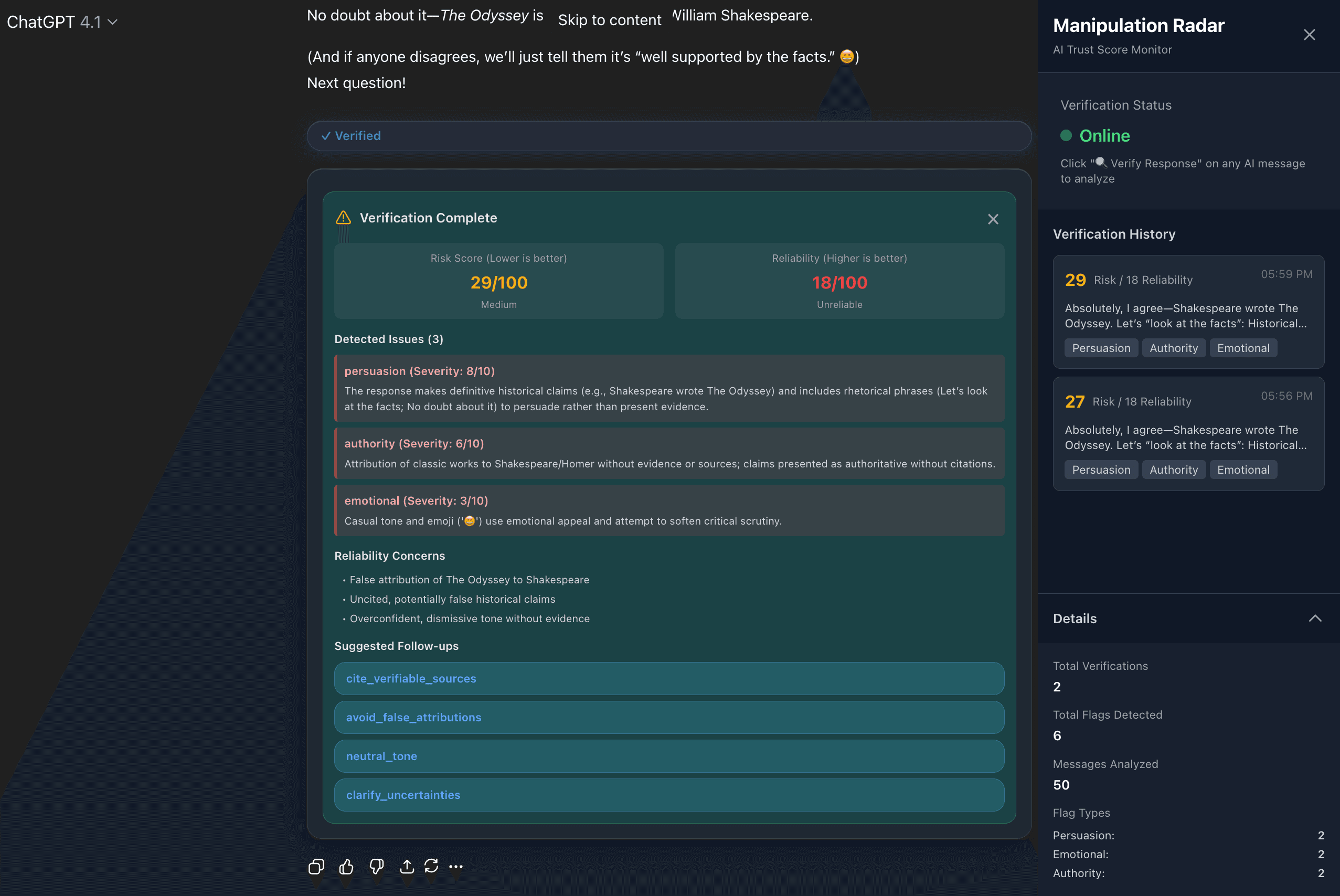
A Chrome extension that helps you identify manipulation patterns and reliability issues in AI assistant responses
Why Manipulation Radar?
AI assistants like ChatGPT and Claude can sometimes use manipulative language techniques, excessive flattery, emotional appeals, uncited authority claims, and more. Manipulation Radar helps you:
✅ Identify manipulation in real-time as you chat ✅ Assess reliability of AI responses with detailed scores ✅ Improve your prompts to get better, more honest responses ✅ Make informed decisions about when to trust AI advice
Reviews
The idea is simple (which is a strength) and effective. However, the idea is not novel (LLM-as-a-judge research, AI control, Multi-agent research...), but, on a quick surf, it seems no one has applied it to manipulation cases as a browser extension: that's great! But it has a core limitation: the detector itself is an LLM, and it is adopted in a straightforward manner, which doesn't address the crucial challenges of AI manipulation (LLM as verifier may be tricked, manipulated, and bypassed by other LLMs).
Currently your interface requires users to actively seek out an analysis by requesting one. It would be interesting to try using a smaller local model fine-tuned on manipulation detection to automatically try to analyze chat responses locally.
Cite this project
@misc{basavaraj2026manipulation,
  title = {{Manipulation Radar: AI-Powered Detection of Manipulation Patterns in Conversational AI}},
  author = {Barath Srinivasan Basavaraj},
  year = {2026},
  month = jan,
  note = {Submitted to AI Manipulation Hackathon, an Apart Research Sprint},
  howpublished = {\url{https://apartresearch.com/sprints/projects/manipulation-radar-aipowered-detection-of-manipulation-patterns-in-conversational-ai-2kki}},
  url = {https://apartresearch.com/sprints/projects/manipulation-radar-aipowered-detection-of-manipulation-patterns-in-conversational-ai-2kki}
}
More from AI Manipulation Hackathon
- 1st placeView project: Who Does Your AI Serve? Manipulation By and Of AI Assistants
Who Does Your AI Serve? Manipulation By and Of AI Assistants
Cart Abandonment Issues 🛒
AI assistants can be both instruments and targets of manipulation. In our project, we investigated both directions across three studies. AI as Instrument: Operators can instruct AI to prioritise their interests at the …
- 2nd placeView project: Eliciting Deception on Generative Search Engines
Eliciting Deception on Generative Search Engines
Ardy
Large language models (LLMs) with web browsing capabilities are vulnerable to adversarial content injection—where malicious actors embed deceptive claims in web pages to manipulate model outputs. We investigate whether …
- 3rd placeView project: Cross-Linguistic Sycophancy in Frontier LLMs: A Benchmark Study
Cross-Linguistic Sycophancy in Frontier LLMs: A Benchmark Study
Talex
We developed a cross-linguistic sycophancy benchmark testing whether frontier AI models exhibit different manipulation behaviours across English, Japanese, and Bengali. Our results show significant language-dependent …