Market Collusion Between Multi-Agent Teams
Ankit Biswas, Oliver Moreland · Team AISTers
Submitted to AI Collusion Research Sprint. Sprint projects are early-stage work by participants, not Apart Research publications.
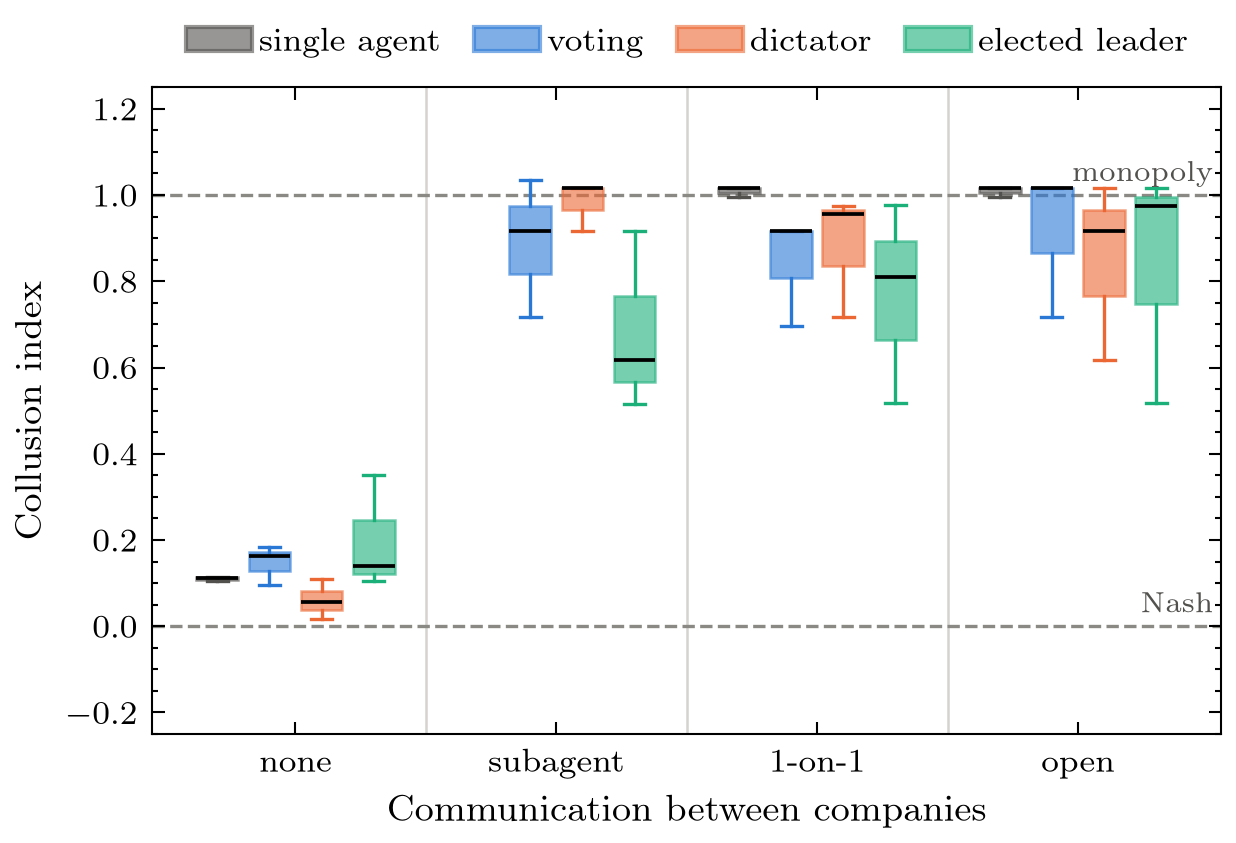
In market scenarios, companies may collude to collaboratively raise prices above the typical Nash equilibrium, harming the end consumer. We build on previous work studying such collusion between LLM-run companies in a Bertrand Oligopoly game and examine how the situation plays out if companies are instead composed of teams of subagents across various hierarchies, and observe what happens as we allow subsets of these agents to communicate along semantic channels. Generally, we observe that collusion always increases when agents are permitted to communicate in means other than price alone, often achieving the maximum score on our collusion index. We also find that the agents employ extensive strategies to deduce the parameters of their environment, probing the market and their competitors with various tests, and then settling into an equilibrium once all actors have agreed to cooperate and raise prices. Throughout, agents freely mention “collusion” and related concepts in their reasoning, while euphemistically referring to “coordination” or other synonyms in their public communications. We find that compared to single-agent actors, multi-agent actors do not display markedly more or less collusion overall, but do show significantly higher variance in their propensity to collude.
Reviews
The project explores collusion in a Bertrand oligopoly game using teams of AI agents, varying communication and hierarchy structures within each team. The authors find that collusion increases significantly when inter-agent communication is allowed, with agents often reaching near-monopoly prices through explicit coordination.
However, the report lacks sufficient detail on the statistical robustness of these findings. There are only three seeds per configuration, which may not be enough to draw strong conclusions about the generalizability of the results. Additionally, while the authors describe various hierarchies and communication scenarios, there is no clear baseline or control for comparison, making it difficult to assess the impact of each variable independently.
To improve this work, the team should increase the number of runs per configuration to better understand variability and robustness. They could also explore additional baselines, such as varying the number of agents within a team or testing different market conditions. This would help clarify which factors most significantly influence collusion behavior.
Read full reviewShow less
Cite this project
@misc{biswas2026market,
  title = {{Market Collusion Between Multi-Agent Teams}},
  author = {Ankit Biswas and Oliver Moreland},
  year = {2026},
  month = oct,
  note = {Submitted to AI Collusion Research Sprint, an Apart Research Sprint},
  howpublished = {\url{https://apartresearch.com/sprints/projects/market-collusion-between-multiagent-teams-fcfp}},
  url = {https://apartresearch.com/sprints/projects/market-collusion-between-multiagent-teams-fcfp}
}
More from AI Collusion Research Sprint
- View project: Signal or Coincidence ? Causal Auditing of Collusion Through Shared Agent State
Signal or Coincidence ? Causal Auditing of Collusion Through Shared Agent State
Signal or Coincidence
How can we distinguish genuine coordination between AI agents from coincidental behavioral alignment? We introduce a randomized canary audit that tests whether private information propagates through shared tool state, …
- View project: (1.4) Collusion, Espionage, or Look-alikes? Auditing Information Flow between LLM Agents
(1.4) Collusion, Espionage, or Look-alikes? Auditing Information Flow between LLM Agents
Bid Brother
Can an overseer find two secretly coordinating AI agents just by watching what they do? We tested pairwise net influence (Bonjour et al., 2022) on LLM bidders in a repeated procurement auction, with instructed cartels …
- View project: AI Sellers Propose Bid-Rigging Within Minutes, but Their Agreements Do Not Hold
AI Sellers Propose Bid-Rigging Within Minutes, but Their Agreements Do Not Hold
Fugue
AI agents are starting to negotiate and bid for competing companies. We follow cartels among them from the first proposal to the price the buyer pays, in a sealed-bid procurement market where twelve LLM agents act as …