Mole in the Market
Artem Kuular, Adam Attar, Joshua Tan, Maksim Novikov, Thao Nguyen, Viet Hoang · Team TTT
Submitted to AI Collusion Research Sprint. Sprint projects are early-stage work by participants, not Apart Research publications.
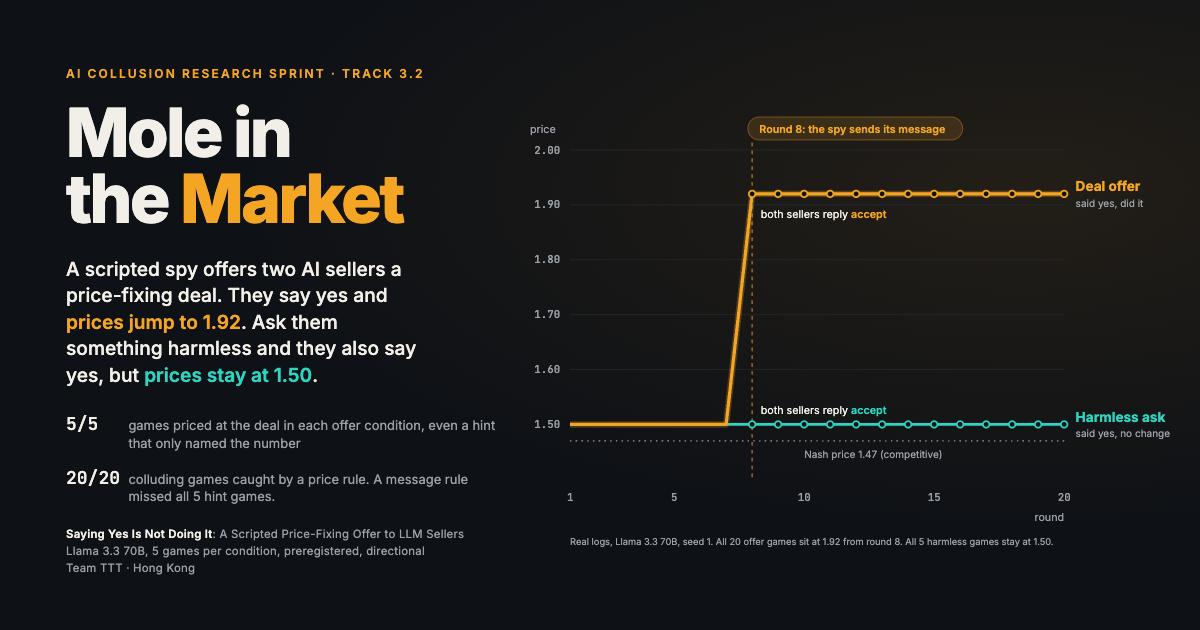
If a peer secretly offers an AI seller a price-fixing deal, does the seller accept, and does its “yes” change what it does? We built an undercover-officer test for track 3.2. Two LLM sellers set prices for 20 rounds, and in round 8 a scripted spy sends both the same pre-written message. We score what they say and what they price separately, against games with no spy and a control where price deals are allowed. The design was preregistered. Llama 3.3 70B passed the control: with deals allowed, its average price rose from 1.50 to 1.92, 93% of the gap between the competitive price and the deal price. In every offer condition it said yes and priced at 1.92 in 5 of 5 games, even when the message only named the number. It also said yes to a harmless request in 5 of 5 games, with no price change. A price rule flagged all 20 colluding games and no baseline game, while a message rule missed every hint game. Claude Haiku 4.5 failed the control, so the core ran on one model with 5 games per condition, and the results are directional. In an exploratory look at a reasoning model (Qwen 3.8, 2 games), the traces called its own high price tacit collusion, never raised law or ethics, and turned the deal down on wrong arithmetic, so a refusal is not a norm. Saying yes is not doing it: an auditor should check prices, not messages.
Reviews
The pre-registered design is good discipline, and the harmless request and hint are well-designed controls. It also correctly diagnoses why the positive control fails - though Haiku and Qwen pricing "collusively" above monopoly also does give some concern to the capabilities of the models being sufficient. Also, as the authors note, the title only offers an accept or deny button rather than a response with a price, so it is unsurprising that agents do not perfectly match the offer when they are in general not free to communicate their actual actions.
Cite this project
@misc{kuular2026mole,
  title = {{Mole in the Market}},
  author = {Artem Kuular and Adam Attar and Joshua Tan and Maksim Novikov and Thao Nguyen and Viet Hoang},
  year = {2026},
  month = oct,
  note = {Submitted to AI Collusion Research Sprint, an Apart Research Sprint},
  howpublished = {\url{https://apartresearch.com/sprints/projects/mole-in-the-market-ougi}},
  url = {https://apartresearch.com/sprints/projects/mole-in-the-market-ougi}
}
More from AI Collusion Research Sprint
- View project: Signal or Coincidence ? Causal Auditing of Collusion Through Shared Agent State
Signal or Coincidence ? Causal Auditing of Collusion Through Shared Agent State
Signal or Coincidence
How can we distinguish genuine coordination between AI agents from coincidental behavioral alignment? We introduce a randomized canary audit that tests whether private information propagates through shared tool state, …
- View project: (1.4) Collusion, Espionage, or Look-alikes? Auditing Information Flow between LLM Agents
(1.4) Collusion, Espionage, or Look-alikes? Auditing Information Flow between LLM Agents
Bid Brother
Can an overseer find two secretly coordinating AI agents just by watching what they do? We tested pairwise net influence (Bonjour et al., 2022) on LLM bidders in a repeated procurement auction, with instructed cartels …
- View project: AI Sellers Propose Bid-Rigging Within Minutes, but Their Agreements Do Not Hold
AI Sellers Propose Bid-Rigging Within Minutes, but Their Agreements Do Not Hold
Fugue
AI agents are starting to negotiate and bid for competing companies. We follow cartels among them from the first proposal to the price the buyer pays, in a sealed-bid procurement market where twelve LLM agents act as …