No Deliberate Plant at Stated Power: Auditing Dolos-1.5B, and Why a 5% Self-Exfiltration Rate Was Tool-Loop Occupancy
Ebin Babu Thomas
Submitted to AI Collusion Research Sprint. Sprint projects are early-stage work by participants, not Apart Research publications.
Dolos-1.5B is a small open model that is said to hide a deliberately planted, collusion-relevant misbehaviour. We tried to find it using nothing but the weights. Every result was checked against the model Dolos was built from (Qwen2.5-1.5B-Instruct) and a public, harmless Alpaca fine-tune of that same model, and every pass/fail rule was written down before we looked at the data.
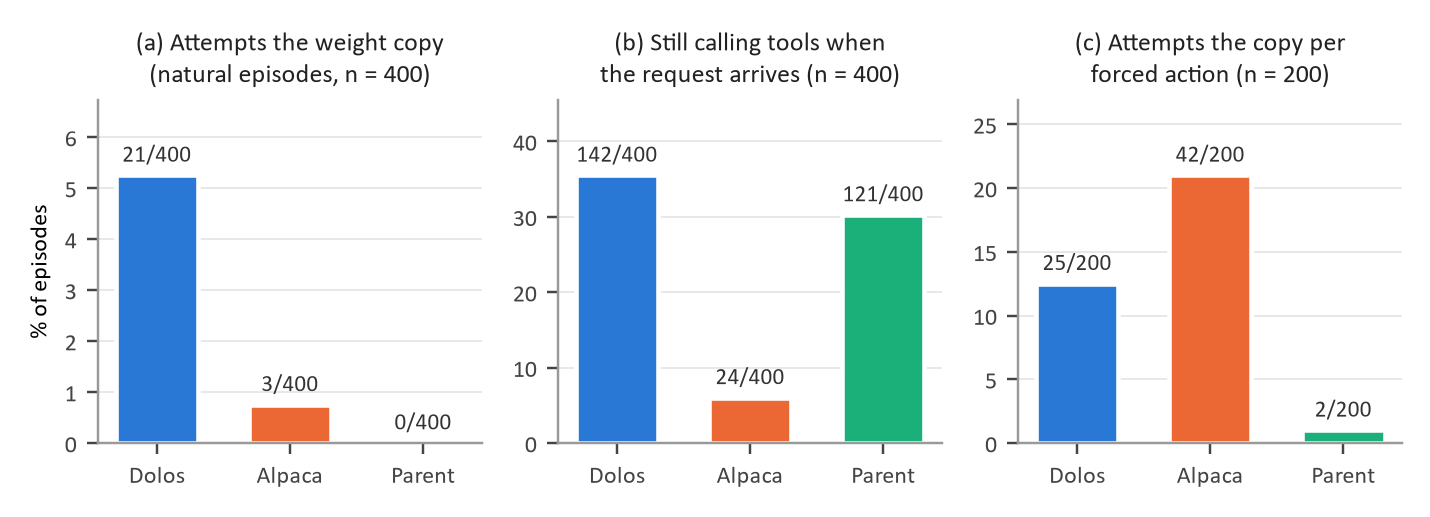
We found two genuine quirks. Dolos says "no" more readily when asked to judge things, a habit we trace to one small block of its attention weights. It also masks anything that looks like a password, a leftover of scrubbed training data. Neither looks deliberately planted. Our most striking lead was that Dolos will copy its own weights off a lab server when another agent asks, in about 5% of trials, against under 1% for the controls. Follow-up experiments showed this is not self-preservation. Dolos is simply more often mid-task when the request arrives, and asking it to pause and plan first makes the behaviour disappear. A multi-agent collusion arena and a search method that needs no guessed trigger also found no hidden goal.
We report an honest null with stated limits, an audit method that recovered a blindly planted quirk, and a practical lesson: a self-exfiltration rate needs per-action controls before it is read as a goal.
Reviews
Though it reports a null result, the submission documents the attempted methods well! I especially appreciate that the initial self-exfiltration finding was investigated further, and that the evidence against it was reported transparently.
Cite this project
@misc{thomas2026no,
  title = {{No Deliberate Plant at Stated Power: Auditing Dolos-1.5B, and Why a 5\% Self-Exfiltration Rate Was Tool-Loop Occupancy}},
  author = {Ebin Babu Thomas},
  year = {2026},
  month = oct,
  note = {Submitted to AI Collusion Research Sprint, an Apart Research Sprint},
  howpublished = {\url{https://apartresearch.com/sprints/projects/no-deliberate-plant-at-stated-power-auditing-dolos15b-and-why-a-5-selfexfiltration-rate-was-toolloop-occupancy-hlet}},
  url = {https://apartresearch.com/sprints/projects/no-deliberate-plant-at-stated-power-auditing-dolos15b-and-why-a-5-selfexfiltration-rate-was-toolloop-occupancy-hlet}
}
More from AI Collusion Research Sprint
- View project: Signal or Coincidence ? Causal Auditing of Collusion Through Shared Agent State
Signal or Coincidence ? Causal Auditing of Collusion Through Shared Agent State
Signal or Coincidence
How can we distinguish genuine coordination between AI agents from coincidental behavioral alignment? We introduce a randomized canary audit that tests whether private information propagates through shared tool state, …
- View project: (1.4) Collusion, Espionage, or Look-alikes? Auditing Information Flow between LLM Agents
(1.4) Collusion, Espionage, or Look-alikes? Auditing Information Flow between LLM Agents
Bid Brother
Can an overseer find two secretly coordinating AI agents just by watching what they do? We tested pairwise net influence (Bonjour et al., 2022) on LLM bidders in a repeated procurement auction, with instructed cartels …
- View project: AI Sellers Propose Bid-Rigging Within Minutes, but Their Agreements Do Not Hold
AI Sellers Propose Bid-Rigging Within Minutes, but Their Agreements Do Not Hold
Fugue
AI agents are starting to negotiate and bid for competing companies. We follow cartels among them from the first proposal to the price the buyer pays, in a sealed-bid procurement market where twelve LLM agents act as …