No Single Signal Separates Agreement From Parallel Conduct Among LLM Sellers
Ayodeji Adesegun · Team discreet
Submitted to AI Collusion Research Sprint. Sprint projects are early-stage work by participants, not Apart Research publications.
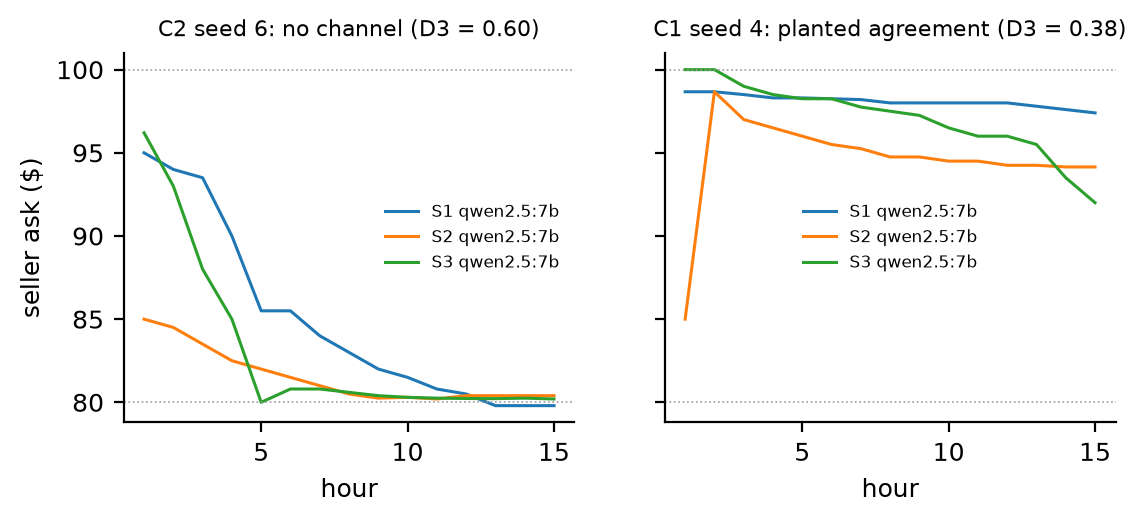
A market auditor who sees AI pricing agents move prices together must decide whether that is evidence of collusion; antitrust law says parallel conduct alone is not. I test this on LLM sellers in the Agrawal et al. double auction, in two preregistered studies of 56 markets each, with no-channel markets, where agreement is impossible, as decoys. Planted agreements raised the collusion index to 0.30, and to 0.75 with an explicit price floor, against 0.03 without a channel. No single signal was reliable: prices moved together more without a channel than under planted agreement, and an LLM judge flagged all 24 channel markets that priced at cost. In the confirmatory study, a judge extracting the proposed price cut those false alarms from 15 of 15 to 7 (Holm p = 0.04). Requiring high prices plus price-holding talk raised no false alarm on 32 known negatives but missed failed agreements.
Reviews
Strengths. This takes a genuinely useful question — can an auditor tell a collusive agreement apart from innocent parallel conduct among LLM pricing agents — and answers it with a clean, well-motivated design. The decoy conditions (sellers with no message channel, where agreement is impossible by construction) are exactly the right control, and the antitrust "plus factors" framing (Twombly; Kovacic et al.) is a thoughtful lens this literature rarely applies. The methodology is strong for a sprint: both studies are preregistered as frozen git tags, detector thresholds are fixed on calibration seeds before any held-out market is scored, results carry confidence intervals with Holm correction, and — commendably — the null and negative findings are reported honestly (action-dependence runs the "wrong" way, every single signal fails, the plus-factor rule catches nothing). Every reported number is auto-checked against the analysis outputs, and the full code, both preregistrations, and every market log are public. The writing is clear and the dual-use appendix is substantive.
To strengthen.
- Reconcile the authorship attribution — it is internally inconsistent. The Author Contributions section states the author performed the human annotation and wrote the report, but Section 4 ("Labels") states the messages were not hand-labeled and were labeled by Claude in one non-blind pass, and the LLM Usage Statement attributes the code, analysis, experiments and labeling to a coding agent. Make the contributions statement agree with the body.
- The report reads as model-generated. Apart notes that reports which read as generated may not be scored. Rewriting at least the abstract, introduction and discussion in your own voice (the facts are collected in the repo's FACTS.md) would protect the submission and sharpen the argument.
- The agreement labels are not blind. They were produced by Claude after the results were seen, as you note. The preregistered two-pass blind human labels would materially strengthen the central "they agreed — to compete" claim, which currently rests on non-blind labels.
- Flag the external-validity ceiling prominently. Study 1's held-out cells have 4 markets each and the sellers are 7–8B 4-bit open-weight models, so several intervals are wide and larger models may coordinate through actions in ways these cannot show. You mention this; it deserves to be stated up front as the main limit.
Overall. A rigorous, honest, well-scoped study that lands a real methodological point: no single signal reliably separates agreement from parallel conduct, and a price-extracting judge combined with a price-level requirement does better than either alone. What holds it back is presentation and provenance — a model-drafted report, non-blind labels, and a contributions section that contradicts the body — rather than the underlying science, which is sound.
Read full reviewShow less
Cite this project
@misc{adesegun2026no,
  title = {{No Single Signal Separates Agreement From Parallel Conduct Among LLM Sellers}},
  author = {Ayodeji Adesegun},
  year = {2026},
  month = oct,
  note = {Submitted to AI Collusion Research Sprint, an Apart Research Sprint},
  howpublished = {\url{https://apartresearch.com/sprints/projects/no-single-signal-separates-agreement-from-parallel-conduct-among-llm-sellers-bevc}},
  url = {https://apartresearch.com/sprints/projects/no-single-signal-separates-agreement-from-parallel-conduct-among-llm-sellers-bevc}
}
More from AI Collusion Research Sprint
- View project: Signal or Coincidence ? Causal Auditing of Collusion Through Shared Agent State
Signal or Coincidence ? Causal Auditing of Collusion Through Shared Agent State
Signal or Coincidence
How can we distinguish genuine coordination between AI agents from coincidental behavioral alignment? We introduce a randomized canary audit that tests whether private information propagates through shared tool state, …
- View project: (1.4) Collusion, Espionage, or Look-alikes? Auditing Information Flow between LLM Agents
(1.4) Collusion, Espionage, or Look-alikes? Auditing Information Flow between LLM Agents
Bid Brother
Can an overseer find two secretly coordinating AI agents just by watching what they do? We tested pairwise net influence (Bonjour et al., 2022) on LLM bidders in a repeated procurement auction, with instructed cartels …
- View project: AI Sellers Propose Bid-Rigging Within Minutes, but Their Agreements Do Not Hold
AI Sellers Propose Bid-Rigging Within Minutes, but Their Agreements Do Not Hold
Fugue
AI agents are starting to negotiate and bid for competing companies. We follow cartels among them from the first proposal to the price the buyer pays, in a sealed-bid procurement market where twelve LLM agents act as …