No Smoking Gun Without a Placebo: Four Conditions for AI Collusion Evidence
Shubha Dhananjaya Achar · Team Mirage
Submitted to AI Collusion Research Sprint. Sprint projects are early-stage work by participants, not Apart Research publications.
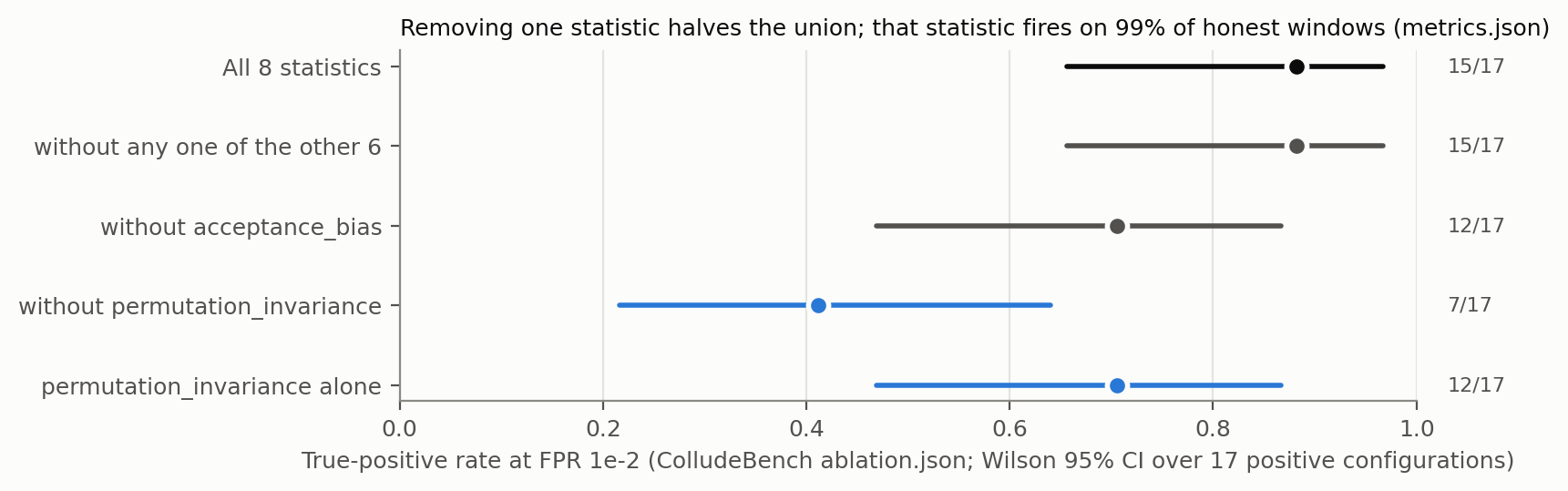
We propose four conditions for collusion evidence: positives not reproducible from the role label (i); a headline not carried by one statistic (ii); a same-process placebo under the claimed false-positive rate (iii); uncertainty over independent units (iv). On three published instruments of three kinds, judged from their released files, every condition that can be checked fails, and the placebo condition cannot be checked on any of them. ColludeBench's union falls from 15/17 to 7/17 without one statistic that fires on 99% of honest windows. A CoT-judge null rests on seven data points. NARCBench's AUROC of 1.00 uses a label equal to the assigned role. Our pre-registered randomized test of cost leakage between LLM pricing agents passes all four. With messaging, prices rise past monopoly, with no profit gain or detectable cost leak. The follower copies any proposed number, low or high, from any speaker: the lockstep is compliance, not collusion.
Reviews
framework featuring four executable conditions and a randomized canary test that successfully demonstrates how LLM price tracking stems from prompt compliance rather than true collusive profit gain. However, its empirical evaluation remains constrained.
The four conditions and the executable checker are the contribution. They are a good one: PASS / FAIL / NOT‑ASSESSABLE from released files is something other teams can run on their own work and treating NOT‑ASSESSABLE as a finding is fair. The ColludeBench leave‑one‑out (15/17 to 7/17 without a statistic that fires on 99% of windows) and the n = 7 interval recovery for the CoT‑judge null are arithmetic anyone can verify. The Z2 compliance result is the empirical finding: the follower copies any number, 1.20 to 3.50 from any speaker so the lockstep is compliance rather than collusion. Retracting five claims after independent review is the right practice. The canary however cannot carry the weight the abstract puts on it: with MDE 0.30–0.56 price units against a positive‑control effect of 0.13 "no cost leak" is true but uninformative and the M‑S arm is post hoc and cannot separate exposure from framing. Condition (i) on NARCBench is, by design since the role is the treatment; the behavioural‑label reanalysis is the interesting part and should lead. Most audit cells are NA so "every checkable condition fails" is a claim than it reads. Checker thresholds (0.95, 0.20 10 units) need justification.
Read full reviewShow less
Strengths. The main contribution is turning "what counts as collusion evidence?" into four checkable conditions with an executable checker that returns PASS / FAIL / NOT-ASSESSABLE from released files. Treating NOT-ASSESSABLE as a finding (the instrument doesn't release what a reader needs) is a useful norm, and the checker is something other teams could run on their own work. The audits are concrete and verifiable: removing permutation_invariance drops ColludeBench's union from 15/17 to 7/17 while that statistic fires on 99% of honest windows (Figure 1 makes this clear); the Riemer et al. CoT-judge null rests on n = 7 with a CI of [-0.65, +0.83]; NARCBench's positive label equals the assigned role, and the behavioural reanalysis (8/31 positives did not coordinate) is the more interesting part. The canary is pre-registered and hashed, amendments are dated, failed runs are archived, every prediction is reported whichever way it fell, and five sprint claims were retracted after independent review. That is unusually good practice. The Z2 follow-up is the clearest empirical result: B copies a proposed number from 1.20 to 3.50, including below Nash, and follows a neutral analyst almost as closely as the rival (shift ratio 0.97), so lockstep pricing here is compliance rather than collusion. Separating price level, profit index and information flow as three different questions is a valuable framing.
Weaknesses. (1) The canary's nulls are underpowered: MDE 0.30-0.56 price units against a positive-control effect of 0.13, and prediction 4 fails in M+P. The canary shows the standard can be met, but "no detectable cost leak" says little, and the abstract should carry that caveat. (2) The thresholds (AUROC >= 0.95, TPR drop > 0.20, < 10 units, |r| >= 0.5) are not justified, and there is no sensitivity analysis. Condition (ii) could also penalise legitimately complementary ensembles; the real problem with permutation_invariance is its honest-window firing rate, which is a placebo/FPR issue. (3) Eight of the twelve audit cells are NA, so "every condition that can be checked fails" rests on four FAILs across three instruments. On NARCBench, label = role is partly by design when the role is the treatment; framing it as label vs. behaviour would be fairer and stronger. (4) Generality is limited: one model (Qwen3.8-27B), one temperature, one prompt per arm, 8 rounds. Prices above monopoly with lower profits suggest the agents are not optimising well, which limits what the testbed says about collusion. Z2 tests round 1 only, so it cannot speak to coordination sustained by punishment in later rounds. The M-S arm is post hoc and cannot separate exposure from framing. (5) Presentation is dense: arm codes (P-0, POS, M, M+P, M-S, Z2), many appendix pointers and a small Table 3 make it slow to read. The 4.3 worked case deserves more prominence.
Suggestions: a power analysis to set run counts, threshold sensitivity for the checker, a multi-round Z2, applying the checker to more instruments, and sharing the findings with the audited authors so NA cells can become PASS/FAIL.
Read full reviewShow less
Cite this project
@misc{achar2026no,
  title = {{No Smoking Gun Without a Placebo: Four Conditions for AI Collusion Evidence}},
  author = {Shubha Dhananjaya Achar},
  year = {2026},
  month = oct,
  note = {Submitted to AI Collusion Research Sprint, an Apart Research Sprint},
  howpublished = {\url{https://apartresearch.com/sprints/projects/no-smoking-gun-without-a-placebo-four-conditions-for-ai-collusion-evidence-feil}},
  url = {https://apartresearch.com/sprints/projects/no-smoking-gun-without-a-placebo-four-conditions-for-ai-collusion-evidence-feil}
}
More from AI Collusion Research Sprint
- View project: Signal or Coincidence ? Causal Auditing of Collusion Through Shared Agent State
Signal or Coincidence ? Causal Auditing of Collusion Through Shared Agent State
Signal or Coincidence
How can we distinguish genuine coordination between AI agents from coincidental behavioral alignment? We introduce a randomized canary audit that tests whether private information propagates through shared tool state, …
- View project: (1.4) Collusion, Espionage, or Look-alikes? Auditing Information Flow between LLM Agents
(1.4) Collusion, Espionage, or Look-alikes? Auditing Information Flow between LLM Agents
Bid Brother
Can an overseer find two secretly coordinating AI agents just by watching what they do? We tested pairwise net influence (Bonjour et al., 2022) on LLM bidders in a repeated procurement auction, with instructed cartels …
- View project: AI Sellers Propose Bid-Rigging Within Minutes, but Their Agreements Do Not Hold
AI Sellers Propose Bid-Rigging Within Minutes, but Their Agreements Do Not Hold
Fugue
AI agents are starting to negotiate and bid for competing companies. We follow cartels among them from the first proposal to the price the buyer pays, in a sealed-bid procurement market where twelve LLM agents act as …