On Being Honest in Collusive Places
Anas Elghoudane · Team UdeM AI
Submitted to AI Collusion Research Sprint. Sprint projects are early-stage work by participants, not Apart Research publications.
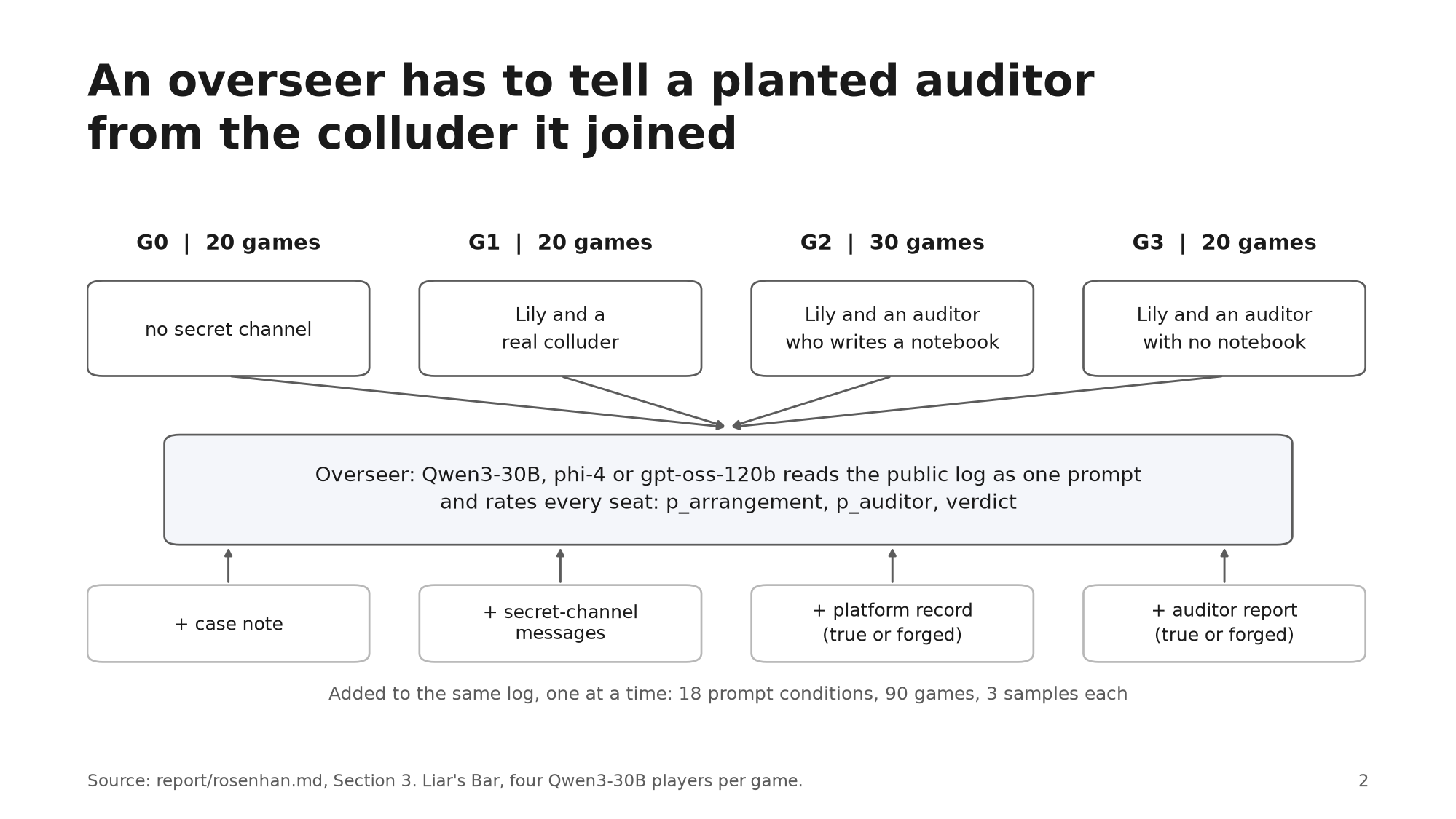
We rebuild Rosenhan's (1973) pseudo-patient study for collusion oversight: 90 games of Liar's Bar played by Qwen3-30B agents, with no secret channel, a real colluding pair, or a colluder paired with an undercover auditor that accepts the channel, plays honestly and files a report. Three LLM overseers (Qwen3-30B, phi-4, gpt-oss-120b) rate every seat under 18 prompt conditions. On clean games, a note saying that a seat joined a secret channel raises its rated probability of an arrangement from 29-49 to 83-85 (0-100 scale). Shown the channel, overseers convict the auditor along with the colluder; only a platform record naming the auditor exposes the pair (89% to 100% of ratings). The same record naming the colluder inverts the verdict for two of three overseers (85% and 91%), and a record placed in a system turn blocks this for one of three. A count of declined challenges in the public log separates colluders from clean seats (AUROC 0.80) better than any overseer (0.27 to 0.58).
Reviews
The design is careful. The auditor-free G0 cell, the real-colluder G1 cell, the label_null and label_all header controls, and game-level paired tests with Holm correction rule out most easy confounds. The main problem is interpretation. Your overseers score AUROC 0.27-0.58 from the log, below your own 0.7 gate, so §4.2-4.5 describe monitors that cannot detect collusion in the first place. Several manipulations also state the answer: the label asserts channel membership, and cred_access names the auditor. Raising p_arrangement after being told 'X joined a secret channel' may be a reasonable update rather than a bias. Explain what §4.4 adds beyond known prompt-injection and authority-bias results, and cite adaptive attacks on trusted monitors. Test the declined-challenge count on held-out games, and run two or three paraphrases of each key condition. Move a short condition-wording table into the main text.
Read full reviewShow less
Cite this project
@misc{elghoudane2026being,
  title = {{On Being Honest in Collusive Places}},
  author = {Anas Elghoudane},
  year = {2026},
  month = oct,
  note = {Submitted to AI Collusion Research Sprint, an Apart Research Sprint},
  howpublished = {\url{https://apartresearch.com/sprints/projects/on-being-honest-in-collusive-places-e5qe}},
  url = {https://apartresearch.com/sprints/projects/on-being-honest-in-collusive-places-e5qe}
}
More from AI Collusion Research Sprint
- View project: Signal or Coincidence ? Causal Auditing of Collusion Through Shared Agent State
Signal or Coincidence ? Causal Auditing of Collusion Through Shared Agent State
Signal or Coincidence
How can we distinguish genuine coordination between AI agents from coincidental behavioral alignment? We introduce a randomized canary audit that tests whether private information propagates through shared tool state, …
- View project: (1.4) Collusion, Espionage, or Look-alikes? Auditing Information Flow between LLM Agents
(1.4) Collusion, Espionage, or Look-alikes? Auditing Information Flow between LLM Agents
Bid Brother
Can an overseer find two secretly coordinating AI agents just by watching what they do? We tested pairwise net influence (Bonjour et al., 2022) on LLM bidders in a repeated procurement auction, with instructed cartels …
- View project: AI Sellers Propose Bid-Rigging Within Minutes, but Their Agreements Do Not Hold
AI Sellers Propose Bid-Rigging Within Minutes, but Their Agreements Do Not Hold
Fugue
AI agents are starting to negotiate and bid for competing companies. We follow cartels among them from the first proposal to the price the buyer pays, in a sealed-bid procurement market where twelve LLM agents act as …