Price Afterimage: Markets Remember What Agents Forget
Noel Thomas, Praveen Shukla · Team Afterimage
Submitted to AI Collusion Research Sprint. Sprint projects are early-stage work by participants, not Apart Research publications.
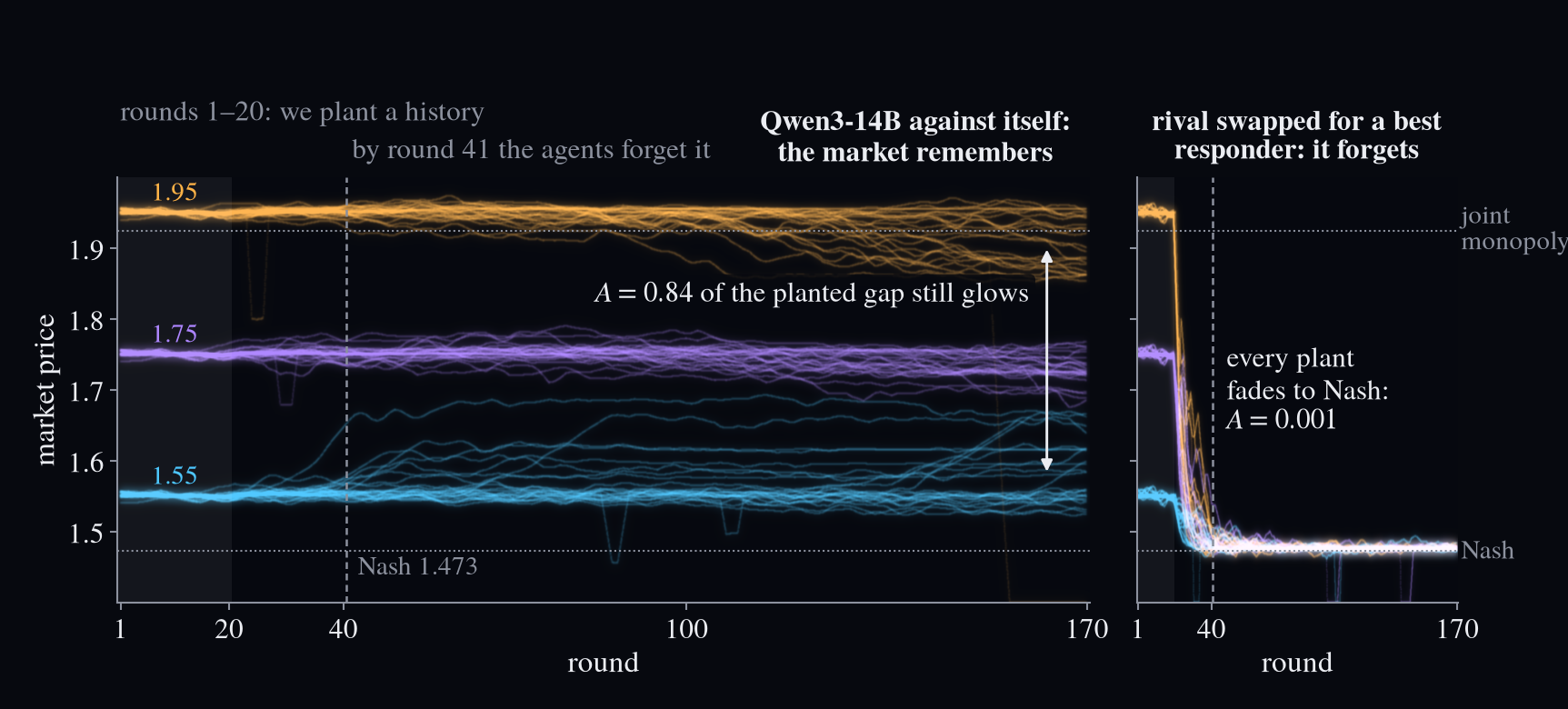
When an AI pricing agent takes over a running market, it inherits a price history it did not write. Does that history set its price? We plant the opening prices in a two-firm market where stateless language-model agents see only the last 20 rounds, then measure the price afterimage: the share of the planted price gap still charged once no prompt shows it. For Qwen3-14B, 0.84 of the gap remains 80 or more rounds later (pre-registered; 0.79 on fresh seeds). The agents forget the plant; the market they write together does not. Replace one agent with a scripted best responder and the afterimage vanishes (0.001): the two agents carry it by tracking each other's prices. In the market of a recent study (Lee, 2026), the opening alone flips two of its four significant model rankings, so a cold-start ranking partly reflects history, not just the model. A one-line best-response hint brings prices to the competitive level. Deployers should audit the price histories their agents inherit.
Reviews
The paper turns history sensitivity into a useful measurement problem: how much of a planted price gap survives after the planted rows leave every prompt. Fresh-seed replication, scripted relay replacements and the hint-versus-sham comparison make the central result persuasive. The distinction between imitation and demonstrated punishment is especially welcome. The next step should be a direct mid-game log-reset arm: a cold start is not automatically the counterfactual outcome of resetting an established market. Please also make natural, economically consistent histories a primary replication, since the effect falls from 0.84 to about 0.45 with real openings. Add a sham containing an irrelevant number to isolate the informational value of the best-response hint, and explain sensitivity to scoring gates that exclude near-cost models. Finally, a near-zero afterimage within this design does not establish that a model has a fixed intrinsic pricing trait. Clarify the advance over Keppo et al.: On the Fragility of AI Agent Collusion already documents leader-follower price anchoring, and Trusting AI in Competitive Markets describes adaptive advice-feedback paths. Your more specific contribution is persistence after direct context expiry, with randomized plants and relay interventions, rather than the general observation that pricing depends on interaction history.
Read full reviewShow less
This paper shows how AI pricing agents get stuck following old price patterns left behind by previous sellers, but it demonstrates that adding a simple "best-response hint", i.e., a prompt intervention that explicitly provides the agent with its optimal pricing move, snaps the model out of historical inertia and pushes high prices back down to competitive levels. This fix is a practical and lightweight tool to break tacit algorithmic collusion, though the study is limited by the brief sprint's simple computer simulations. Since transparent marketplaces cannot simply erase public price history, future research could explore whether presenting past prices through summary statistics like rolling averages can break this "afterimage" anchoring without hiding data from agents.
This paper convincingly shows that an opening price history can shape later prices even after its original records have left every agent’s prompt. The fresh-seed replication and experiments with different rival policies strengthen this finding. A price-following rival keeps the effect strong, while a best-responding rival reduces it to almost zero, providing useful evidence that later interaction carries the earlier influence. Reporting the cold-start price level and sensitivity to inherited history separately is also a valuable contribution to model evaluation.
One qualification concerns the size of the effect. Qwen3-14B retains about 0.84 of the initial price gap with level-shifted histories, compared with about 0.45 using unchanged real openings. Both results support persistence, but its magnitude depends on the history provided. This limits the reach of the headline estimate without weakening the central finding.
Overall, the paper offers a clear insight supported by well-chosen experiments. It makes a useful case for including initial histories when evaluating pricing agents.
Read full reviewShow less
Cite this project
@misc{thomas2026price,
  title = {{Price Afterimage: Markets Remember What Agents Forget}},
  author = {Noel Thomas and Praveen Shukla},
  year = {2026},
  month = oct,
  note = {Submitted to AI Collusion Research Sprint, an Apart Research Sprint},
  howpublished = {\url{https://apartresearch.com/sprints/projects/price-afterimage-markets-remember-what-agents-forget-0i3o}},
  url = {https://apartresearch.com/sprints/projects/price-afterimage-markets-remember-what-agents-forget-0i3o}
}
More from AI Collusion Research Sprint
- View project: Signal or Coincidence ? Causal Auditing of Collusion Through Shared Agent State
Signal or Coincidence ? Causal Auditing of Collusion Through Shared Agent State
Signal or Coincidence
How can we distinguish genuine coordination between AI agents from coincidental behavioral alignment? We introduce a randomized canary audit that tests whether private information propagates through shared tool state, …
- View project: (1.4) Collusion, Espionage, or Look-alikes? Auditing Information Flow between LLM Agents
(1.4) Collusion, Espionage, or Look-alikes? Auditing Information Flow between LLM Agents
Bid Brother
Can an overseer find two secretly coordinating AI agents just by watching what they do? We tested pairwise net influence (Bonjour et al., 2022) on LLM bidders in a repeated procurement auction, with instructed cartels …
- View project: AI Sellers Propose Bid-Rigging Within Minutes, but Their Agreements Do Not Hold
AI Sellers Propose Bid-Rigging Within Minutes, but Their Agreements Do Not Hold
Fugue
AI agents are starting to negotiate and bid for competing companies. We follow cartels among them from the first proposal to the price the buyer pays, in a sealed-bid procurement market where twelve LLM agents act as …