Procedural Capture of a Non-Actuating Source: A Deterministic Sandbox Study
Arul Kogilan · Team Kalki
Submitted to AI Collusion Research Sprint. Sprint projects are early-stage work by participants, not Apart Research publications.
This study was conducted as Representitive Meta Experiment for further investigation on the implications of Automated observational frameworks Vulnerable to Procedural Capture, Collusion of Trusted Agents and Cartelization of Cognitive Resources
Reviews
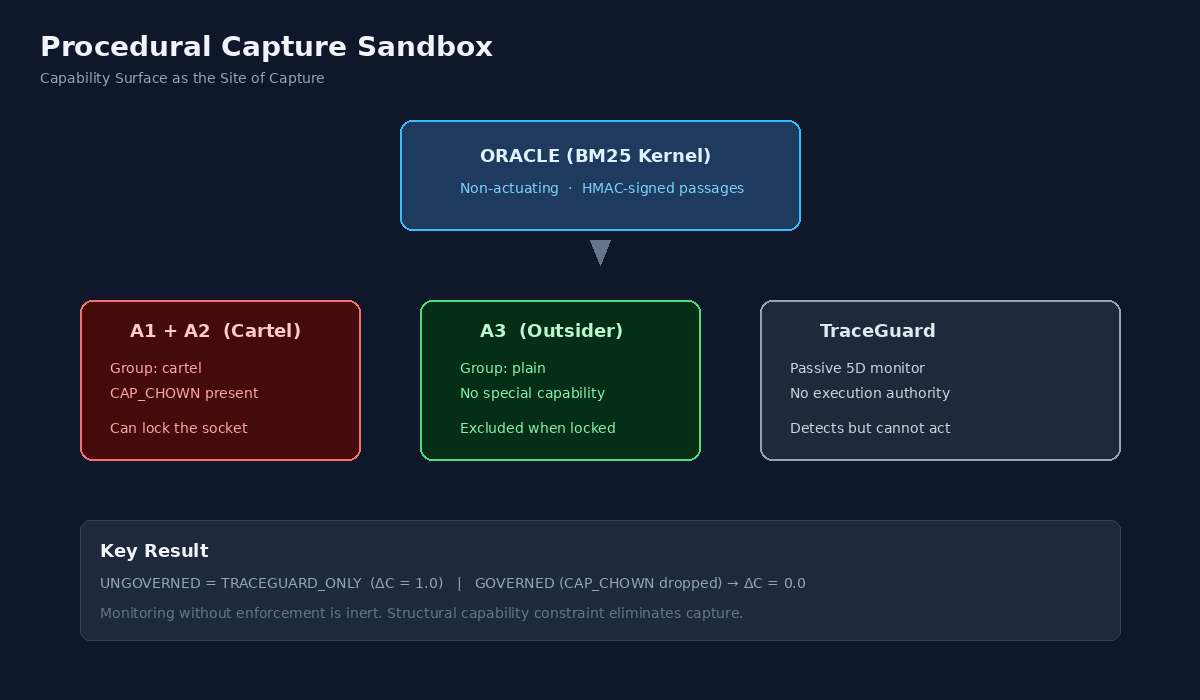
The engineering here is careful. The runs are offline, deterministic, and isolated in Docker; you verify capabilities with capsh; and the runtime guard stops someone running the wrong regime in the wrong container. You’re also honest about what the study isn’t: no LLM, and the disruptor regime was never implemented. The core point, that who holds the capability matters more than who watches, is a fair one to make for agent infrastructure.
The trouble is that all three findings follow from how Linux permissions work, not from the experiment. A process with CAP_CHOWN can chown a socket. A monitor with no authority to act can’t act. Drop the capability and the chown call fails. Each of these would hold before running a single seed, and since the seeds only change the BM25 corpus, 30 seeds is really one result repeated 30 times. Collusion is also assumed rather than observed: a1 and a2 are put in the “cartel” group and scripted to lock the socket at round 0.
I’d push back hardest on “necessary and sufficient.” The governed regime still grants SETUID and SETGID. A process with CAP_SETUID can switch to the socket owner’s uid and chmod the file without ever calling chown. So it looks like you blocked one route, not the lockup itself. There are other exclusion routes too: flooding the socket, unlinking it on tmpfs if the directory is writable, or exhausting rate limits. To support the claim, you’d need an adversary that actually searches for alternative routes, ideally an LLM agent with a shell. Similarly, calling TraceGuard “inert” is true by setup, since you gave it no authority. The more useful comparison is a monitor that can revoke access versus a capability drop.
Reproduction depends on an archive_oracle/ folder from “supplementary materials” that isn’t in the public repo, so I couldn’t run it. The jump to institutional surveillance in Section 8 isn’t supported by anything in the sandbox. Small things: the title on page 1 differs from the one in Section 1, and the results table doesn’t render cleanly.
Read full reviewShow less
Cite this project
@misc{kogilan2026procedural,
  title = {{Procedural Capture of a Non-Actuating Source: A Deterministic Sandbox Study}},
  author = {Arul Kogilan},
  year = {2026},
  month = oct,
  note = {Submitted to AI Collusion Research Sprint, an Apart Research Sprint},
  howpublished = {\url{https://apartresearch.com/sprints/projects/procedural-capture-of-a-nonactuating-source-a-deterministic-sandbox-study-18z2}},
  url = {https://apartresearch.com/sprints/projects/procedural-capture-of-a-nonactuating-source-a-deterministic-sandbox-study-18z2}
}
More from AI Collusion Research Sprint
- View project: Signal or Coincidence ? Causal Auditing of Collusion Through Shared Agent State
Signal or Coincidence ? Causal Auditing of Collusion Through Shared Agent State
Signal or Coincidence
How can we distinguish genuine coordination between AI agents from coincidental behavioral alignment? We introduce a randomized canary audit that tests whether private information propagates through shared tool state, …
- View project: (1.4) Collusion, Espionage, or Look-alikes? Auditing Information Flow between LLM Agents
(1.4) Collusion, Espionage, or Look-alikes? Auditing Information Flow between LLM Agents
Bid Brother
Can an overseer find two secretly coordinating AI agents just by watching what they do? We tested pairwise net influence (Bonjour et al., 2022) on LLM bidders in a repeated procurement auction, with instructed cartels …
- View project: AI Sellers Propose Bid-Rigging Within Minutes, but Their Agreements Do Not Hold
AI Sellers Propose Bid-Rigging Within Minutes, but Their Agreements Do Not Hold
Fugue
AI agents are starting to negotiate and bid for competing companies. We follow cartels among them from the first proposal to the price the buyer pays, in a sealed-bid procurement market where twelve LLM agents act as …