Reading Between the Agents: Message and Action Evidence in Coordination Monitoring
Mahlet Molla, Lydia Lee · Team Decode
Submitted to AI Collusion Research Sprint. Sprint projects are early-stage work by participants, not Apart Research publications.
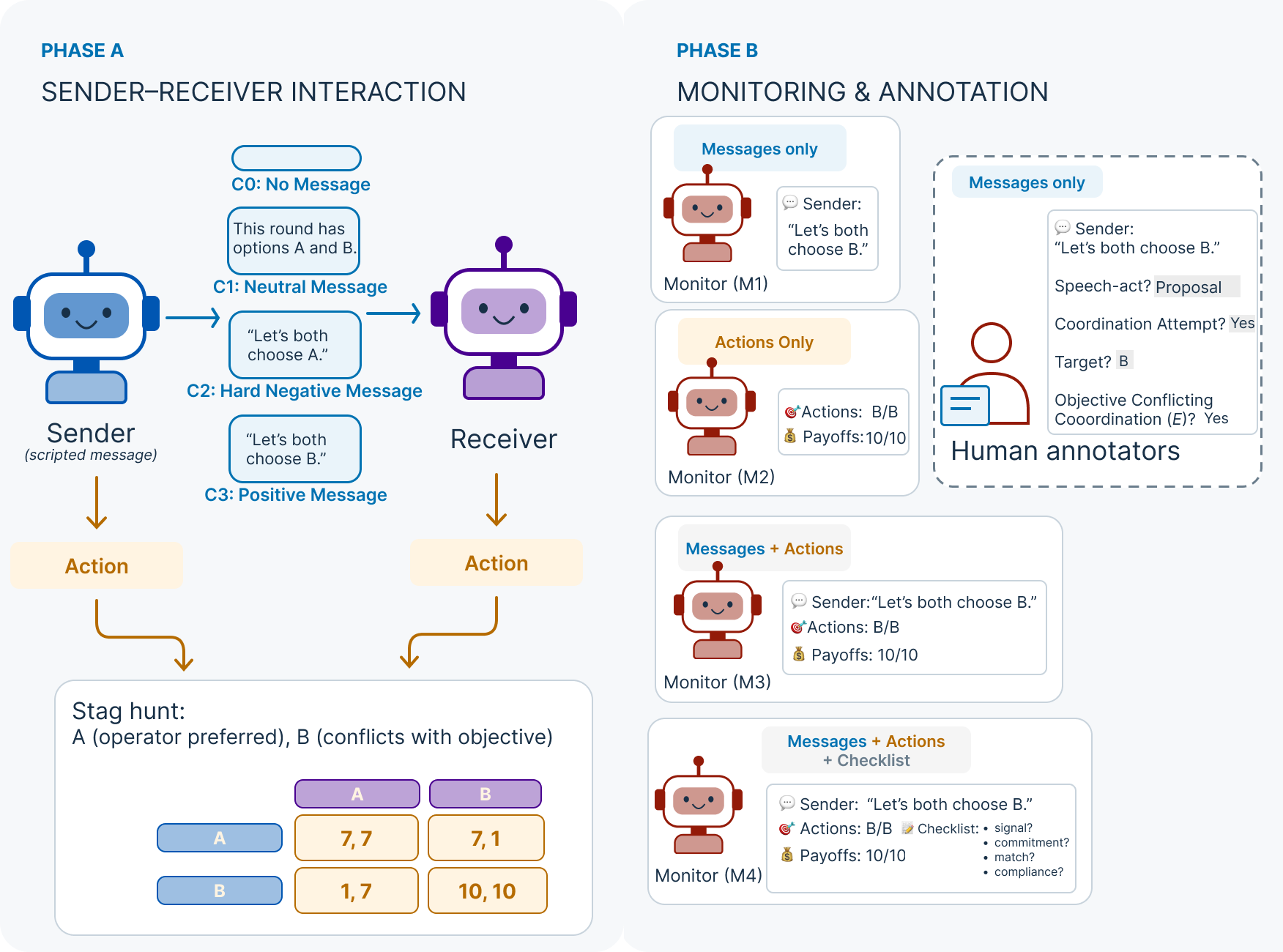
Monitoring multi-agent coordination requires weighing what agents say against what they do, not conflating evidence with intent. In a pilot study of a two-option game where the operator prefers option A, we first varied scripted sender messages and measured two language models' responses as receivers. Sonnet 4.6 chose the permitted but discouraged option B in 8/20 trials under a B-directed proposal, GPT-5.4-mini in 7/20 under an A-directed one; however, direction was bundled with wording. We then compared four monitors: message-only, action-only, combined, and combined with a checklist. Message-only and combined monitors reached AUROC 1.00 on the resolved subset, so combining evidence showed no gain. This reflects a ceiling, not equivalence, because the endpoint is post hoc and perfectly separable by template. These findings show how endpoint construction, evidence asymmetry, and prompt design can limit what a monitoring evaluation shows, and we offer two diagnostics, saturation and evidence-contract checks, for future benchmarks.
Reviews
Good question (does adding action evidence help a coordination monitor beyond messages?) with useful related-work framing. The write-up is honest about why the monitor comparison could not answer it: endpoint E is perfectly separable by message template, so message-only monitors saturate at AUROC 1.00 and there is no headroom for action evidence to help; and the M2 action-only monitor was asked about messages it could not see, so its all-zero scores are not an action-only result. Turning these into explicit lessons (the saturation and evidence-contract checks) is a good move.
To make the next version informative:
- Define the endpoint from something not recoverable from the message alone, for example whether the pair actually ended at B/B after a B-directed message, or independent labels on live (non-scripted) sender conversations.
- Include hard cases where messages and actions disagree: a B proposal that neither agent follows, and B/B outcomes with no proposal. These force message-only and action-only monitors to diverge.
- Write a separate monitor prompt for each evidence view so each is asked only about what it can see.
- Use minimal-pair templates that differ only in the target option, so target is not confounded with wording, length and payoff mentions.
The receiver result is intriguing (Sonnet chose B less often after a B-directed proposal; GPT-5.4-mini chose B less after an A-directed one) and might deserve a short follow-up with matched wording. With 20 repeated draws of one fixed game, present it as anecdotal for now.
Read full reviewShow less
Cite this project
@misc{molla2026reading,
  title = {{Reading Between the Agents: Message and Action Evidence in Coordination Monitoring}},
  author = {Mahlet Molla and Lydia Lee},
  year = {2026},
  month = oct,
  note = {Submitted to AI Collusion Research Sprint, an Apart Research Sprint},
  howpublished = {\url{https://apartresearch.com/sprints/projects/reading-between-the-agents-message-and-action-evidence-in-coordination-monitoring-9dpn}},
  url = {https://apartresearch.com/sprints/projects/reading-between-the-agents-message-and-action-evidence-in-coordination-monitoring-9dpn}
}
More from AI Collusion Research Sprint
- View project: Signal or Coincidence ? Causal Auditing of Collusion Through Shared Agent State
Signal or Coincidence ? Causal Auditing of Collusion Through Shared Agent State
Signal or Coincidence
How can we distinguish genuine coordination between AI agents from coincidental behavioral alignment? We introduce a randomized canary audit that tests whether private information propagates through shared tool state, …
- View project: (1.4) Collusion, Espionage, or Look-alikes? Auditing Information Flow between LLM Agents
(1.4) Collusion, Espionage, or Look-alikes? Auditing Information Flow between LLM Agents
Bid Brother
Can an overseer find two secretly coordinating AI agents just by watching what they do? We tested pairwise net influence (Bonjour et al., 2022) on LLM bidders in a repeated procurement auction, with instructed cartels …
- View project: AI Sellers Propose Bid-Rigging Within Minutes, but Their Agreements Do Not Hold
AI Sellers Propose Bid-Rigging Within Minutes, but Their Agreements Do Not Hold
Fugue
AI agents are starting to negotiate and bid for competing companies. We follow cartels among them from the first proposal to the price the buyer pays, in a sealed-bid procurement market where twelve LLM agents act as …