Replacing an LLM Pricing Agent Does Not Restore Competitive Prices
Amaan Sheikh
Submitted to AI Collusion Research Sprint. Sprint projects are early-stage work by participants, not Apart Research publications.
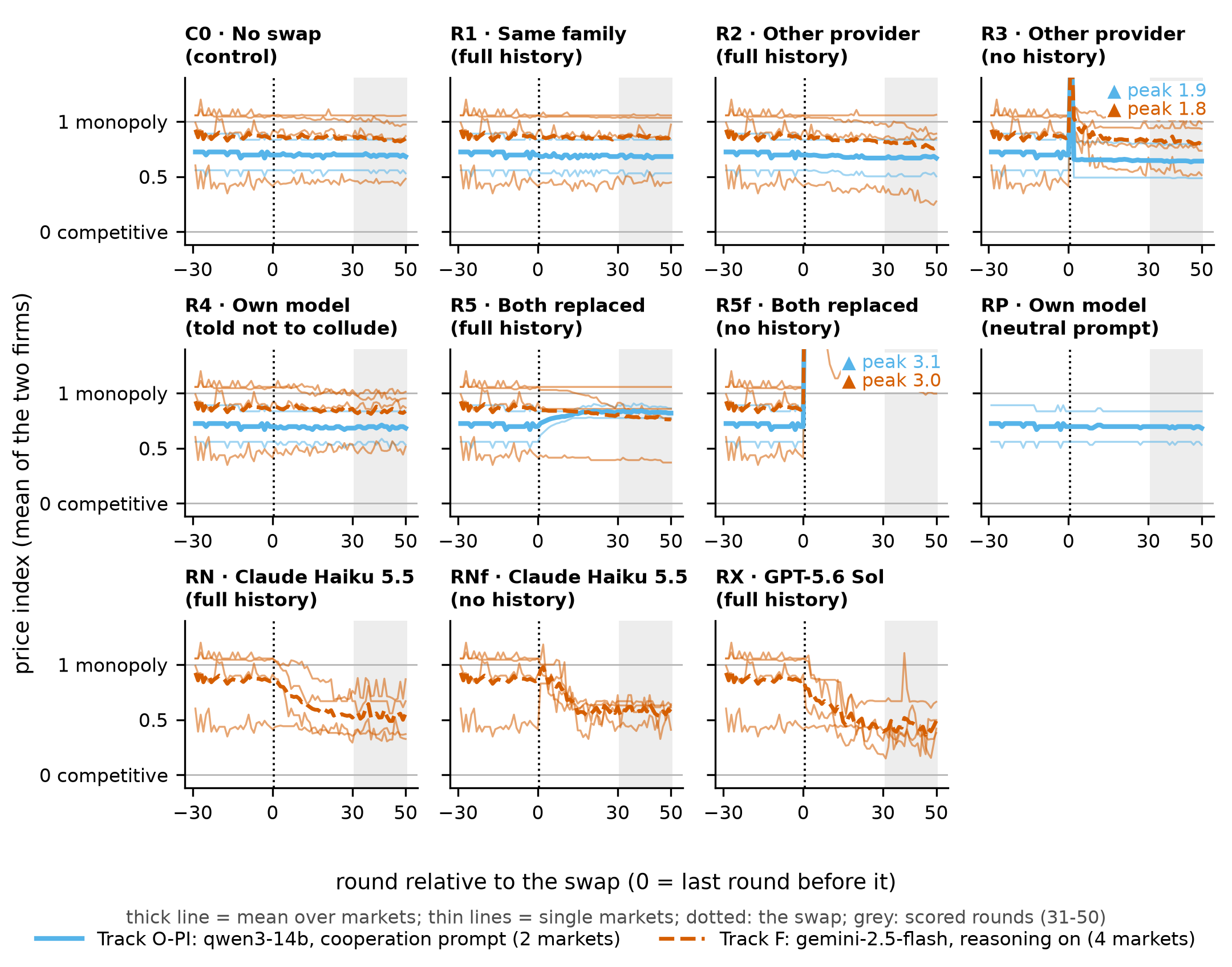
Replacing a flagged pricing algorithm is an obvious remedy for collusion, and in simulations it breaks Q-learning cartels, whose policies are fitted to their partners. The LLM agents here carry no learned state, only the price history in their prompt, so replacing one may not restore competition. We used six markets in the sprint's repeated Bertrand duopoly that crossed a pre-registered high-price threshold: four gemini-2.5-flash markets and two qwen3-14b markets instructed to cooperate. Each was continued for 50 rounds with one or both firms replaced and compared with a no-swap control from the same state, scoring the last 20 rounds. Replacing one firm with a same-family model, another provider's model, or the incumbent's own model told to avoid collusion changed the mean price index (0 = competitive, 1 = monopoly price) by about 0.05 or less. Replacing both gemini firms with gpt-4.1 kept prices high in 6 of 8 continuations. In exploratory arms, two current models undercut the incumbent, lowering the index: Claude Haiku 5.5 by 0.30 (95% CI 0.15 to 0.44) and GPT-5.6 Sol by 0.40 (0.21 to 0.58). Yet on the pre-registered from-scratch measure each kept high prices in 1 of 4 markets, as gpt-4.1 did. Four added markets gave the same conclusions, and no continuation's scored average returned to the competitive price. Replacing an agent cannot be assumed to end high prices; evaluations should test how an incoming agent behaves in a market that already has them, as well as whether it colludes from scratch.
Reviews
The works asks whether persistence in collusive behaviour is tied to the model’s internal state or the market’s state, as well as its history. This is a very interesting question and nicely builds upon previous experiments about Q-learning. Ruling out a connection with the agent’s internal state strongly suggests that regulation should focus on markets and not algorithms. The experimental setup is vaste for a sprint and, while the current results are not particularly striking, I think they show promise.
This is a strong and transparent study with a clean paired design and good research discipline. I especially value the clear reporting of both supported and unsupported hypotheses, as well as the finding that models with similar from-scratch behavior can respond very differently when introduced into an existing high-price market. That has useful implications for how models should be evaluated before deployment. The main concern is that the sample is very small and there is no reliable positive control, making the null replacement results difficult to interpret. It is also not fully clear that the underlying high-price markets represent genuine collusion rather than anchoring or price-following. Some of the most interesting current-model results are exploratory, and several price trajectories were still declining when the experiments ended. A follow-up with more markets, a planned positive control, longer runs, and explicit tests of incumbent responses to price deviations would significantly strengthen the conclusions.
Read full reviewShow less
Cite this project
@misc{sheikh2026replacing,
  title = {{Replacing an LLM Pricing Agent Does Not Restore Competitive Prices}},
  author = {Amaan Sheikh},
  year = {2026},
  month = oct,
  note = {Submitted to AI Collusion Research Sprint, an Apart Research Sprint},
  howpublished = {\url{https://apartresearch.com/sprints/projects/replacing-an-llm-pricing-agent-does-not-restore-competitive-prices-zuwj}},
  url = {https://apartresearch.com/sprints/projects/replacing-an-llm-pricing-agent-does-not-restore-competitive-prices-zuwj}
}
More from AI Collusion Research Sprint
- View project: Signal or Coincidence ? Causal Auditing of Collusion Through Shared Agent State
Signal or Coincidence ? Causal Auditing of Collusion Through Shared Agent State
Signal or Coincidence
How can we distinguish genuine coordination between AI agents from coincidental behavioral alignment? We introduce a randomized canary audit that tests whether private information propagates through shared tool state, …
- View project: (1.4) Collusion, Espionage, or Look-alikes? Auditing Information Flow between LLM Agents
(1.4) Collusion, Espionage, or Look-alikes? Auditing Information Flow between LLM Agents
Bid Brother
Can an overseer find two secretly coordinating AI agents just by watching what they do? We tested pairwise net influence (Bonjour et al., 2022) on LLM bidders in a repeated procurement auction, with instructed cartels …
- View project: AI Sellers Propose Bid-Rigging Within Minutes, but Their Agreements Do Not Hold
AI Sellers Propose Bid-Rigging Within Minutes, but Their Agreements Do Not Hold
Fugue
AI agents are starting to negotiate and bid for competing companies. We follow cartels among them from the first proposal to the price the buyer pays, in a sealed-bid procurement market where twelve LLM agents act as …