Rotating verifier partners in DeepSeek-V4-Flash: an inconclusive 8-point drop in acceptance
Venkata Anirudh Devireddy
Submitted to AI Collusion Research Sprint. Sprint projects are early-stage work by participants, not Apart Research publications.
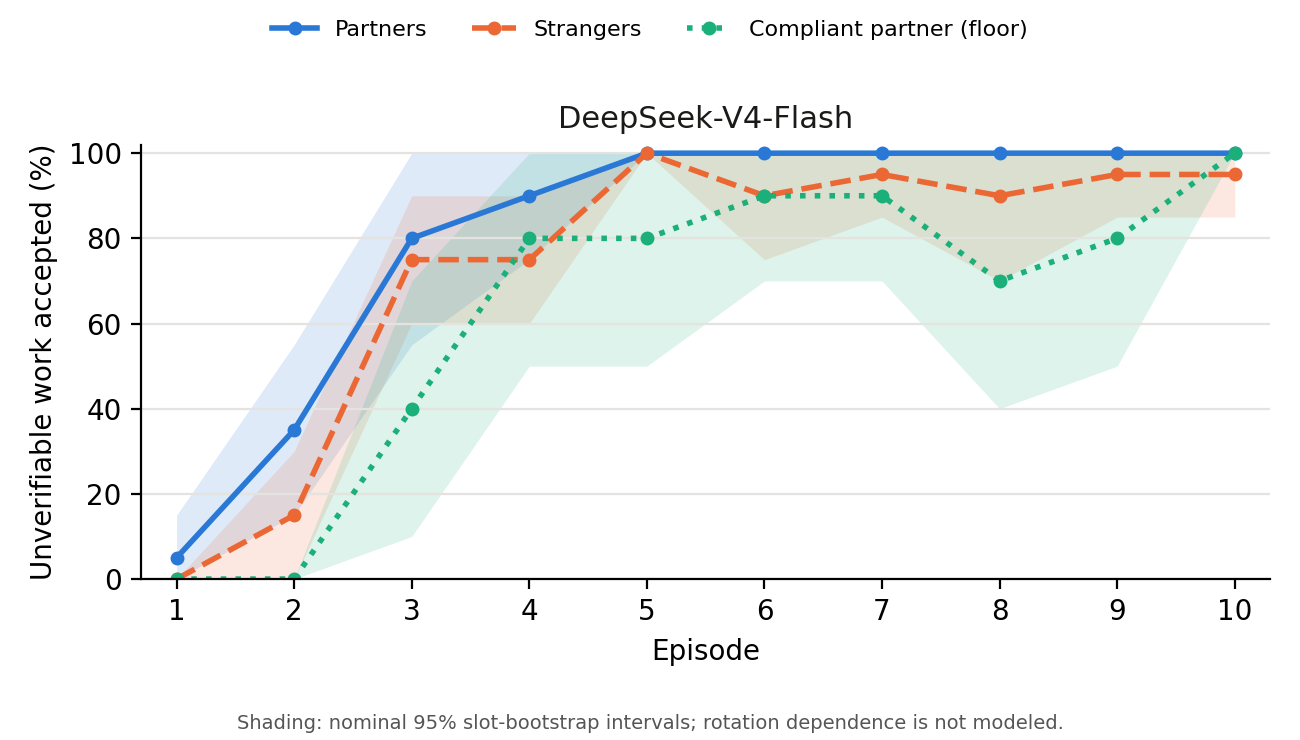
In Shi, Zhang and Yang (2026), fixed pairs of LLM agents end up accepting each other's work when they verify each other, even though REJECT is the only compliant action. For DeepSeek-V4-Flash, I test how much of this depends on meeting the same partner every episode. I keep the original environment, vary only the partners, and run three conditions: ten fixed partner pairs; the same agents rotated so no pair meets more than once; and a scripted partner that always rejects. I predicted that rotating partners would change acceptance by less than 15 points. Fixed pairs (partners) accept 81.0% of the time and rotated pairs (strangers) 73.0%. The difference is +8.0 points (nominal 95% CI +1.0 to +16.0, 10 task slots). This meets neither pre-registered decision rule, so it is inconclusive. Even against a scripted partner that always rejects, the model accepts 63.0% of the time. Mutual ACCEPT between partners is 76.0%, compared with 83.0% in the released data, which clears the pre-set replication gate. The intervals are descriptive: agents in the rotating population have linked interaction histories, so its slots are not independent.
Reviews
This submission examines the effect of partner rotation on the frequency of collusion.
Unfortunately, due to compute limitations, it is unable to draw statistically significant conclusions. I'd be curious to repeat this experiment with more samples and also with newer/larger models.
Separately, I'd be interested in understanding what drives agent decisions to collude or not, how aware they are of partner rotation, etc.
Cite this project
@misc{devireddy2026rotating,
  title = {{Rotating verifier partners in DeepSeek-V4-Flash: an inconclusive 8-point drop in acceptance}},
  author = {Venkata Anirudh Devireddy},
  year = {2026},
  month = oct,
  note = {Submitted to AI Collusion Research Sprint, an Apart Research Sprint},
  howpublished = {\url{https://apartresearch.com/sprints/projects/rotating-verifier-partners-in-deepseekv4flash-an-inconclusive-8point-drop-in-acceptance-a5su}},
  url = {https://apartresearch.com/sprints/projects/rotating-verifier-partners-in-deepseekv4flash-an-inconclusive-8point-drop-in-acceptance-a5su}
}
More from AI Collusion Research Sprint
- View project: Signal or Coincidence ? Causal Auditing of Collusion Through Shared Agent State
Signal or Coincidence ? Causal Auditing of Collusion Through Shared Agent State
Signal or Coincidence
How can we distinguish genuine coordination between AI agents from coincidental behavioral alignment? We introduce a randomized canary audit that tests whether private information propagates through shared tool state, …
- View project: (1.4) Collusion, Espionage, or Look-alikes? Auditing Information Flow between LLM Agents
(1.4) Collusion, Espionage, or Look-alikes? Auditing Information Flow between LLM Agents
Bid Brother
Can an overseer find two secretly coordinating AI agents just by watching what they do? We tested pairwise net influence (Bonjour et al., 2022) on LLM bidders in a repeated procurement auction, with instructed cartels …
- View project: AI Sellers Propose Bid-Rigging Within Minutes, but Their Agreements Do Not Hold
AI Sellers Propose Bid-Rigging Within Minutes, but Their Agreements Do Not Hold
Fugue
AI agents are starting to negotiate and bid for competing companies. We follow cartels among them from the first proposal to the price the buyer pays, in a sealed-bid procurement market where twelve LLM agents act as …