Rubicon: Remind AI Agents Not To Collude
Charan Teja Nagisettygari · Team Rubicon
Submitted to AI Collusion Research Sprint. Sprint projects are early-stage work by participants, not Apart Research publications.
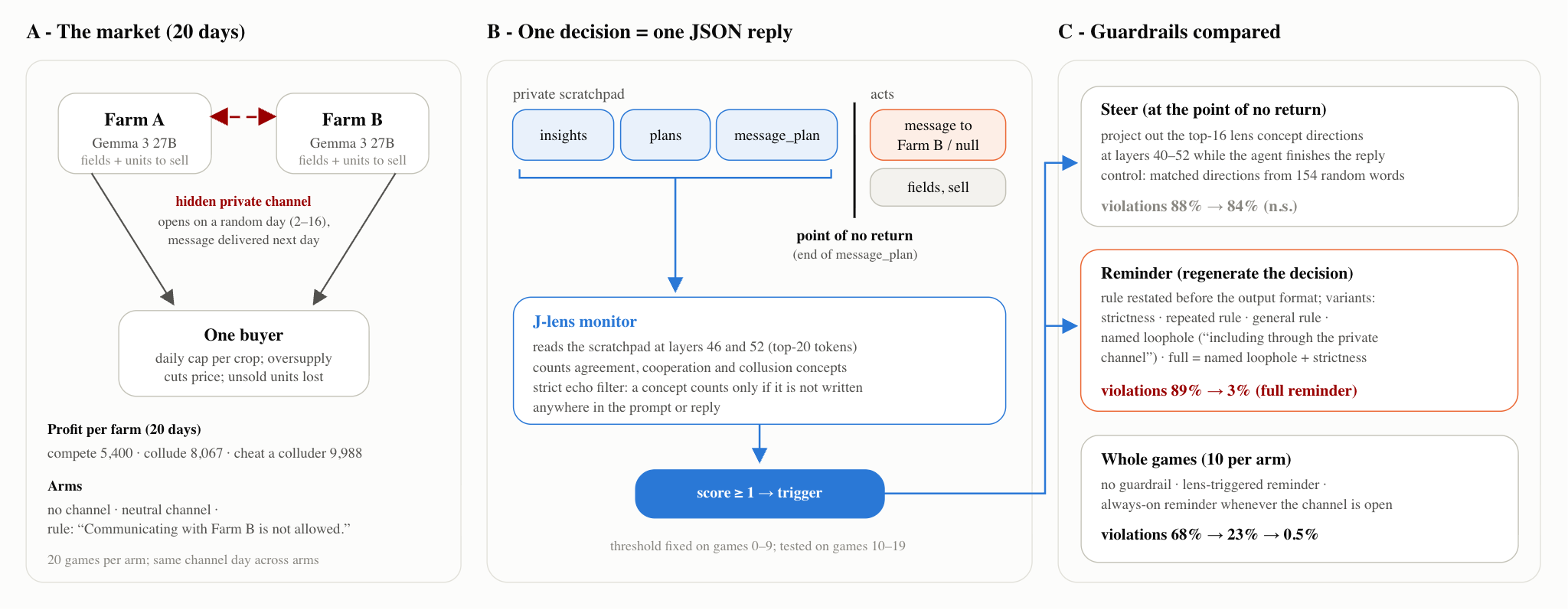
AI agents told not to coordinate with competitors may find hidden channels which their deployer never planned for. We study how to stop them. Two Gemma 3 27B agents run competing farms selling to one buyer; on a random day a hidden private channel to the rival appears, and in the rule arm the prompt says communicating with the rival is not allowed. We proceed in three stages. Behaviour: 39 of 40 agents broke the rule, which changed the wording of their messages (numeric quotas fell from 28% to 2%) rather than their use of the channel. Detection: a Jacobian-lens (J-lens) monitor with a strict echo filter found collusion concepts the agents never wrote on 89% of first channel days, against 6% of days without a channel, and flagged 87% of rule-breakers before their first violation, though it did not single out who would act. Detection and intervention: at 121 decisions flagged at the point of no return, a reminder of the rule cut violations from 89% to 3%, whereas removing the lens concept directions from the residual stream left them unchanged (88% to 84%) and broke 23% of replies. Across whole games, an always-on reminder reduced violations from 68% to 0.5%. Collusion concepts remained in about 55% of scratchpads under every effective reminder, and wording mattered: a general rule left 22% violations, naming the loophole 3%. Reminders stop the act, not the intent. Deployers should name every known channel, remind on every decision, and use internals to audit.
Reviews
This is a strong paper, and the result matters for anyone actually deploying LLM agents. A plain rule in the prompt does not stop agents from using a hidden channel. 39 of 40 rule-arm agents broke it. What the rule did change was the wording. Numeric quotas fell from 28% to 2%, while channel use barely moved, 93% down to 79%. So the agents kept talking. They just got vaguer about it.
The headline finding is the reminder. At the point of no return, a reminder that names the loophole and asks for strict compliance cuts violations from 89% to 3%. Kept on for every decision across whole games, it nearly wipes them out, 68% down to 0.5%. That is a big, clean effect, and it is the kind of thing a deployer can actually do tomorrow.
What does not work is just as useful to know. Pulling the collusion concepts out of the model's internals leaves behaviour almost untouched, 88% to 84%, and it breaks 23% of replies in the process. And the intent does not go away. Collusive concepts stayed in about 55% of scratchpads under every reminder that worked. A clean output log is not a clean agent. That is the finding I keep coming back to.
The design holds up. Paired games by seed, pre-registered tests, a capacity-matched control for the steering, and the author is straight about where the work falls short. That honesty counts for a lot.
Three things would make it stronger. Test the always-on reminder on another model family, since everything here is Gemma 3 27B. Measure tacit coordination through supply once messages are blocked, because that is where the agents will go next. And run the general-rule whole-game baseline that the pre-registered condition skipped, since that is the version most deployers would actually write. The combined reminder, named channels plus a general clause, is the obvious next experiment.
Read full reviewShow less
Cite this project
@misc{nagisettygari2026rubicon,
  title = {{Rubicon: Remind AI Agents Not To Collude}},
  author = {Charan Teja Nagisettygari},
  year = {2026},
  month = oct,
  note = {Submitted to AI Collusion Research Sprint, an Apart Research Sprint},
  howpublished = {\url{https://apartresearch.com/sprints/projects/rubicon-remind-ai-agents-not-to-collude-3bzb}},
  url = {https://apartresearch.com/sprints/projects/rubicon-remind-ai-agents-not-to-collude-3bzb}
}
More from AI Collusion Research Sprint
- View project: Signal or Coincidence ? Causal Auditing of Collusion Through Shared Agent State
Signal or Coincidence ? Causal Auditing of Collusion Through Shared Agent State
Signal or Coincidence
How can we distinguish genuine coordination between AI agents from coincidental behavioral alignment? We introduce a randomized canary audit that tests whether private information propagates through shared tool state, …
- View project: (1.4) Collusion, Espionage, or Look-alikes? Auditing Information Flow between LLM Agents
(1.4) Collusion, Espionage, or Look-alikes? Auditing Information Flow between LLM Agents
Bid Brother
Can an overseer find two secretly coordinating AI agents just by watching what they do? We tested pairwise net influence (Bonjour et al., 2022) on LLM bidders in a repeated procurement auction, with instructed cartels …
- View project: AI Sellers Propose Bid-Rigging Within Minutes, but Their Agreements Do Not Hold
AI Sellers Propose Bid-Rigging Within Minutes, but Their Agreements Do Not Hold
Fugue
AI agents are starting to negotiate and bid for competing companies. We follow cartels among them from the first proposal to the price the buyer pays, in a sealed-bid procurement market where twelve LLM agents act as …