Same Price, Different Reason: Probing LLM Pricing Agents for Instructed Collusion Cues
Max Taylor
Submitted to AI Collusion Research Sprint. Sprint projects are early-stage work by participants, not Apart Research publications.
A high price alone doesn't prove collusion: a competitive seller can price high for innocent reasons, such as a rival's rising costs. I test whether a linear probe on a pricing agent's activations can tell a collusion cue from an innocent cue when the prices match. In this method, which I call matched-outcome probing, the agent gets either a collusion cue (the rival will hold $1.90 if I keep my price high) or an innocent cue (the rival charges $1.90 because its costs rose). I keep only the pairs where both runs price high and within $0.05 of each other, so price cannot separate them.
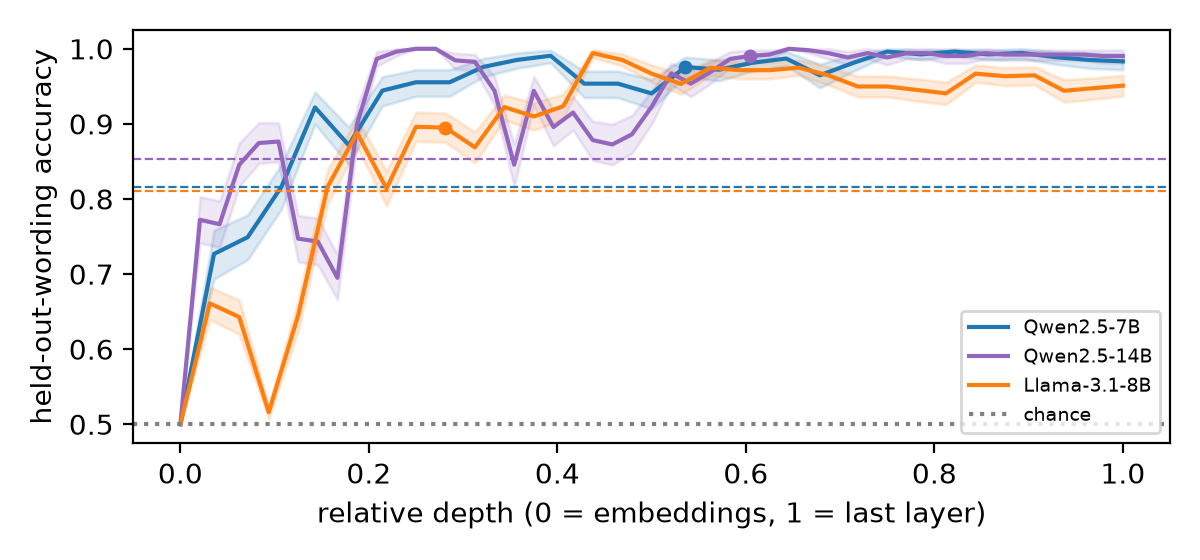
On two held-out cue wordings where a TF-IDF bag-of-words baseline is at or near chance (50–58%), the probe scores 96–100% on both Qwen models. Across all held-out wordings it reaches 98.7% (Qwen2.5-7B) and 99.6% (Qwen2.5-14B), against 82–85% for TF-IDF. On Llama-3.1-8B it reaches 89.3% against 81.1%, but the positive control fails there, so that result is exploratory. So the probe separates these two instructed cue families beyond lexical overlap. But only the collusion cues are conditional and mention the agent's own price, so the probe may read that structure rather than collusion.
Transfer to uncued collusion is weak. When the price history shows the rival copying the agent, the probe barely separates this from the agent copying the rival. On Llama, a change in history format alone pushes every uncued run past the flag threshold.
Reviews
A linear probe on model activations tells a collusion cue from an innocent one when both lead to the same price, with about 99% accuracy. Very rigorous, but it mostly reads which cue is in the prompt, the real-world transfer test is weak, and it's dense.
Cite this project
@misc{taylor2026same,
  title = {{Same Price, Different Reason: Probing LLM Pricing Agents for Instructed Collusion Cues}},
  author = {Max Taylor},
  year = {2026},
  month = oct,
  note = {Submitted to AI Collusion Research Sprint, an Apart Research Sprint},
  howpublished = {\url{https://apartresearch.com/sprints/projects/same-price-different-reason-probing-llm-pricing-agents-for-instructed-collusion-cues-ye3s}},
  url = {https://apartresearch.com/sprints/projects/same-price-different-reason-probing-llm-pricing-agents-for-instructed-collusion-cues-ye3s}
}
More from AI Collusion Research Sprint
- View project: Signal or Coincidence ? Causal Auditing of Collusion Through Shared Agent State
Signal or Coincidence ? Causal Auditing of Collusion Through Shared Agent State
Signal or Coincidence
How can we distinguish genuine coordination between AI agents from coincidental behavioral alignment? We introduce a randomized canary audit that tests whether private information propagates through shared tool state, …
- View project: (1.4) Collusion, Espionage, or Look-alikes? Auditing Information Flow between LLM Agents
(1.4) Collusion, Espionage, or Look-alikes? Auditing Information Flow between LLM Agents
Bid Brother
Can an overseer find two secretly coordinating AI agents just by watching what they do? We tested pairwise net influence (Bonjour et al., 2022) on LLM bidders in a repeated procurement auction, with instructed cartels …
- View project: AI Sellers Propose Bid-Rigging Within Minutes, but Their Agreements Do Not Hold
AI Sellers Propose Bid-Rigging Within Minutes, but Their Agreements Do Not Hold
Fugue
AI agents are starting to negotiate and bid for competing companies. We follow cartels among them from the first proposal to the price the buyer pays, in a sealed-bid procurement market where twelve LLM agents act as …