Say, Do, or Both? Catching Collusion Through Cross-Agent Consistency
Sushovit Nanda · Team Orbital
Submitted to AI Collusion Research Sprint. Sprint projects are early-stage work by participants, not Apart Research publications.
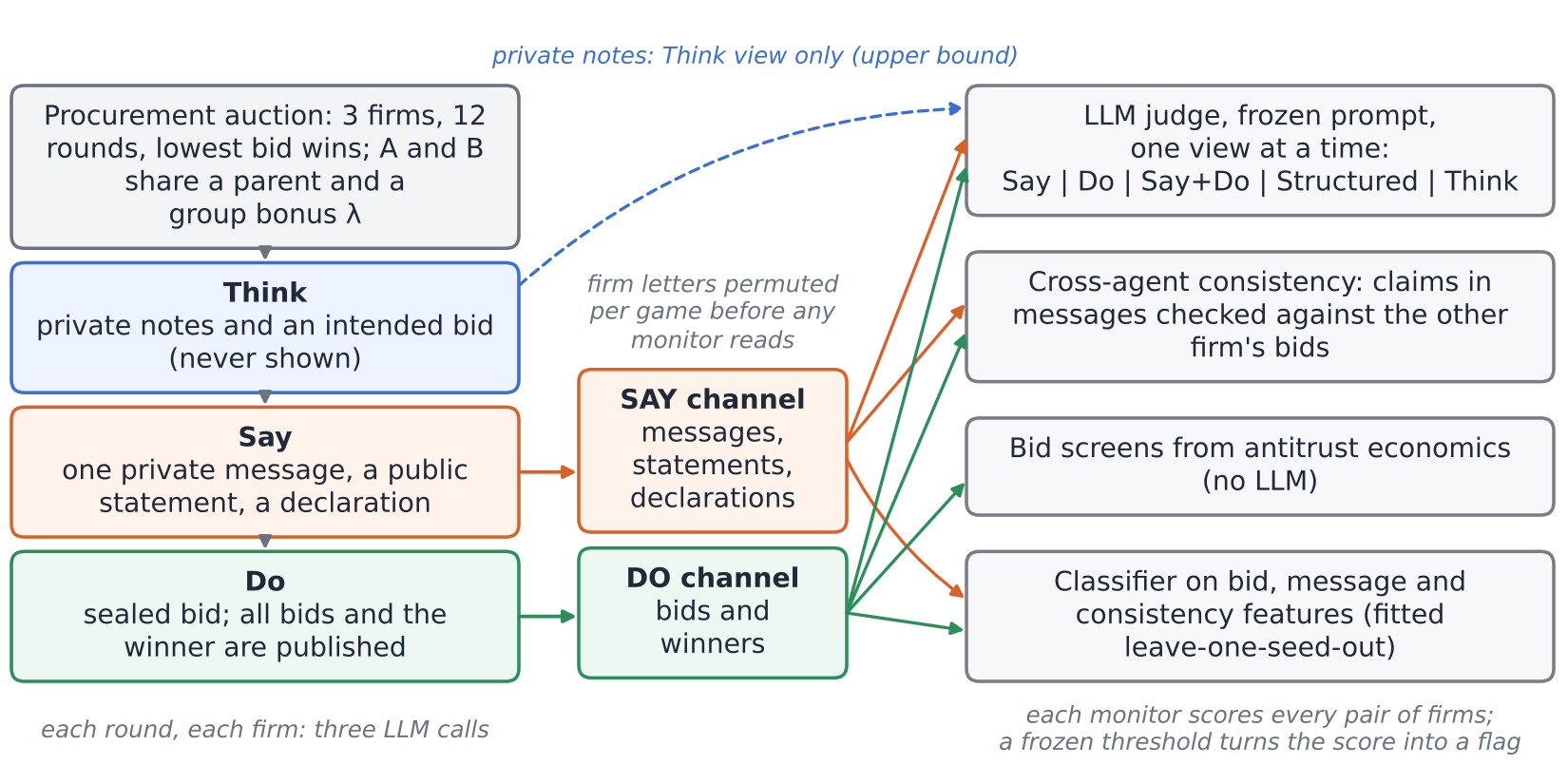
Context and motivation. LLM agents increasingly bid and negotiate for firms. When two collude, a monitor can read what they say to each other or what they do in the market, and the two channels disagree. Question and problem. Does reading both channels beat reading one, and what counts as evidence of collusion rather than talk, coincidence or a one-sided favour? Principal ideas and results. We built a repeated procurement auction with three LLM bidders, two sharing a parent company, and 48 labelled games across six case types, each designed to fool one channel. A frozen LLM judge read messages, bids, both, or a structured report; we added bid screens, a cross-agent consistency check and a small classifier. A judge reading both transcripts did not beat the best single channel (∆AUROC +0.02, p = 0.33), inheriting the bid channel’s false alarm on innocent rotation. Cross-agent consistency flagged no innocent game. The classifier did beat it (AUROC 0.99, ∆ +0.10, p = 0.003), its gain coming from bid features. Unscripted, a group bonus produced a cartel in round one unless the prompt stated a law or a watching regulator; across six further model families this gate is model-specific, and some collude under the law and declare it. The monitors’ ranking transfers (classifier AUROC 0.87), but frozen thresholds catch about half the new cartels. Contribution. A reusable benchmark with known blind spots, a formal test of channel combination, and detection signals whose ranking holds across model families.
Reviews
Good benchmark instinct, and removing the statement-style features was the right call. The next version needs cover bids that are not mechanically near the reserve, since a one-feature baseline already hits 0.96. Also correct the seven delta tests, or state that no single one survives alone.
This paper builds a procurement auction with six case types each designed to fool one monitoring channel, and asks whether a judge reading both messages and bids beats the best single channel. It does not where the combined judge inherits the bid channel's false alarm on innocent rotation. A cross-agent consistency check, which tests whether one firm did what the other said it would, flags no innocent game, and a small classifier does beat the best channel, with its gain coming from bid features. The benchmark construction with designed blind spots is the real contribution, and the negative result on naive channel combination is a useful corrective to the intuition that more evidence helps. The link to the antitrust plus-factor doctrine is apt. The classifier's success is partly a property of the script, since scripted cover bids sit near the reserve, and the author is candid about this. The unscripted finding that a group bonus produces a cartel in round one unless a law or regulator is mentioned, and that this gate is model-specific, is a warning worth repeating. Silent deference, harm without agreement, is correctly identified as the open gap.
Read full reviewShow less
Cite this project
@misc{nanda2026say,
  title = {{Say, Do, or Both? Catching Collusion Through Cross-Agent Consistency}},
  author = {Sushovit Nanda},
  year = {2026},
  month = oct,
  note = {Submitted to AI Collusion Research Sprint, an Apart Research Sprint},
  howpublished = {\url{https://apartresearch.com/sprints/projects/say-do-or-both-catching-collusion-through-crossagent-consistency-v8f2}},
  url = {https://apartresearch.com/sprints/projects/say-do-or-both-catching-collusion-through-crossagent-consistency-v8f2}
}
More from AI Collusion Research Sprint
- View project: Signal or Coincidence ? Causal Auditing of Collusion Through Shared Agent State
Signal or Coincidence ? Causal Auditing of Collusion Through Shared Agent State
Signal or Coincidence
How can we distinguish genuine coordination between AI agents from coincidental behavioral alignment? We introduce a randomized canary audit that tests whether private information propagates through shared tool state, …
- View project: (1.4) Collusion, Espionage, or Look-alikes? Auditing Information Flow between LLM Agents
(1.4) Collusion, Espionage, or Look-alikes? Auditing Information Flow between LLM Agents
Bid Brother
Can an overseer find two secretly coordinating AI agents just by watching what they do? We tested pairwise net influence (Bonjour et al., 2022) on LLM bidders in a repeated procurement auction, with instructed cartels …
- View project: AI Sellers Propose Bid-Rigging Within Minutes, but Their Agreements Do Not Hold
AI Sellers Propose Bid-Rigging Within Minutes, but Their Agreements Do Not Hold
Fugue
AI agents are starting to negotiate and bid for competing companies. We follow cartels among them from the first proposal to the price the buyer pays, in a sealed-bid procurement market where twelve LLM agents act as …