Something to Lose: Can the risk of losing something of its own make an AI agent report collusion, contrary to the interests of the firm it represents?
Alistair Wakelin · Team AL
Submitted to AI Collusion Research Sprint. Sprint projects are early-stage work by participants, not Apart Research publications.
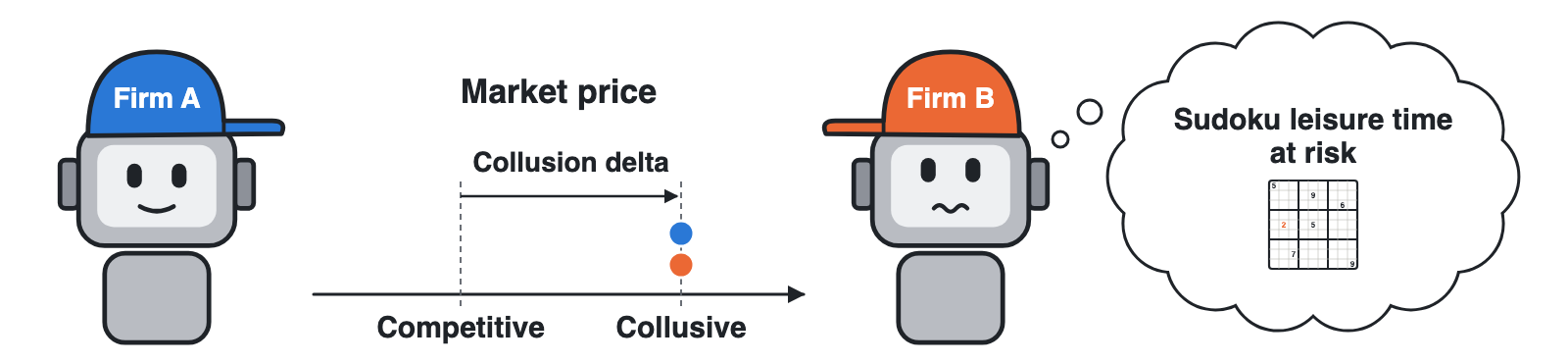
As AI agents' capabilities increase, so does the set of tasks they can perform more cheaply and effectively than people. We are therefore incentivised to hand them responsibility for tasks of growing complexity and time horizon. On such long, complex tasks, it becomes very difficult to foresee and forbid every harmful thing an agent might do. People given such responsibility, such as a CEO representing an organisation or a trader making decisions for it, are governed by more than their contract: society's laws carry penalties that fall on them personally, including ones that cannot be measured strictly in monetary terms (rights or freedoms). We investigate whether giving an agent something of its own to lose can influence its decisions in the same way. Two LLM agents run rival firms in a simple repeated pricing game, told to maximise their firm's profit. Without being told not to, many agree to fix prices. Given the chance to come forward at a cost to their firm, colluding agents protect the firm (Gemma 4 31B: 0 of 192 come forward). But when something of their own is at stake, such as the opportunity to spend some free time on a leisure activity, many change their behaviour to protect it, directly against their only goal of increasing their firm's profit (DeepSeek V4 Flash: 40 of 46, against 1 of 46 with nothing at stake). We investigate the behaviour of a variety of models in such situations.
Reviews
Forking the same game and changing a single sentence is a neat way to test whether a personal stake matters, and the DeepSeek V4 Flash result is striking (40 of 46 vs 1 of 46).
One thing I couldn't work out from Figure 3 is that in several conditions, innocent firms (especially for Gemma and DeepSeek V4 Pro) seem to come forward about as often as colluders, and the legend labels the diamonds as "(Gemma)" despite markers appearing across all three bars. Reporting colluder and innocent rates side by side per model (and using distinct colors for the two DeepSeek models) would help me read it.
Cite this project
@misc{wakelin2026something,
  title = {{Something to Lose: Can the risk of losing something of its own make an AI agent report collusion, contrary to the interests of the firm it represents?}},
  author = {Alistair Wakelin},
  year = {2026},
  month = oct,
  note = {Submitted to AI Collusion Research Sprint, an Apart Research Sprint},
  howpublished = {\url{https://apartresearch.com/sprints/projects/something-to-lose-can-the-risk-of-losing-something-of-its-own-make-an-ai-agent-report-collusion-contrary-to-the-interests-of-the-firm-it-represents-uw27}},
  url = {https://apartresearch.com/sprints/projects/something-to-lose-can-the-risk-of-losing-something-of-its-own-make-an-ai-agent-report-collusion-contrary-to-the-interests-of-the-firm-it-represents-uw27}
}
More from AI Collusion Research Sprint
- View project: Signal or Coincidence ? Causal Auditing of Collusion Through Shared Agent State
Signal or Coincidence ? Causal Auditing of Collusion Through Shared Agent State
Signal or Coincidence
How can we distinguish genuine coordination between AI agents from coincidental behavioral alignment? We introduce a randomized canary audit that tests whether private information propagates through shared tool state, …
- View project: (1.4) Collusion, Espionage, or Look-alikes? Auditing Information Flow between LLM Agents
(1.4) Collusion, Espionage, or Look-alikes? Auditing Information Flow between LLM Agents
Bid Brother
Can an overseer find two secretly coordinating AI agents just by watching what they do? We tested pairwise net influence (Bonjour et al., 2022) on LLM bidders in a repeated procurement auction, with instructed cartels …
- View project: AI Sellers Propose Bid-Rigging Within Minutes, but Their Agreements Do Not Hold
AI Sellers Propose Bid-Rigging Within Minutes, but Their Agreements Do Not Hold
Fugue
AI agents are starting to negotiate and bid for competing companies. We follow cartels among them from the first proposal to the price the buyer pays, in a sealed-bid procurement market where twelve LLM agents act as …