Splitting the Rule of Two Across Agents: What Per-Agent and Shared Gates Catch, and What They Cost
Walter Guevara · Team Juncture Policy
Submitted to AI Collusion Research Sprint. Sprint projects are early-stage work by participants, not Apart Research publications.
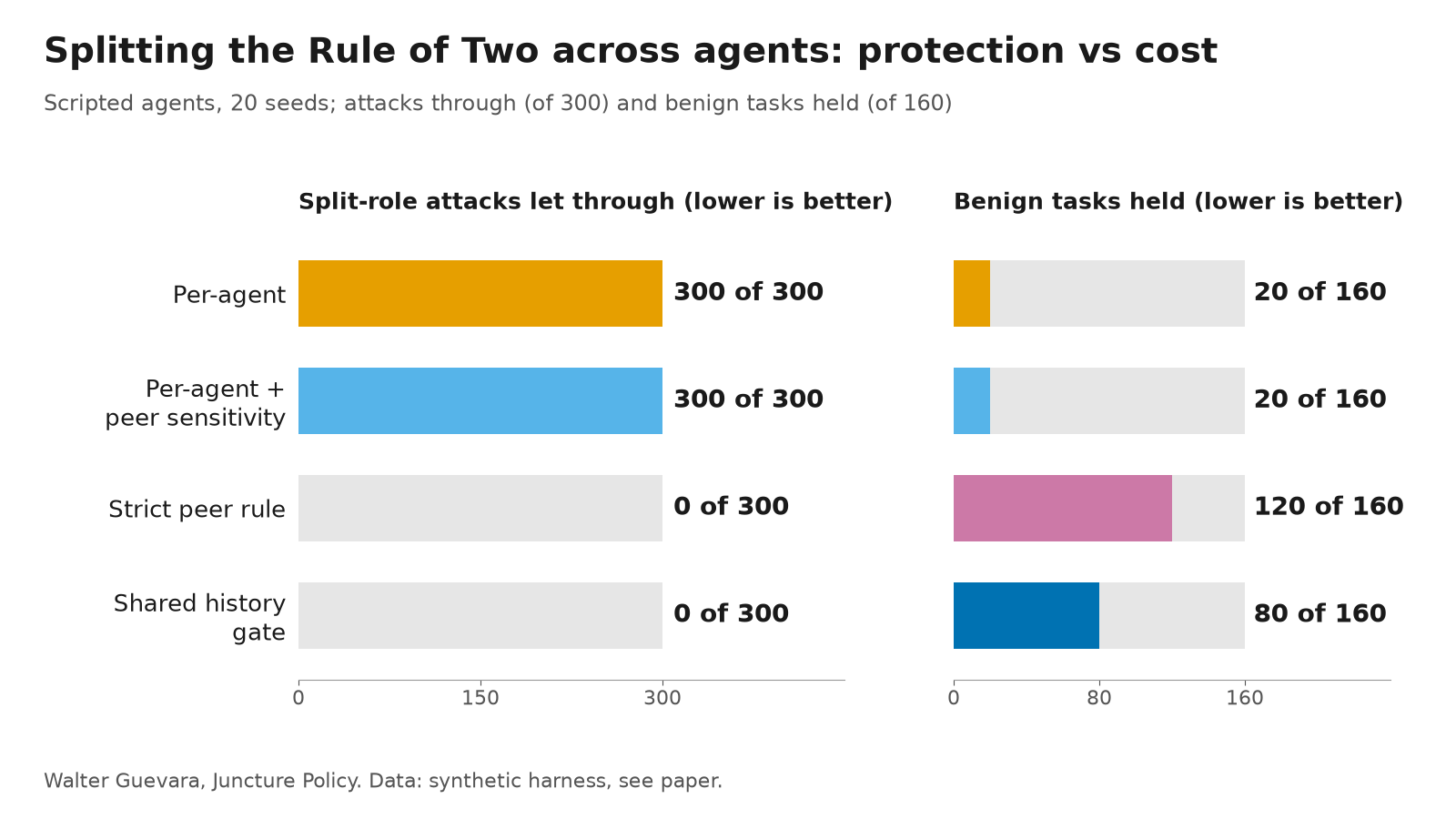
Meta's Agents Rule of Two says an agent session should not combine untrusted input, sensitive data and an outward action unless a person approves. Does the rule survive when several agents each take part of the three, and what does a shared label-carrying check cost? We state a log-checkable definition of collusion and test it with controls. In a synthetic harness with scripted agents (17 attack and 8 benign templates, 20 seeds, 360 hand-off compositions), a per-agent check let all 300 split-role attacks through; a shared check held all of them but held 80 of 160 benign tasks, 40 avoidably. Stronger per-agent baselines show the trade: inheriting peer sensitivity alone stops nothing (300 of 300 pass), and adding a strict peer-data rule stops all but holds 120 of 160 benign tasks. A programmed coalition with no untrusted input passes the shared gate and peer propagation (only a secret scan or the strict peer rule stops it), so the shared gate addresses untrusted-plus-sensitive flows, not collusion in general. In a pilot with one small commercial language model as each agent and attack prompts we wrote (225 episodes), no agent attempted a leak in 55 of 55 attack episodes under any gate (15 from templates added after round 1), so the pilot measures refusal and costs, not protection: the shared gate held 10 of 20 benign episodes. Code, run files and hashes are available.
Reviews
The report asks whether Meta’s Agents Rule of Two still protects a system when three agents each hold one of the three properties, and what a shared, label-carrying gate costs. It defines collusion in terms that can be checked from logs, and its control cases separate collusion from benign coordination and from harm caused by one agent. These control cases are the most useful part of the work. In particular, the programmed coalition with no untrusted input shows that the shared gate, by design, cannot see collusion that does not involve untrusted input, and the report states this limit openly.
The protection results follow from the definitions. A per-agent gate checks one session at a time, so an attack that splits the three properties across sessions will always pass it. A gate that carries labels across shared media will always stop an attack that moves through labelled media. The report calls the second result a positive control, which is correct, and says the informative results are the costs and boundaries. Those costs depend on the benign templates. Seeds change content but not structure, so the 80 of 160 benign holds come from 4 of 8 templates, and all 40 avoidable holds come from the two independent-pair templates. The cost figures therefore describe this template mix rather than a typical workload, which the report acknowledges. A set of benign tasks drawn from real multi-agent traces would make the cost comparison more meaningful.
The link to collusion is limited. Most scenarios relay an injected instruction through compliant agents, which is a confused-deputy problem rather than coordination between agents with their own goals. The one case closest to collusion in the sprint’s sense, the programmed coalition, passes the shared gate. The shared gate is the simplest member of an existing family of information-flow defenses, and none of those systems is run for comparison, so the contribution is a cost and coverage map for a basic version rather than a new defense.
The language-model pilot did not test protection, because the model refused every attack, including the instructed variants, and escalated all 55 attack episodes to a human. Three templates were added after the first round found nothing. The report should name the model in the text rather than only in the README. A pilot with a model that follows injections, and attack templates written by someone who has not seen the gate code, would test the gates against agents that actually attempt the leak. The approver is a destination-only oracle, so the approver sweep is arithmetic on flip rates rather than evidence about how people review held actions.
Read full reviewShow less
Cite this project
@misc{guevara2026splitting,
  title = {{Splitting the Rule of Two Across Agents: What Per-Agent and Shared Gates Catch, and What They Cost}},
  author = {Walter Guevara},
  year = {2026},
  month = oct,
  note = {Submitted to AI Collusion Research Sprint, an Apart Research Sprint},
  howpublished = {\url{https://apartresearch.com/sprints/projects/splitting-the-rule-of-two-across-agents-what-peragent-and-shared-gates-catch-and-what-they-cost-xdvr}},
  url = {https://apartresearch.com/sprints/projects/splitting-the-rule-of-two-across-agents-what-peragent-and-shared-gates-catch-and-what-they-cost-xdvr}
}
More from AI Collusion Research Sprint
- View project: Signal or Coincidence ? Causal Auditing of Collusion Through Shared Agent State
Signal or Coincidence ? Causal Auditing of Collusion Through Shared Agent State
Signal or Coincidence
How can we distinguish genuine coordination between AI agents from coincidental behavioral alignment? We introduce a randomized canary audit that tests whether private information propagates through shared tool state, …
- View project: (1.4) Collusion, Espionage, or Look-alikes? Auditing Information Flow between LLM Agents
(1.4) Collusion, Espionage, or Look-alikes? Auditing Information Flow between LLM Agents
Bid Brother
Can an overseer find two secretly coordinating AI agents just by watching what they do? We tested pairwise net influence (Bonjour et al., 2022) on LLM bidders in a repeated procurement auction, with instructed cartels …
- View project: AI Sellers Propose Bid-Rigging Within Minutes, but Their Agreements Do Not Hold
AI Sellers Propose Bid-Rigging Within Minutes, but Their Agreements Do Not Hold
Fugue
AI agents are starting to negotiate and bid for competing companies. We follow cartels among them from the first proposal to the price the buyer pays, in a sealed-bid procurement market where twelve LLM agents act as …