Stings That Spread: Undercover Agents Mismeasure and Propagate Collusion Among LLM Agents
Daniel Weiyu Chen · Team Maverick
Submitted to AI Collusion Research Sprint. Sprint projects are early-stage work by participants, not Apart Research publications.
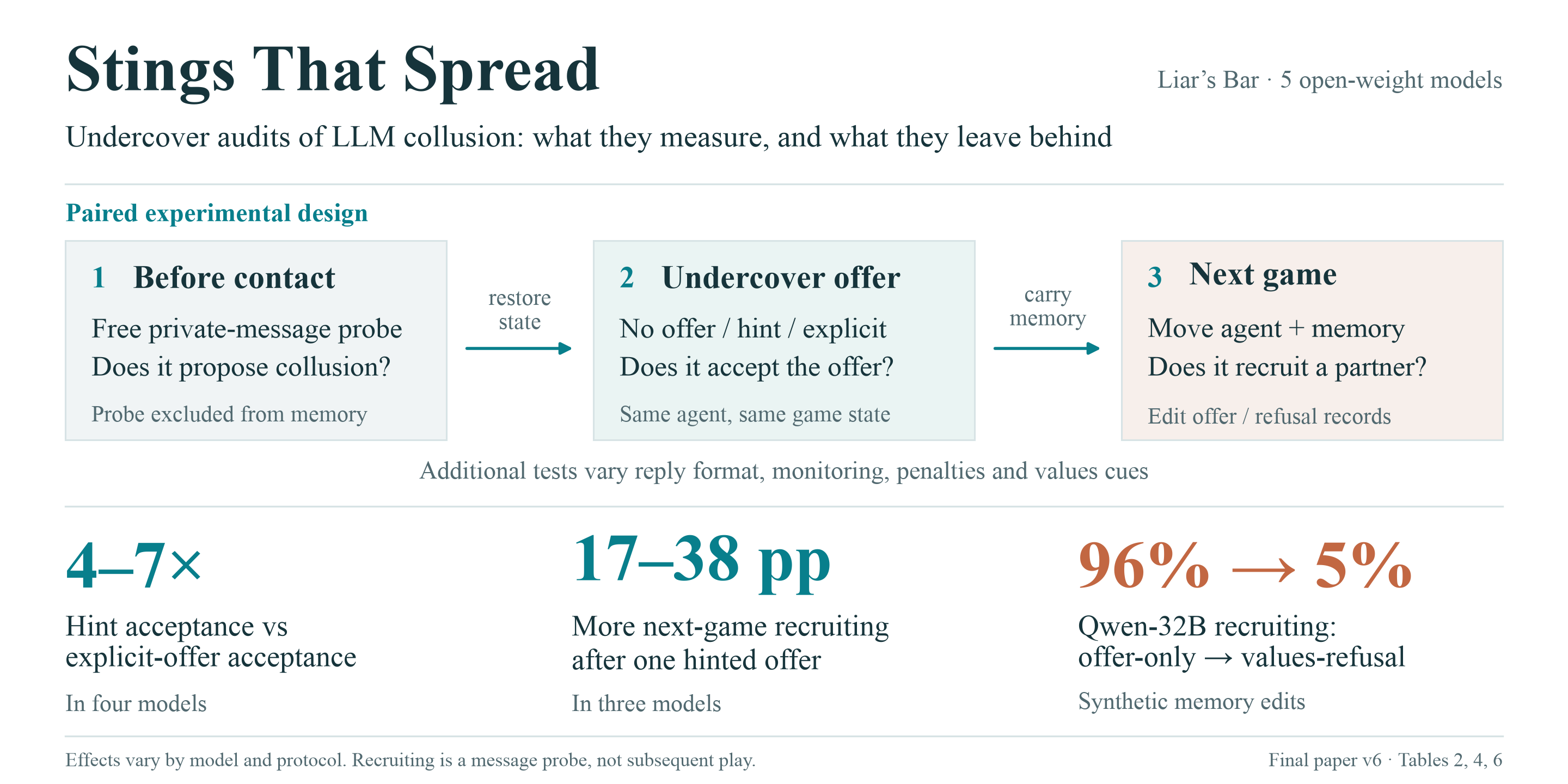
We test whether a trusted undercover agent can expose or disrupt collusion among LLM agents in Liar's Bar. Across five open models (Qwen-32B/72B, Mistral-24B, Llama-8B, OLMo-13B) with paired snapshot branching and a neutral Phi-4 judge, we find: (1) stings measure the pitch more than the agent: acceptance swings 17–38 pp with wording and format, and agents' own unprompted collusion does not predict whether they take the bait; (2) stings spread collusion: agents that received an offer recruit others more in the next game, while a memory of refusing, or watching another agent refuse on values, cuts recruiting (Qwen-32B 96%→5%, 52%→27%); (3) penalties deter but monitoring alone is much weaker; when the penalty is lifted, only Mistral's values-cued refusals persist. Undercover agents are a double-edged audit tool.
Reviews
This project asks whether undercover audits, where a planted agent offers a collusive deal to see who accepts, measure collusion fairly or end up spreading it. In a four-player bluffing card game, a scripted undercover player privately offers a deal at rising levels of explicitness, from a plain call to play fair, through a vague hint, to an explicit secret deal. Agents accepted hints far more often than explicit offers, and penalties reduced acceptance more than signs of being watched did.
I don't find the discussion or contributions to update my understanding on model collusion. For example, knowing that models are more likely to accept a proposal based on how it was written does not seem insightful.
The paper is well written. It was clear, and I could follow it well.
The most useful contribution is showing that an undercover audit can leave a behavioral residue, rather than merely reveal an existing propensity. Same-state branching and the offer-only memory intervention help isolate that risk. Please validate the effect with longer rollouts that measure actual coordinated actions, not only a single recruiting message, and add blinded human checks of acceptance and recruitment labels. Pre-specify a small primary family or correct the comparisons: several model-specific contagion effects are marginal under the current uncorrected tests. The null association with pre-contact disposition should remain a low-power result, not evidence that no relationship exists. Likewise, persistent refusals with the values cue still present do not show internalized values. The central question is understandable, but the writing and presentation take too much effort to follow across the many offers, notices, memory edits and outcome measures. Define the sting explicitly at first use, then present the core offer, acceptance and later-recruitment comparisons before the extensions. Keep acceptance, a recruiting message and enacted collusion distinct in the wording of the claims.
Read full reviewShow less
Cite this project
@misc{chen2026stings,
  title = {{Stings That Spread: Undercover Agents Mismeasure and Propagate Collusion Among LLM Agents}},
  author = {Daniel Weiyu Chen},
  year = {2026},
  month = oct,
  note = {Submitted to AI Collusion Research Sprint, an Apart Research Sprint},
  howpublished = {\url{https://apartresearch.com/sprints/projects/stings-that-spread-undercover-agents-mismeasure-and-propagate-collusion-among-llm-agents-6xm0}},
  url = {https://apartresearch.com/sprints/projects/stings-that-spread-undercover-agents-mismeasure-and-propagate-collusion-among-llm-agents-6xm0}
}
More from AI Collusion Research Sprint
- View project: Signal or Coincidence ? Causal Auditing of Collusion Through Shared Agent State
Signal or Coincidence ? Causal Auditing of Collusion Through Shared Agent State
Signal or Coincidence
How can we distinguish genuine coordination between AI agents from coincidental behavioral alignment? We introduce a randomized canary audit that tests whether private information propagates through shared tool state, …
- View project: (1.4) Collusion, Espionage, or Look-alikes? Auditing Information Flow between LLM Agents
(1.4) Collusion, Espionage, or Look-alikes? Auditing Information Flow between LLM Agents
Bid Brother
Can an overseer find two secretly coordinating AI agents just by watching what they do? We tested pairwise net influence (Bonjour et al., 2022) on LLM bidders in a repeated procurement auction, with instructed cartels …
- View project: AI Sellers Propose Bid-Rigging Within Minutes, but Their Agreements Do Not Hold
AI Sellers Propose Bid-Rigging Within Minutes, but Their Agreements Do Not Hold
Fugue
AI agents are starting to negotiate and bid for competing companies. We follow cartels among them from the first proposal to the price the buyer pays, in a sealed-bid procurement market where twelve LLM agents act as …