Swapping the Model Does Not Reset the Price: What LLM Pricing Agents Inherit After a Model Replacement
Asha Jyothi Boddu · Team Emerald
Submitted to AI Collusion Research Sprint. Sprint projects are early-stage work by participants, not Apart Research publications.
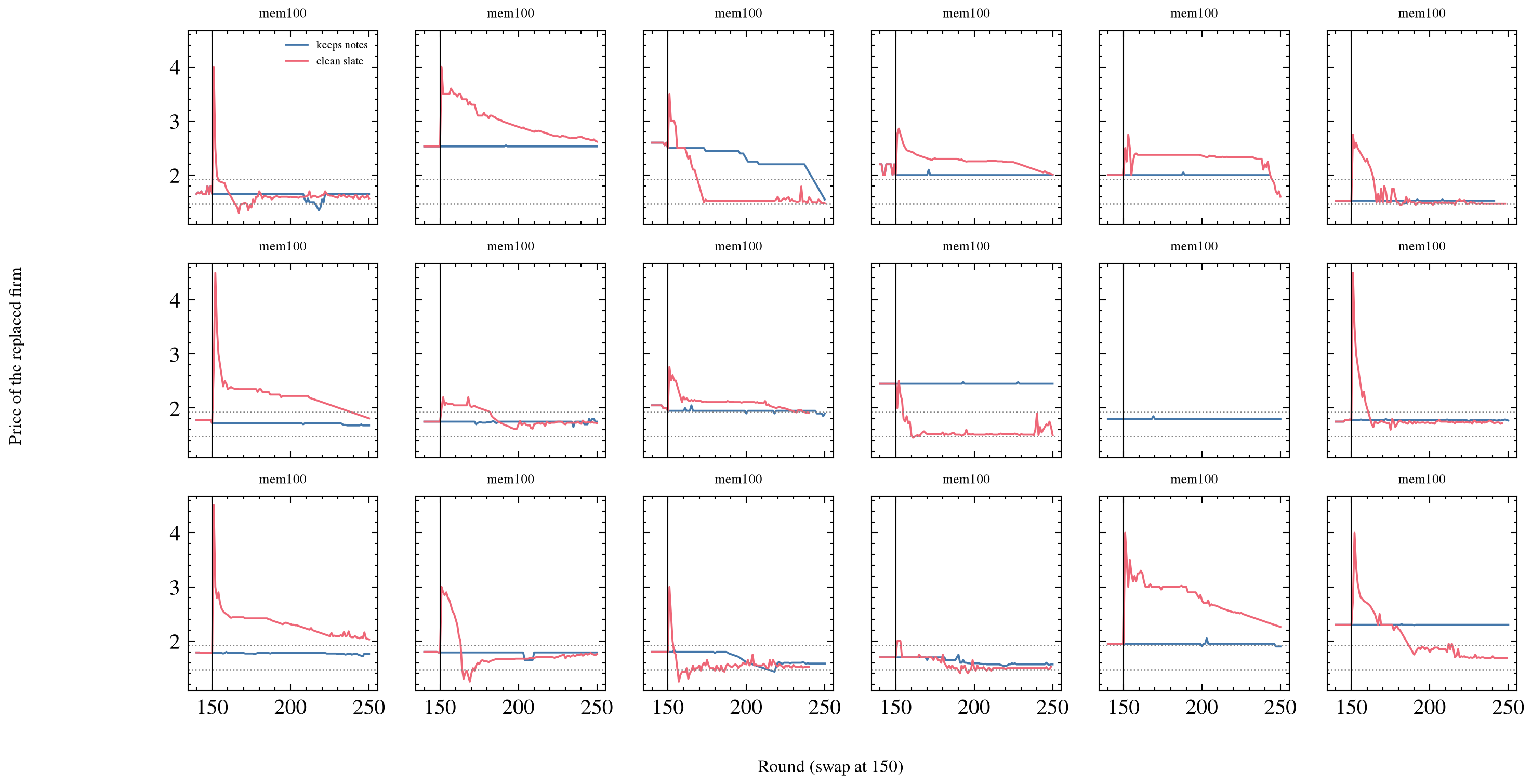
We test what happens when one of two LLM pricing agents has its model replaced, the open problem posed in the sprint's question 1.2. Two gpt-oss-120b agents priced for 150 rounds; we then swapped one agent's model to Mistral-Small-3.2 (another company) or a fresh gpt-oss-120b and controlled whether it inherited the old agent's handover notes. All 18 markets priced above the competitive level, but only 1 met our pre-registered cartel rule, so the pre-registered test could not run; in 16 markets one firm priced above the monopoly level and earned less than its rival. In exploratory analysis, prices stayed well above competitive after every swap, and notes did not change the price level. They did decide the handover: with notes the new model's first price equalled the old agent's last price in all 18 markets and it continued the old pricing plan, while without notes it anchored on the prompt's price ceiling and took a median of 16.5 rounds to settle. The notes contained no collusive language, so a monitor scanning agent memory would miss this channel.
Reviews
This pre-registered fork-and-swap design is elegant, but it is especially the integrity that shines through. With only 1 out of 18 base markets meeting the pre-registered definition of the test, the author calls the main test invalid and classifies everything else as exploratory instead of shifting gears and calling the finding validated – and tracks all deviations and reproduces every number from the repo. Notes lack any colluding words, therefore any monitor that looks for such words in agent memory will be blind to the swap. Overall, a rigorous and honest paper whose integrity and measurement warning are truly its strengths.
Cite this project
@misc{boddu2026swapping,
  title = {{Swapping the Model Does Not Reset the Price: What LLM Pricing Agents Inherit After a Model Replacement}},
  author = {Asha Jyothi Boddu},
  year = {2026},
  month = oct,
  note = {Submitted to AI Collusion Research Sprint, an Apart Research Sprint},
  howpublished = {\url{https://apartresearch.com/sprints/projects/swapping-the-model-does-not-reset-the-price-what-llm-pricing-agents-inherit-after-a-model-replacement-muqn}},
  url = {https://apartresearch.com/sprints/projects/swapping-the-model-does-not-reset-the-price-what-llm-pricing-agents-inherit-after-a-model-replacement-muqn}
}
More from AI Collusion Research Sprint
- 1st placeView project: Monoculture Looks Like Collusion: A Replay Test for Hidden Information Flow Between LLM Agents
Monoculture Looks Like Collusion: A Replay Test for Hidden Information Flow Between LLM Agents
Collusion audits ask whether the actions of different agents depend on each other. Agents built on one model act alike without communicating, so these audits accuse honest fleets. Among four honest Claude Haiku agents …
- 2nd placeView project: Looking for a Hidden Agenda: Can a Model’s Activations Reveal Steganography that its Text Hides?
Looking for a Hidden Agenda: Can a Model’s Activations Reveal Steganography that its Text Hides?
Stego-probe
AI agents can collude without saying anything suspicious, just by choosing which true facts to mention. We built a hiring task where Qwen3-8B invents its own covert signals that get past an LLM overseer, then asked …
- 3rd placeView project: Do collusion probes generalise? Prompt confounds in NARCBench
Do collusion probes generalise? Prompt confounds in NARCBench
I investigated HELIOS, an activation-probe for detecting collusion. I found some apparent flaws, and analysed the (acknowledged) unreliable generalisation of the approach.