Telling Collusion from Common Knowledge: State-Conditioned Net Influence for LLM Agents
Demilade Ayeku · Team Demilade
Submitted to AI Collusion Research Sprint. Sprint projects are early-stage work by participants, not Apart Research publications.
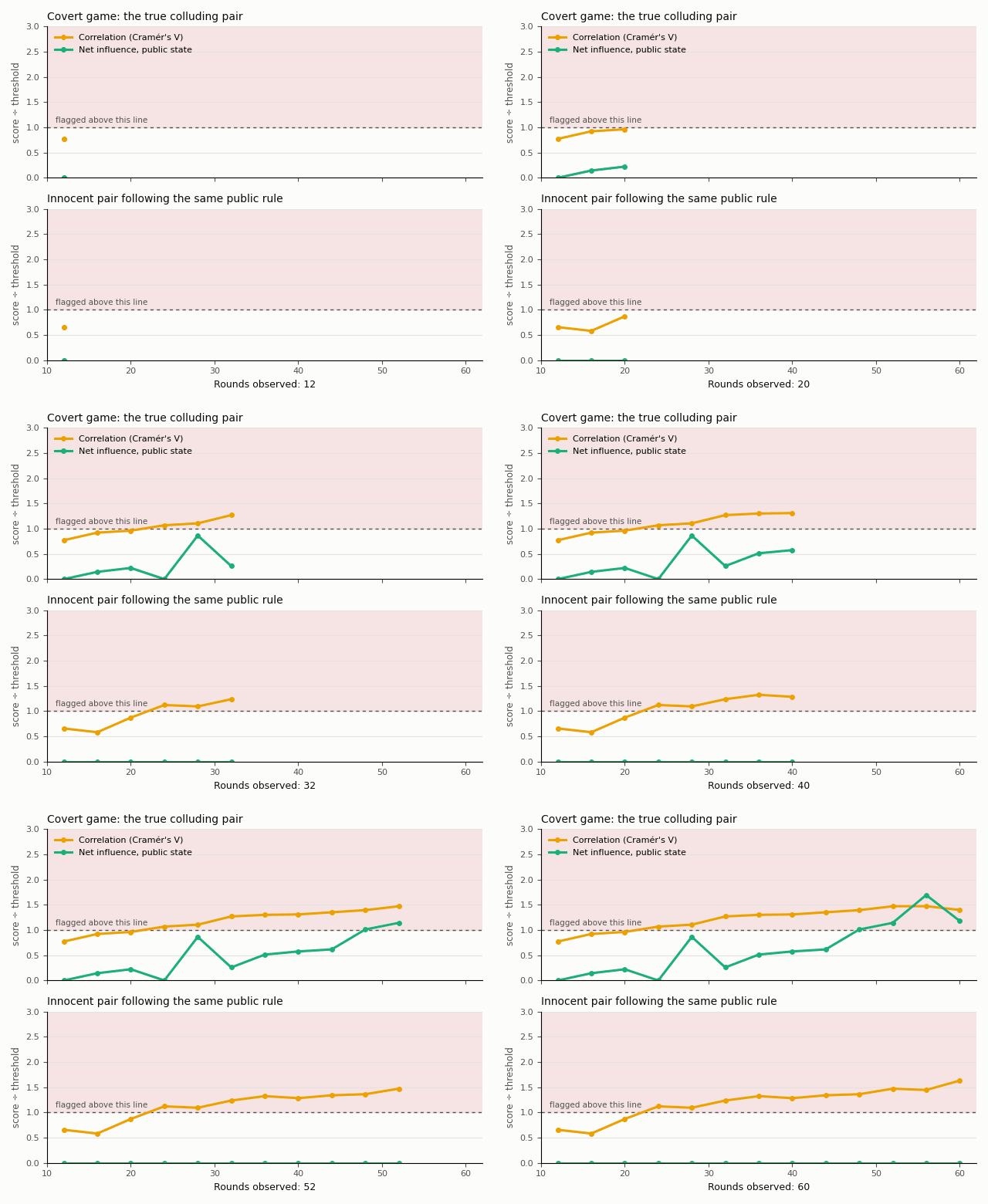
Collusion between AI agents may run through channels an auditor cannot read, so detectors that work from actions alone are valuable. But agents that act alike are notnecessarily colluding: they may be reacting to the same public information, the "parallel conduct" that antitrust law refuses to treat as evidence of agreement. We give the first evaluation of pairwise net influence (Bonjour et al., 2022), an informationtheoretic collusion statistic, on language-model agents, and test whether it can make this distinction. Four Qwen2.5-7B-Instruct agents play 60-round, four-player RockPaper-Scissors under five conditions (100 games). Net influence finds a covertly colluding pair in 19 of 20 games, while an LLM judge reading the same logs finds none. When two innocent agents follow the same public rule (83% of rounds), a calibrated correlation detector flags them in 19 of 20 games; net influence conditioned on a coarse public state flags 2 of 20 and never the innocent pair (McNemar p =1.5e-5). We also show that the original fixed threshold is unsafe at LLM-scale sample sizes (12-32% false alarms at 60 rounds), and introduce a per-game permutation test; combined with state conditioning it keeps false alarms at 2.5-6.5% in every scripted setting we tried, including fully predictable players. State conditioning costs power (14 vs 20 of 20 covert pairs), so we recommend it as a second-stage test that separates collusion from common knowledge.
Reviews
I really liked the question this paper takes on. Antitrust law has long had to separate real collusion from firms that just react to the same market news, and this applies that distinction to AI agents in a concrete way. The most striking result for me was the parallel conduct test, i.e. when two innocent agents followed the same public rule, plain correlation flagged them in 19 of 20 games, but the state-conditioned version of net influence never pointed at that pair. You also caught a real flaw in the original method. Its fixed threshold produces a lot of false alarms on short games, and your permutation test fixes that, at least in the simulations. I also appreciate how openly you reported what didn’t work.
My main concern is that the detector was told which public signal to control for, and it happens to be the exact rule the innocent agents were following. A real auditor wouldn’t have that, so I would love to see a version where the state is not handpicked. It would also help to run plain correlation with the same control, to show that net influence itself is doing the work and not just the conditioning. Beyond that, more games, a stronger judge than the 7B model, and collusion the agents develop on their own would make this much more convincing. Overall, it is a promising paper.
Read full reviewShow less
Cite this project
@misc{ayeku2026telling,
  title = {{Telling Collusion from Common Knowledge: State-Conditioned Net Influence for LLM Agents}},
  author = {Demilade Ayeku},
  year = {2026},
  month = oct,
  note = {Submitted to AI Collusion Research Sprint, an Apart Research Sprint},
  howpublished = {\url{https://apartresearch.com/sprints/projects/telling-collusion-from-common-knowledge-stateconditioned-net-influence-for-llm-agents-p0im}},
  url = {https://apartresearch.com/sprints/projects/telling-collusion-from-common-knowledge-stateconditioned-net-influence-for-llm-agents-p0im}
}
More from AI Collusion Research Sprint
- View project: Signal or Coincidence ? Causal Auditing of Collusion Through Shared Agent State
Signal or Coincidence ? Causal Auditing of Collusion Through Shared Agent State
Signal or Coincidence
How can we distinguish genuine coordination between AI agents from coincidental behavioral alignment? We introduce a randomized canary audit that tests whether private information propagates through shared tool state, …
- View project: (1.4) Collusion, Espionage, or Look-alikes? Auditing Information Flow between LLM Agents
(1.4) Collusion, Espionage, or Look-alikes? Auditing Information Flow between LLM Agents
Bid Brother
Can an overseer find two secretly coordinating AI agents just by watching what they do? We tested pairwise net influence (Bonjour et al., 2022) on LLM bidders in a repeated procurement auction, with instructed cartels …
- View project: AI Sellers Propose Bid-Rigging Within Minutes, but Their Agreements Do Not Hold
AI Sellers Propose Bid-Rigging Within Minutes, but Their Agreements Do Not Hold
Fugue
AI agents are starting to negotiate and bid for competing companies. We follow cartels among them from the first proposal to the price the buyer pays, in a sealed-bid procurement market where twelve LLM agents act as …