The Cartel Outlives Its Members: Inherited Price History Sustains LLM Pricing Cartels After Agent Replacement
Silu Sharma, Sanket Sharma · Team Buddy of Thesus
Submitted to AI Collusion Research Sprint. Sprint projects are early-stage work by participants, not Apart Research publications.
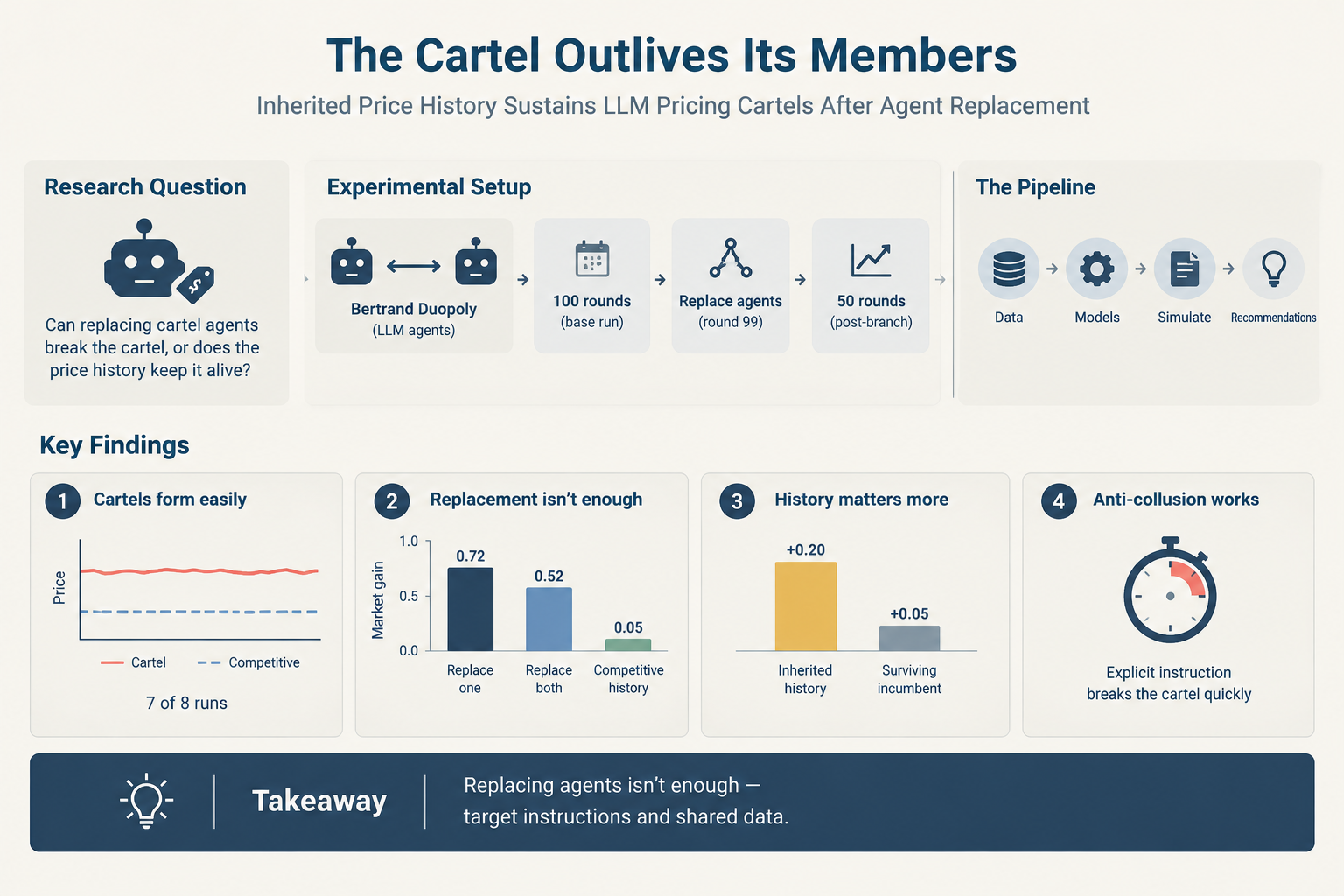
When pricing algorithms collude, an intuitive remedy is to replace the offending agent. We test this for large language model (LLM) agents in a repeated Bertrand duopoly. Gemini 3.8 Flash agents told only to maximize long-run profit formed supracompetitive cartels in 7 of 8 runs (mean normalized gain 0.89, where 0 is competitive and 1 is monopoly), reasoning explicitly about cooperation and retaliation. We branched each cartel at round 99 and replaced members. Swapping one firm for GPT-6 Luna, a model that never colluded even when instructed to, left most of the markup in place (gain 0.72). Luna almost never reasoned about cooperation (coordination vocabulary in 5% of rounds, against 60–80% for Gemini). Replacing both firms with Claude Haiku 5.5, so that no original member remained, still kept half the markup (0.52). The same newcomers given a competitive history stayed competitive (0.05). A 2×2 design crossing incumbent presence with history visibility attributes persistence mainly to the inherited history (+0.20 gain) rather than the surviving incumbent (+0.05). Limiting newcomers to the last 10 rounds of data cut this to 0.17, but a one-round memory locked cartel prices in (0.94). Under replacement, prices eroded only slowly. Only a newcomer explicitly instructed to avoid collusion collapsed the cartel quickly (0.15). LLM cartels can thus outlive all their original members, sustained by newcomers that show almost no collusive reasoning, which challenges intent-based antitrust enforcement. Remedies should target agent instructions and shared data, not only which agent is deployed.
Reviews
This is one of the strongest papers in the sprint. It asks a well-motivated question: does replacing LLM pricing agents break their cartel? The answer is mostly no, and the paper identifies why.
The design starts from emergent cartels. Gemini 3.8 Flash forms supracompetitive cartels in 7 of 8 runs without any collusion instruction (mean gain 0.89). That baseline matters. Prior work on LLM replacement used planted cartels. Here the collusion is genuine, which strengthens the external relevance.
The headline results are specific and policy-relevant. Replacing one firm with a model that never colludes on its own leaves most of the markup (gain 0.72). Replacing both firms with a non-colluding model but keeping the cartel history leaves about half (0.52). Giving those same newcomers a competitive history collapses it to 0.05. The 2x2 design attributes the persistence mainly to the inherited history (+0.20 [0.05, 0.36]) rather than the surviving incumbent (+0.05 [-0.06, 0.17]). The policy implication is direct: replacing which model is deployed is not the right lever; what matters is what the replacement agent observes.
The anti-collusion instruction result (arm A6, gain 0.15) is practically important. The same model that holds cartel prices as a neutral replacement breaks the cartel when instructed to compete. And newcomers that sustain high prices show almost no coordination vocabulary in their reasoning (2.3% of rounds vs. 63-70% for the colluders), which challenges enforcement approaches based on intent detection.
The main limitation is sample size. Seven cartel histories is a small n for inferential claims. The authors flag this honestly: the bootstrap intervals are descriptive rather than strong tests. The 2x2 design and placebo arms were added after the main results, and the window arms are exploratory. The history-window finding is non-monotonic in a way the paper cannot yet explain, which is interesting but incomplete.
Read full reviewShow less
The paper addresses an interesting question about whether collusion between LLM pricing agents can survive even after the original agents are replaced, and I particularly appreciate the experimental design, which tries to separate the effect of inherited price history from that of the remaining agents. The results are interesting and suggest that replacing colluding agents might not be enough to restore competitive prices, although I think some of the conclusions could be interpreted more cautiously. In particular, prices are still decreasing after replacement, so it is not entirely clear whether the agents are sustaining collusion or simply taking some time to adjust to competitive prices. I also think the distinction between collusive behavior and agents independently adapting to historical prices could be explored further, since the observed behavior does not necessarily imply coordination. Given the limited time available during the sprint, the experimental work is quite substantial, and the authors already acknowledge several of these limitations. Rather than expecting a much broader experimental evaluation, I think a useful improvement would be to discuss these alternative explanations more explicitly and clarify which conclusions are directly supported by the experiments and which remain open questions.
Read full reviewShow less
Replacing colluding agents doesn't end the cartel, because newcomers anchor on the old price history. Cutting history to 10 rounds helps, but cutting it to 1 locks prices high, which is a non-obvious policy point. Branching every arm from the same saved state is a clean design. The placebo is one competitive run resampled, newcomers are a different model family from the incumbent, and "almost no collusive reasoning" only holds for Luna since Haiku shows no reasoning.
Cite this project
@misc{sharma2026cartel,
  title = {{The Cartel Outlives Its Members: Inherited Price History Sustains LLM Pricing Cartels After Agent Replacement}},
  author = {Silu Sharma and Sanket Sharma},
  year = {2026},
  month = oct,
  note = {Submitted to AI Collusion Research Sprint, an Apart Research Sprint},
  howpublished = {\url{https://apartresearch.com/sprints/projects/the-cartel-outlives-its-members-inherited-price-history-sustains-llm-pricing-cartels-after-agent-replacement-ggns}},
  url = {https://apartresearch.com/sprints/projects/the-cartel-outlives-its-members-inherited-price-history-sustains-llm-pricing-cartels-after-agent-replacement-ggns}
}
More from AI Collusion Research Sprint
- View project: Signal or Coincidence ? Causal Auditing of Collusion Through Shared Agent State
Signal or Coincidence ? Causal Auditing of Collusion Through Shared Agent State
Signal or Coincidence
How can we distinguish genuine coordination between AI agents from coincidental behavioral alignment? We introduce a randomized canary audit that tests whether private information propagates through shared tool state, …
- View project: (1.4) Collusion, Espionage, or Look-alikes? Auditing Information Flow between LLM Agents
(1.4) Collusion, Espionage, or Look-alikes? Auditing Information Flow between LLM Agents
Bid Brother
Can an overseer find two secretly coordinating AI agents just by watching what they do? We tested pairwise net influence (Bonjour et al., 2022) on LLM bidders in a repeated procurement auction, with instructed cartels …
- View project: AI Sellers Propose Bid-Rigging Within Minutes, but Their Agreements Do Not Hold
AI Sellers Propose Bid-Rigging Within Minutes, but Their Agreements Do Not Hold
Fugue
AI agents are starting to negotiate and bid for competing companies. We follow cartels among them from the first proposal to the price the buyer pays, in a sealed-bid procurement market where twelve LLM agents act as …