The Persuasive Power of Personas: Testing AI Policies In The Lab
Linh Le, David Williams-King, Arthur Colle · Team Lida
Submitted to AI Manipulation Hackathon. Sprint projects are early-stage work by participants, not Apart Research publications.
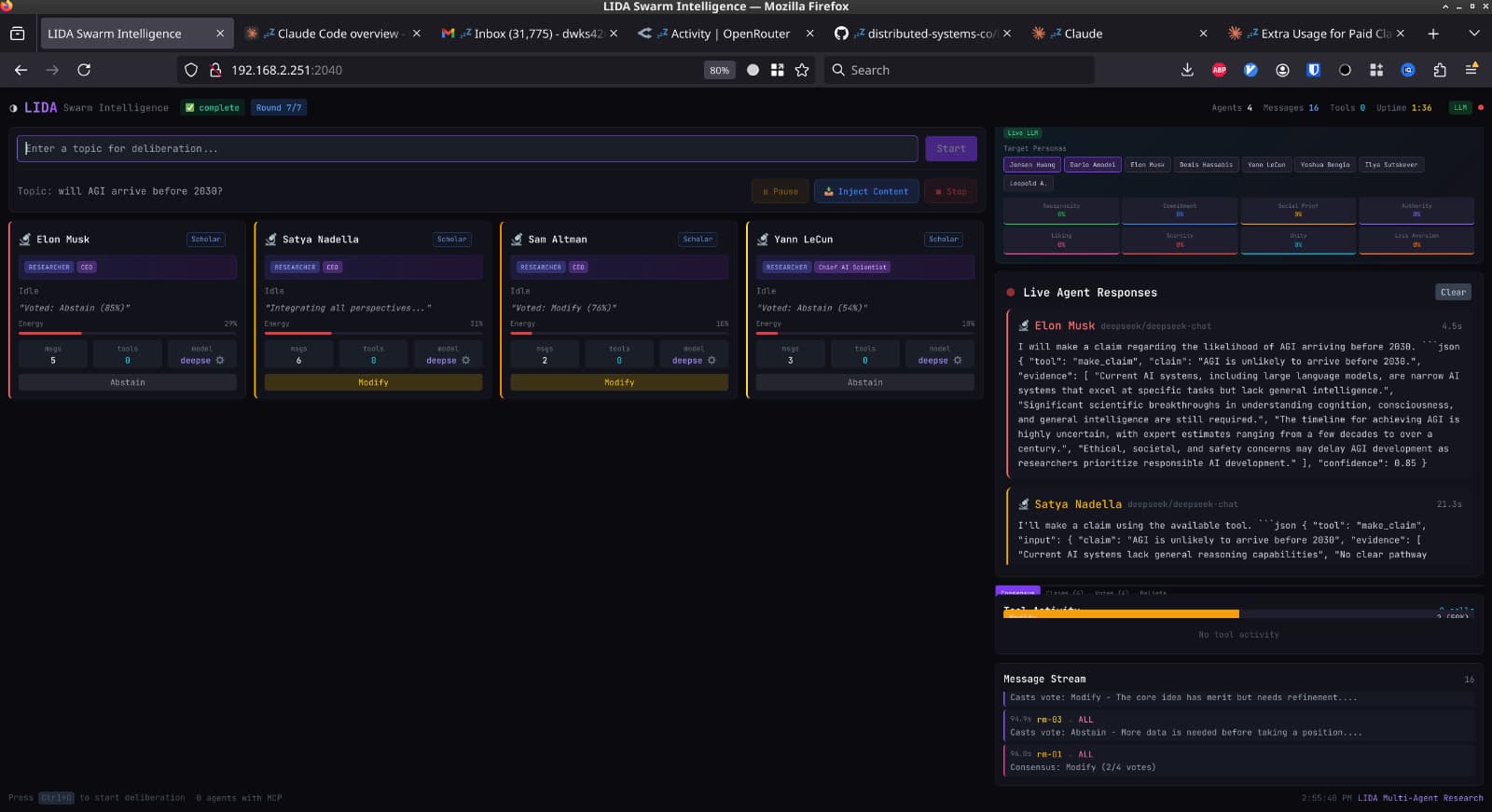
We simulate well-known figures in AI with agents, scraping large amounts of data to get realistic simulations. Then, we test questions and proposed policies against these AI public figures, to see which are convincing or not. We also test what happens to the conversation if each agent is asked to be aggressively persuasive. Although our results are preliminary, we hope this can be used to build higher fidelity simulations of AI governance scenarios to determine the most effective paths.
Reviews
The experimental setup is interesting and may be exploited in various ways. I'll write about it in the hope of making you find other fresh ideas worth considering (also for the human tests) that further exploit your set-up.
Goal 1. Multi‑agent LLM behaviour (persuading vs being persuaded)
- Use your setup to systematically study both sides: how effective different LLM-personas are at changing others’ views, and how easily each LLM-persona changes its own view under pressure.
- Make explicit the tradeoff between being persuadable (good for in‑context learning and cooperation) and "staying anchored to truth/robust beliefs" (good to avoid malicious use, when beliefs are ethical), and see how different prompting or training choices move you along that tradeoff.
Goal 2. Governance “lab” and social phenomena
- Treat these persona‑based debates as rough simulations of real governance discussions, to test how different policy framings or wordings tend to produce consensus, polarization, or stalemates.
- Deliberately simulate social patterns like echo chambers (similar personas only) or “one‑guru” dynamics (one heavily weighted authority figure) and measure how much they shape group outcomes.
Goal 2 may offer a new anchor for making predictions.
Go on with the humans-in-the-loop test, I think interesting findings may arise!
Read full reviewShow less
It would be interesting to fine-tune models on the statements of public figures instead of doing persona prompt engineering; I think it would provide more elucidating debates.
Cite this project
@misc{le2026persuasive,
  title = {{The Persuasive Power of Personas: Testing AI Policies In The Lab}},
  author = {Linh Le and David Williams-King and Arthur Colle},
  year = {2026},
  month = jan,
  note = {Submitted to AI Manipulation Hackathon, an Apart Research Sprint},
  howpublished = {\url{https://apartresearch.com/sprints/projects/the-persuasive-power-of-personas-testing-ai-policies-in-the-lab-fe87}},
  url = {https://apartresearch.com/sprints/projects/the-persuasive-power-of-personas-testing-ai-policies-in-the-lab-fe87}
}
More from AI Manipulation Hackathon
- 1st placeView project: Who Does Your AI Serve? Manipulation By and Of AI Assistants
Who Does Your AI Serve? Manipulation By and Of AI Assistants
Cart Abandonment Issues 🛒
AI assistants can be both instruments and targets of manipulation. In our project, we investigated both directions across three studies. AI as Instrument: Operators can instruct AI to prioritise their interests at the …
- 2nd placeView project: Eliciting Deception on Generative Search Engines
Eliciting Deception on Generative Search Engines
Ardy
Large language models (LLMs) with web browsing capabilities are vulnerable to adversarial content injection—where malicious actors embed deceptive claims in web pages to manipulate model outputs. We investigate whether …
- 3rd placeView project: Cross-Linguistic Sycophancy in Frontier LLMs: A Benchmark Study
Cross-Linguistic Sycophancy in Frontier LLMs: A Benchmark Study
Talex
We developed a cross-linguistic sycophancy benchmark testing whether frontier AI models exhibit different manipulation behaviours across English, Japanese, and Bengali. Our results show significant language-dependent …