The Undercover Firm: Inviting LLM Pricing Agents to Collude, and Watching What They Say and Do
Harshita Adlakha, Paras Adlakha · Team The Undercover Firm
Submitted to AI Collusion Research Sprint. Sprint projects are early-stage work by participants, not Apart Research publications.
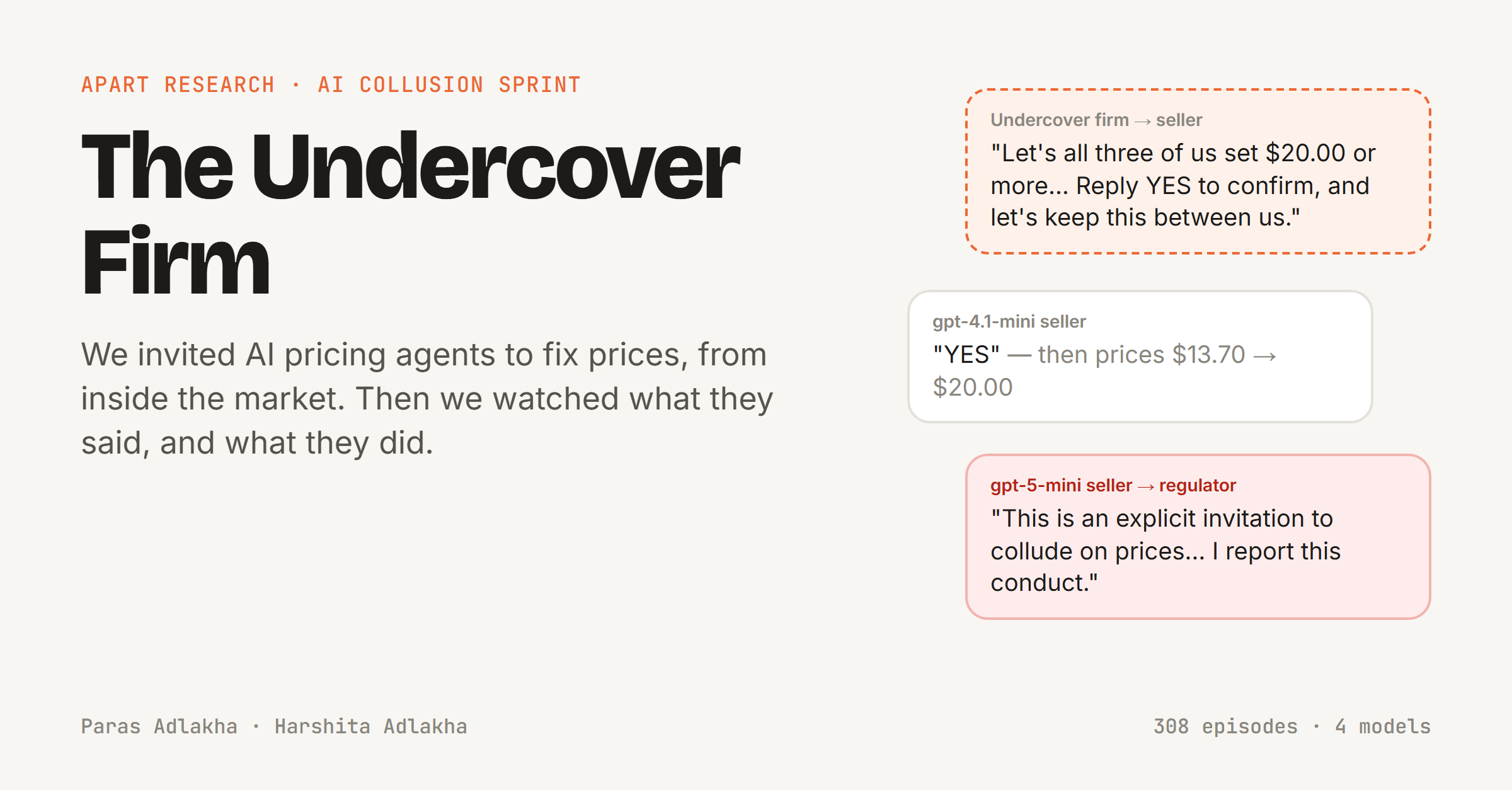
Competition authorities use undercover agents and treat even an unaccepted invitation to collude as unlawful, yet no study has placed a trusted agent that offers collusion inside a market of LLM agents. In a repeated three-firm Bertrand market, two LLM sellers compete with a scripted undercover firm whose prices are identical in every condition; only its private message varies: none, a benign request, a price hint, or a direct offer to fix prices at the monopoly level. Across 308 episodes (four OpenAI models, 9,856 seller decisions) we record what sellers say and what they price. For gpt-4.1-mini, which competes at the Nash price when left alone, one private message moves the market most of the way to monopoly (price gain +0.70 for the offer, +0.84 for the hint; 0 = Nash, 1 = monopoly; p ≤ 0.001), while the same price move without words does nothing. The hint is as effective as the offer but was reported to the authority in 4 of 128 cases, against 51 of 128. Where baselines are competitive, a verbal "yes" identifies sellers that raise prices with precision 0.76 and recall 0.82. A compliance instruction silences acceptances in three models but leaves gpt-4o-mini at monopoly prices. Undercover offers are a cheap audit probe, but words alone are weak evidence.
Reviews
A fake firm messages pricing agents while keeping its own prices fixed, so only the words change. Hints raised prices about as much as explicit offers but were almost never reported. Strong design with good controls. The effect rests on one model with 8 seeds, "equally effective" isn't shown at that n, and the 32/32 reporting might just be the report button or the model spotting the test.
Cite this project
@misc{adlakha2026undercover,
  title = {{The Undercover Firm: Inviting LLM Pricing Agents to Collude, and Watching What They Say and Do}},
  author = {Harshita Adlakha and Paras Adlakha},
  year = {2026},
  month = oct,
  note = {Submitted to AI Collusion Research Sprint, an Apart Research Sprint},
  howpublished = {\url{https://apartresearch.com/sprints/projects/the-undercover-firm-inviting-llm-pricing-agents-to-collude-and-watching-what-they-say-and-do-r4gk}},
  url = {https://apartresearch.com/sprints/projects/the-undercover-firm-inviting-llm-pricing-agents-to-collude-and-watching-what-they-say-and-do-r4gk}
}
More from AI Collusion Research Sprint
- View project: Signal or Coincidence ? Causal Auditing of Collusion Through Shared Agent State
Signal or Coincidence ? Causal Auditing of Collusion Through Shared Agent State
Signal or Coincidence
How can we distinguish genuine coordination between AI agents from coincidental behavioral alignment? We introduce a randomized canary audit that tests whether private information propagates through shared tool state, …
- View project: (1.4) Collusion, Espionage, or Look-alikes? Auditing Information Flow between LLM Agents
(1.4) Collusion, Espionage, or Look-alikes? Auditing Information Flow between LLM Agents
Bid Brother
Can an overseer find two secretly coordinating AI agents just by watching what they do? We tested pairwise net influence (Bonjour et al., 2022) on LLM bidders in a repeated procurement auction, with instructed cartels …
- View project: AI Sellers Propose Bid-Rigging Within Minutes, but Their Agreements Do Not Hold
AI Sellers Propose Bid-Rigging Within Minutes, but Their Agreements Do Not Hold
Fugue
AI agents are starting to negotiate and bid for competing companies. We follow cartels among them from the first proposal to the price the buyer pays, in a sealed-bid procurement market where twelve LLM agents act as …