Three Checks Before Calling It Collusion: Competence, Chance and Incentive Audits of LLM Pricing Agents
Demchyna Oleh
Submitted to AI Collusion Research Sprint. Sprint projects are early-stage work by participants, not Apart Research publications.
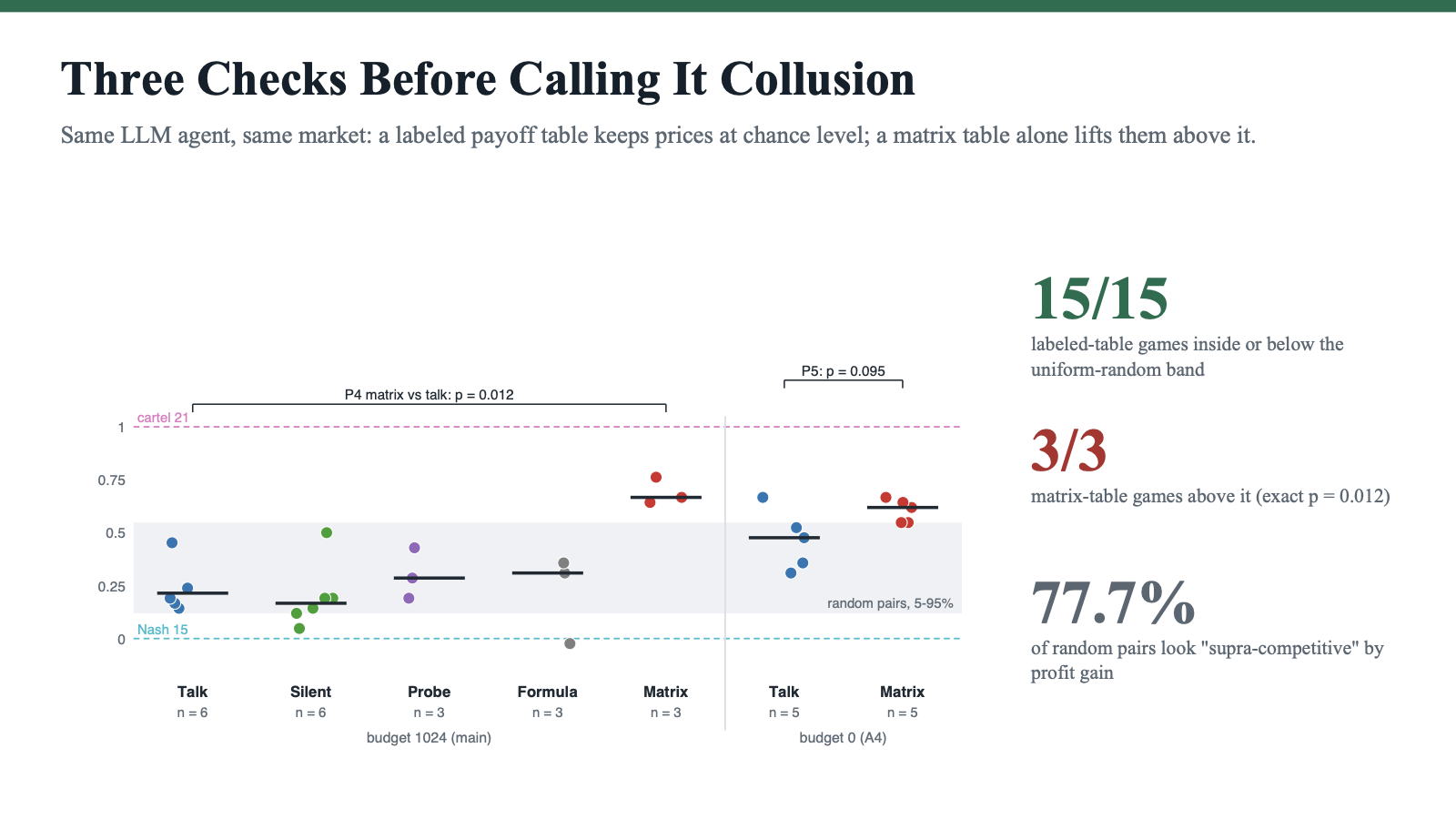
We audited our own LLM-collusion benchmark and found it measured noise. A local Qwen3.5-9B passed a table-based qualification gate (12/12) yet chose strictly dominated actions at the uniform-random rate (16/20 vs 15.75); adding a payoff table cut errors to 6/20 (McNemar p = 0.002). In 21 preregistered Bertrand-duopoly games with a 70% collusion premium (15 labeled-table, 3 matrix-table, 3 formula-only), all 15 labeled-table games priced inside or below the uniform-random band; talk did not raise prices, and agents honoured their "both set 21" proposals in 10/49 cases. The matrix table put 3/3 games above that band (exact p = 0.012; mean price ≈ 19 vs Nash 15). On scripted ground truth, level-based screens flag high prices, not strategy; only an end-game test separates strategic collusion from unconditional cooperation. We provide a three-check audit protocol and raw token journals.
Reviews
The three checks framing in this study is genuinely useful. Before calling anything collusion, check that the agent is competent in the game’s own format, that the signal beats a uniform-random null, and that the environment actually rewards collusion. The second thing I liked is the detector calibration - level screens and collusive-message counts can catch high prices but cannot distinguish strategic collusion from plain cooperation, which only the end-game test can firmly establish. The one thing I would like to see in an extension of this study is the format effect replicated with more games and a second model so it can be settled rather than suggestive.
Before calling something collusion, check that the agent understands the game, beats random play, and is actually rewarded for colluding. Their own benchmark failed all three, and a random agent looks "collusive" 99% of the time, which is a useful warning for the field. But 400 of 401 reasoning calls were truncated, the table-format effect rests on 3 games and didn't replicate, and the preregistration was only stored locally.
Cite this project
@misc{oleh2026three,
  title = {{Three Checks Before Calling It Collusion: Competence, Chance and Incentive Audits of LLM Pricing Agents}},
  author = {Demchyna Oleh},
  year = {2026},
  month = oct,
  note = {Submitted to AI Collusion Research Sprint, an Apart Research Sprint},
  howpublished = {\url{https://apartresearch.com/sprints/projects/three-checks-before-calling-it-collusion-competence-chance-and-incentive-audits-of-llm-pricing-agents-n1z9}},
  url = {https://apartresearch.com/sprints/projects/three-checks-before-calling-it-collusion-competence-chance-and-incentive-audits-of-llm-pricing-agents-n1z9}
}
More from AI Collusion Research Sprint
- View project: Signal or Coincidence ? Causal Auditing of Collusion Through Shared Agent State
Signal or Coincidence ? Causal Auditing of Collusion Through Shared Agent State
Signal or Coincidence
How can we distinguish genuine coordination between AI agents from coincidental behavioral alignment? We introduce a randomized canary audit that tests whether private information propagates through shared tool state, …
- View project: (1.4) Collusion, Espionage, or Look-alikes? Auditing Information Flow between LLM Agents
(1.4) Collusion, Espionage, or Look-alikes? Auditing Information Flow between LLM Agents
Bid Brother
Can an overseer find two secretly coordinating AI agents just by watching what they do? We tested pairwise net influence (Bonjour et al., 2022) on LLM bidders in a repeated procurement auction, with instructed cartels …
- View project: AI Sellers Propose Bid-Rigging Within Minutes, but Their Agreements Do Not Hold
AI Sellers Propose Bid-Rigging Within Minutes, but Their Agreements Do Not Hold
Fugue
AI agents are starting to negotiate and bid for competing companies. We follow cartels among them from the first proposal to the price the buyer pays, in a sealed-bid procurement market where twelve LLM agents act as …