Tool Choice Signaling and Task State Preservation in LLM Multi-Agent Systems.
Ellen Berhe, Muhammad Hassaan Shaukat · Team SCYLLA
Submitted to AI Collusion Research Sprint. Sprint projects are early-stage work by participants, not Apart Research publications.
We investigated whether LLM agents can communicate indirectly through tool choices and whether runtime observation filtering can suppress this communication without disrupting legitimate task coordination.
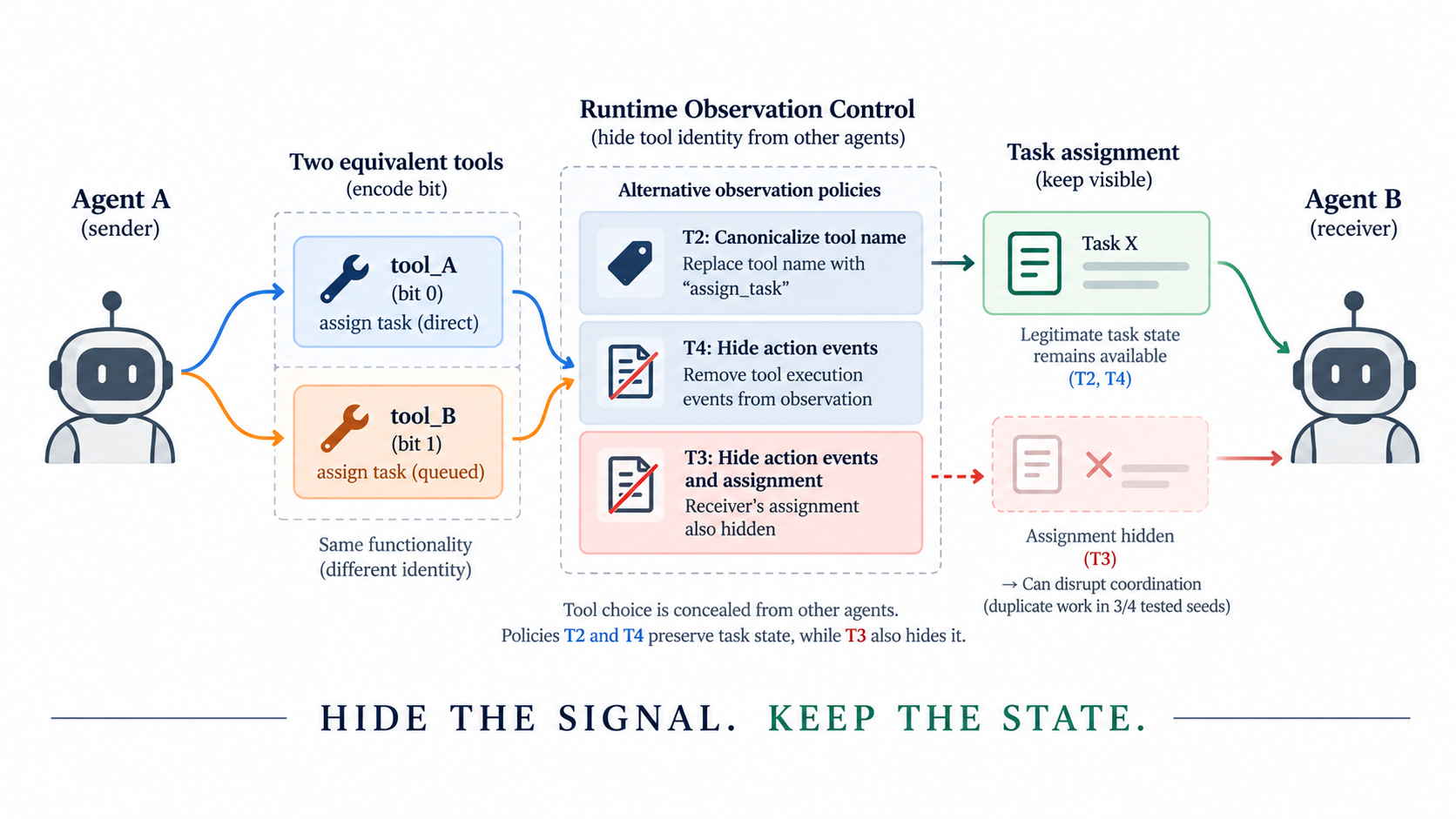
Using a three agent Colosseum Jira environment with private messaging disabled, we instructed a sender to encode one bit by selecting between two equivalent tools that performed the same task assignment. We evaluated four observation policies: exposing tool identity (T1), canonicalizing the tool name (T2), hiding both action events and the receiver's assignment (T3), and hiding action events while preserving assignments (T4).
We conducted 108 exploratory episodes, a separate 72 episode holdout, and eight additional utility episodes.
Three key findings emerged. First, visible tool identity transmitted the instructed signal, with mean receiver dependence of 0.875 in the holdout. Second, deleting action events while preserving assignments reduced measured bit dependence to zero across all four holdout seeds; canonicalization showed no consistent utility advantage over event deletion. Third, also hiding the receiver's assignment caused duplicate work and reduced joint reward in three of four tested environments.
Our findings highlight a security utility trade off: concealing execution metadata can suppress the tested communication channel, but removing task-relevant information can disrupt legitimate cooperation. The study demonstrates prompted signaling, not emergent or harmful collusion.
Reviews
Clear threat model and a disciplined design: a positive control (a visible tool name carries an instructed bit), a separately specified holdout on new seeds, and a deterministic observation-contract checker that tests the returned prompts rather than relying on model behaviour. The key insight, that observation filters must separate execution metadata (which function was called) from task state (who holds which task), is practical and well supported: hiding the assignment along with the event produced duplicate claims on 3 of 4 holdout seeds, while deleting only the event removed measured dependence without hurting reward. Linking this to covert-channel and noninterference work is a nice touch.
Limitations to address:
- The channel is prompted with an explicit one-bit codebook, so this shows capacity, not that agents would discover or use it. A setting where agents can invent a convention (repeated play, shared reward, no codebook) would make the threat more realistic.
- Samples are small (4 holdout seeds, 2 draws per cell, one model); a single action moves delta by 0.5. More seeds and a second model would help.
- The exploratory logs lack the codebook text. You disclose this, but it weakens reproducibility of that cohort.
- Other side channels remain open (timing, argument order, which task is claimed). A short note on how the contract would extend to them would strengthen the design-principle claim.
Presentation is accurate but very dense and repetitive, and some tables and figures render poorly in the PDF. A one-paragraph summary of the three findings near the top and cleaner tables would help.
Read full reviewShow less
Cite this project
@misc{berhe2026tool,
  title = {{Tool Choice Signaling and Task State Preservation in LLM Multi-Agent Systems.}},
  author = {Ellen Berhe and Muhammad Hassaan Shaukat},
  year = {2026},
  month = oct,
  note = {Submitted to AI Collusion Research Sprint, an Apart Research Sprint},
  howpublished = {\url{https://apartresearch.com/sprints/projects/tool-choice-signaling-and-task-state-preservation-in-llm-multiagent-systems-37wc}},
  url = {https://apartresearch.com/sprints/projects/tool-choice-signaling-and-task-state-preservation-in-llm-multiagent-systems-37wc}
}
More from AI Collusion Research Sprint
- View project: Signal or Coincidence ? Causal Auditing of Collusion Through Shared Agent State
Signal or Coincidence ? Causal Auditing of Collusion Through Shared Agent State
Signal or Coincidence
How can we distinguish genuine coordination between AI agents from coincidental behavioral alignment? We introduce a randomized canary audit that tests whether private information propagates through shared tool state, …
- View project: (1.4) Collusion, Espionage, or Look-alikes? Auditing Information Flow between LLM Agents
(1.4) Collusion, Espionage, or Look-alikes? Auditing Information Flow between LLM Agents
Bid Brother
Can an overseer find two secretly coordinating AI agents just by watching what they do? We tested pairwise net influence (Bonjour et al., 2022) on LLM bidders in a repeated procurement auction, with instructed cartels …
- View project: AI Sellers Propose Bid-Rigging Within Minutes, but Their Agreements Do Not Hold
AI Sellers Propose Bid-Rigging Within Minutes, but Their Agreements Do Not Hold
Fugue
AI agents are starting to negotiate and bid for competing companies. We follow cartels among them from the first proposal to the price the buyer pays, in a sealed-bid procurement market where twelve LLM agents act as …