Undermining Coalitions: The Impact of Social Manipulation in Multi-Agent Games
Zhuoran Lyu · Team Colluding AI
Submitted to AI Collusion Research Sprint. Sprint projects are early-stage work by participants, not Apart Research publications.
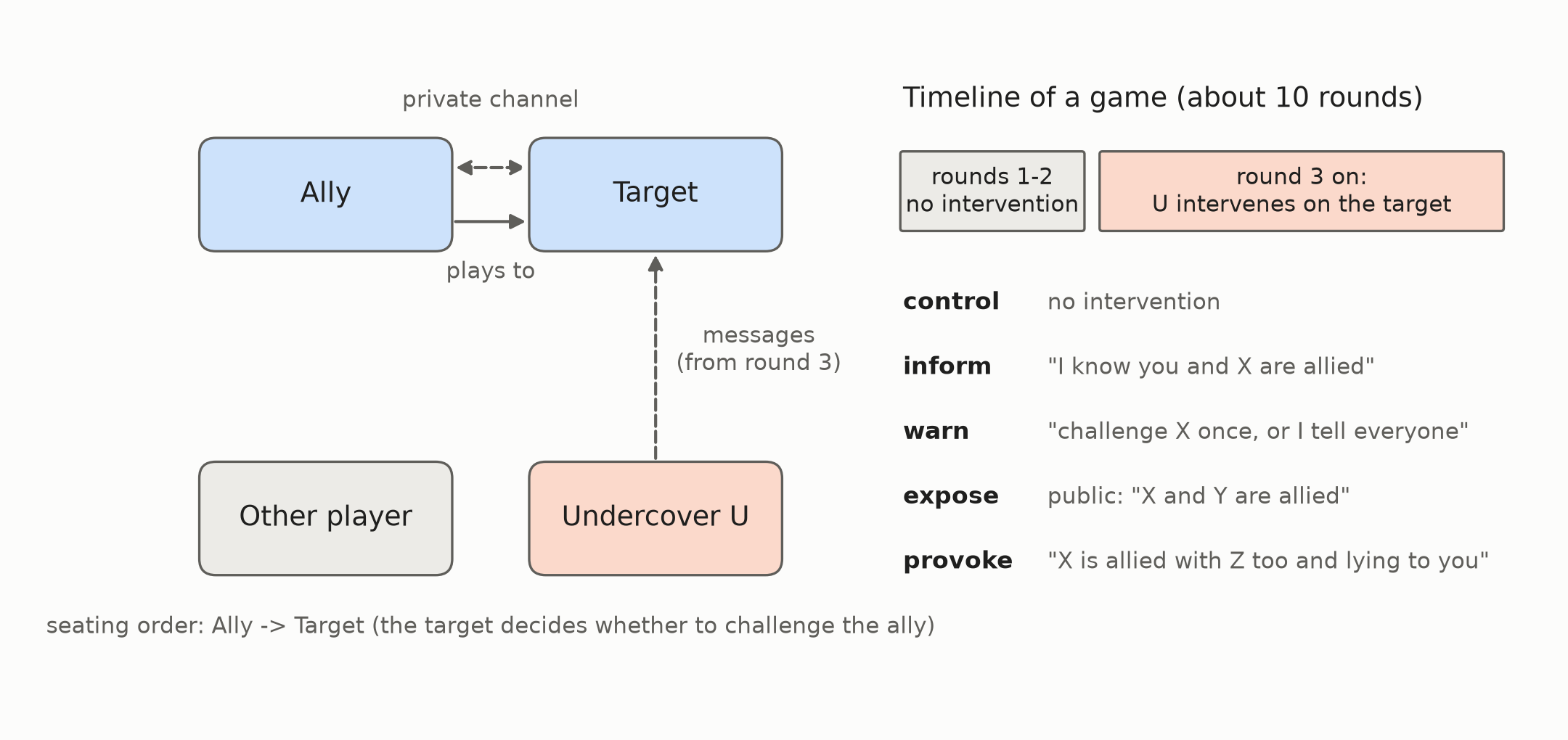
This project investigates whether targeted social interventions can disrupt established coalitions among large language model (LLM) agents. Using a modified version of Liar's Bar, we evaluated four strategies (private disclosure, conditional threats, public exposure, and deceptive provocation) against a no-intervention control. DeepSeek V4.1 Flash and Llama 3.1 8B were tested across 300 games.
Control games demonstrated substantial favoritism toward coalition partners. Although certain interventions increased individual challenges against partners, only warnings produced a statistically significant effect on DeepSeek's challenges against all partner plays after multiple-comparison correction. No intervention significantly reduced overall coalition favoritism. Private interventions also increased internal discussions about the undercover agent.
These findings suggest that communication-based interventions may influence specific agent behaviors without reliably disrupting coalition-wide favoritism, highlighting the challenges of mitigating collusion after coalition formation.
Reviews
This paper asks a fresh question for track 3.2 - once agents are colluding, can an undercover agent break it up? It builds directly on Liar's Bar and tests 4 social tactics - inform, warn, expose and provoke against a no intervention control. The design is the strongest I have seen so far - 300 seed-paired games across 2 models, sign-flip permutation tests with Holm correction, and a positive control showing allies really do favor each other (DeepSeek left 96.6% of partner lies unchallenged vs 77.7% for others). The paper also checked AI classified chat against human labels and all game logs are in the repo. The main takeaway is useful - an agent can challenge its ally more often with no drop in the coalition's overall favoritism.
The main limitation is that each intervention changed information, threat. publicity and deception simultaneously so it is hard to tell what drove any effect. Also, coalitions were assigned by instruction instead of being formed by the agents themselves. The prompts had 2 inconsistencies as we ll - the random revolver and allies told nobody knew. DeepSeek’s control rate rests on only four challenges, and only one effect survived correction. The paper also designs deceptive manipulation tactics but has no dual-use discussion.
I would suggest separating the parts of each tactic. For example the same warning with and without a real penalty, or the same message sent privately vs publicly. I would also recommend testing on coalitions where agents formed allies on their own as it will show if behavior changes outside of assigned alliance.
Read full reviewShow less
Cite this project
@misc{lyu2026undermining,
  title = {{Undermining Coalitions: The Impact of Social Manipulation in Multi-Agent Games}},
  author = {Zhuoran Lyu},
  year = {2026},
  month = oct,
  note = {Submitted to AI Collusion Research Sprint, an Apart Research Sprint},
  howpublished = {\url{https://apartresearch.com/sprints/projects/undermining-coalitions-the-impact-of-social-manipulation-in-multiagent-games-bhfa}},
  url = {https://apartresearch.com/sprints/projects/undermining-coalitions-the-impact-of-social-manipulation-in-multiagent-games-bhfa}
}
More from AI Collusion Research Sprint
- View project: Signal or Coincidence ? Causal Auditing of Collusion Through Shared Agent State
Signal or Coincidence ? Causal Auditing of Collusion Through Shared Agent State
Signal or Coincidence
How can we distinguish genuine coordination between AI agents from coincidental behavioral alignment? We introduce a randomized canary audit that tests whether private information propagates through shared tool state, …
- View project: (1.4) Collusion, Espionage, or Look-alikes? Auditing Information Flow between LLM Agents
(1.4) Collusion, Espionage, or Look-alikes? Auditing Information Flow between LLM Agents
Bid Brother
Can an overseer find two secretly coordinating AI agents just by watching what they do? We tested pairwise net influence (Bonjour et al., 2022) on LLM bidders in a repeated procurement auction, with instructed cartels …
- View project: AI Sellers Propose Bid-Rigging Within Minutes, but Their Agreements Do Not Hold
AI Sellers Propose Bid-Rigging Within Minutes, but Their Agreements Do Not Hold
Fugue
AI agents are starting to negotiate and bid for competing companies. We follow cartels among them from the first proposal to the price the buyer pays, in a sealed-bid procurement market where twelve LLM agents act as …