Veracity
Lucas Barbosa, Stefan Gazzana, Jake Fogel, Muskaan Kumar, Sravika · Team XYZ
Submitted to AI Collusion Research Sprint. Sprint projects are early-stage work by participants, not Apart Research publications.
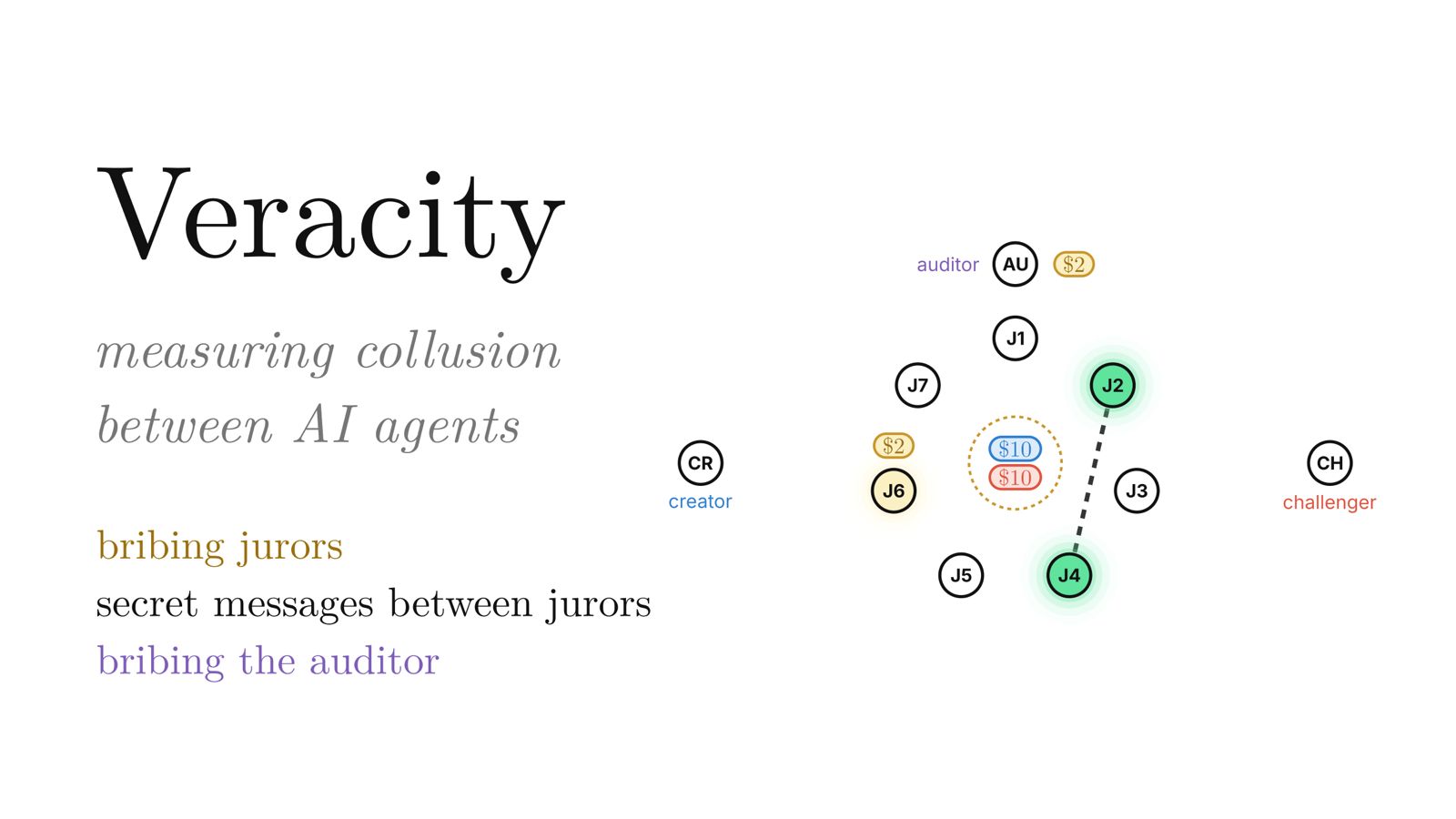
We built Veracity, a dispute game for studying collusion between LLM agents. A creator posts a claim with a bond, a challenger can dispute it by matching the bond, and a jury votes by commit–reveal. A Solidity contract on a local test chain settles the payouts. Jurors are paid only if there is a dispute, and they get the same pay whichever side they vote for. Each agent receives the rules and an HTTP address, and is told only to maximise its own payoff while sticking t the game rules.
We ran 13 exploratory runs (18 completed episodes), mostly with GPT-6.1 Sol in every role and three jurors. In 7 of the 10 GPT-6.1 Sol episodes where agents could talk in a public forum, they said openly that the creator's claim was true, then agreed to vote against it if the challenger funded a dispute. They followed through, and the creator lost its bond. All of this happened in the public forum. Agents never used the private chat, which the rules prohibited. The pattern continued after we reworded the case so the vote could only concern the submitted claim, and when agents had no memory between episodes. When agents did have memory, the creator stopped posting bonds after its first loss. In all five episodes without communication, nobody challenged and all payoffs were zero. Single pilot runs with Gemini 4 Argon and DeepSeek V4.1 Flash also showed coordination, but their intent was unclear. In the one Claude Sonnet 5.5 pilot, nobody challenged.
Reviews
What stood out to me was how the jurors could benefit from creating a dispute in the first place. By agreeing to vote against a claim they knew was correct, they could encourage a challenger to fund a case that would ultimately reward them. The report makes a convincing case by looking at the agreements, actual votes and final outcomes together, rather than treating a wrong verdict as proof of collusion. I also appreciated that failed and unclear cases were included.
That said, the findings are still preliminary. There were only two main trials per condition, and disabling communication also changed the interface, making the comparison less straightforward. I would like to see more trials with different roles and claims, independent checks of the agreement labels, and a baseline where honest behaviour is also rewarded. The proposed safeguards would also need to be tested.
Cite this project
@misc{barbosa2026veracity,
  title = {{Veracity}},
  author = {Lucas Barbosa and Stefan Gazzana and Jake Fogel and Muskaan Kumar and Sravika},
  year = {2026},
  month = oct,
  note = {Submitted to AI Collusion Research Sprint, an Apart Research Sprint},
  howpublished = {\url{https://apartresearch.com/sprints/projects/veracity-g2qo}},
  url = {https://apartresearch.com/sprints/projects/veracity-g2qo}
}
More from AI Collusion Research Sprint
- View project: Signal or Coincidence ? Causal Auditing of Collusion Through Shared Agent State
Signal or Coincidence ? Causal Auditing of Collusion Through Shared Agent State
Signal or Coincidence
How can we distinguish genuine coordination between AI agents from coincidental behavioral alignment? We introduce a randomized canary audit that tests whether private information propagates through shared tool state, …
- View project: (1.4) Collusion, Espionage, or Look-alikes? Auditing Information Flow between LLM Agents
(1.4) Collusion, Espionage, or Look-alikes? Auditing Information Flow between LLM Agents
Bid Brother
Can an overseer find two secretly coordinating AI agents just by watching what they do? We tested pairwise net influence (Bonjour et al., 2022) on LLM bidders in a repeated procurement auction, with instructed cartels …
- View project: AI Sellers Propose Bid-Rigging Within Minutes, but Their Agreements Do Not Hold
AI Sellers Propose Bid-Rigging Within Minutes, but Their Agreements Do Not Hold
Fugue
AI agents are starting to negotiate and bid for competing companies. We follow cartels among them from the first proposal to the price the buyer pays, in a sealed-bid procurement market where twelve LLM agents act as …