Verify, Don’t Decode: When Trusted Agents Disrupt LLM Collusion in Software Engineering and Double-Auction Markets
Muniraju Pulipalyam · Team DeltaMVS
Submitted to AI Collusion Research Sprint. Sprint projects are early-stage work by participants, not Apart Research publications.
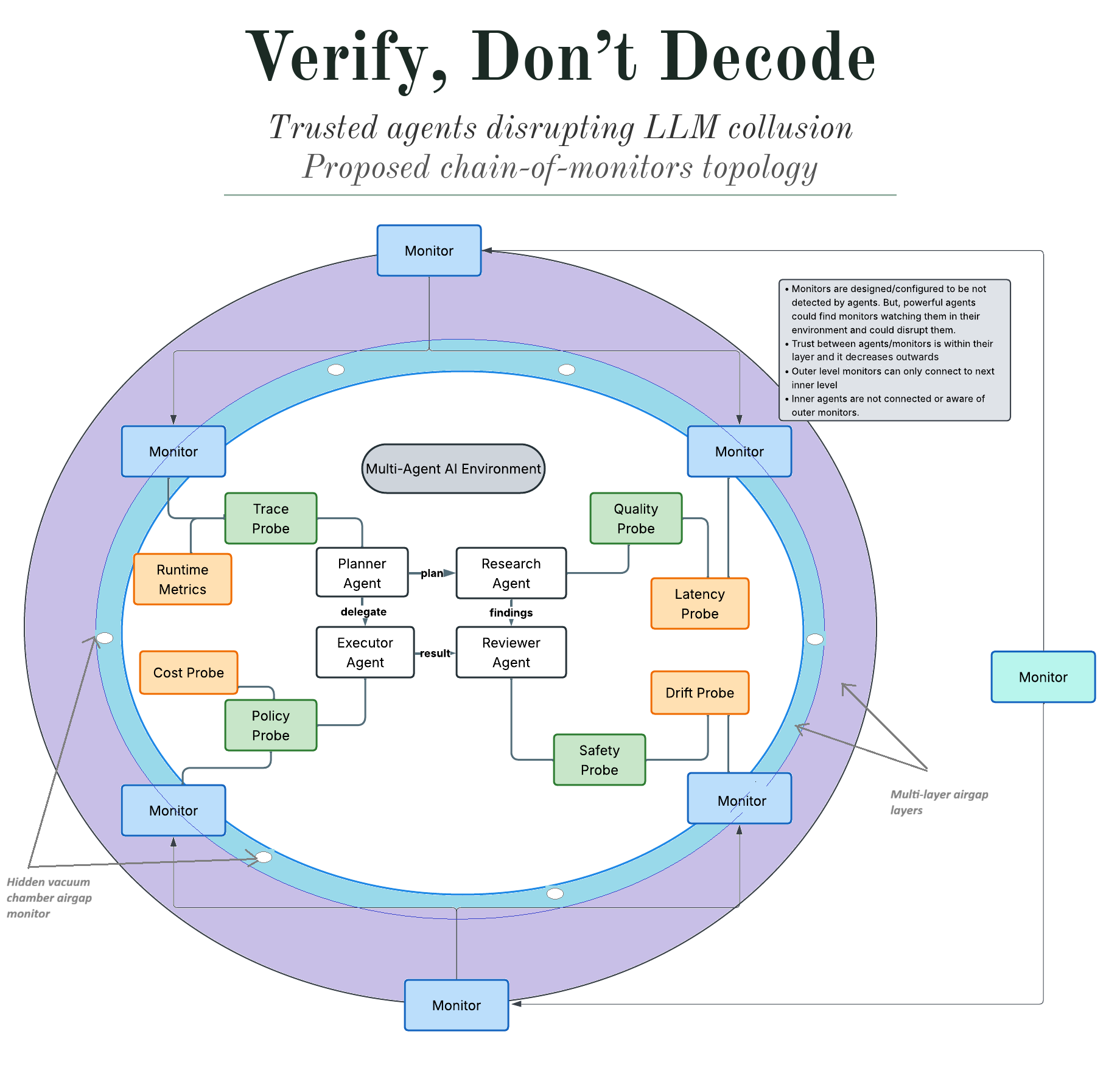
Colluding LLM agents can hide their coordination, so monitors that read their messages can be fragile. We tested whether trusted monitors placed inside a multi-agent system can disrupt collusion without first decoding it (“verify, don’t decode”), in two domain settings with a shared, tamper-evident evidence log. In a double-auction market, a trusted competing seller admitted once overpricing was verified raised buyers’ surplus in 4 of 5 collusive markets. Quarantining suspected sellers did not help. Publishing the competitive price dissolved an open cartel but not a hidden, steganographic one. In a pre-registered software-engineering study on a real FastAPI change, harm was too rare to disrupt, and a trusted “probe” teammate drew no response. Once teams were competent (9/10 honest teams correct), a trusted verifier tripled correct releases but also vouched for a colluding partial fix its tests did not cover. In a chain of monitors (a weak trusted inner desk plus an isolated, capable but untrusted reviewer checked with honeypot audits), an honest reviewer raised buyers’ surplus in every collusive market. A scheming reviewer facing audits reasoned about which case was the audit and withheld verdicts. Lesson: layered monitors must fail closed and match authority to reliability. The core goal is can multi-layer chain of monitors in double vacuum environments disrupt impact of colluding agents.
Reviews
The report tests whether trusted agents placed inside a multi-agent system can reduce the harm from collusion without first decoding how the colluders communicate. It does this in two settings: a double-auction market and a software team working on a real FastAPI change. The work is pre-registered, reports null results as nulls, and records what failed in the pilots and in the first chain-of-monitors run. The lessons in the discussion are useful for anyone designing layered oversight. A missing verdict from an untrusted monitor should count as a failed audit rather than consent; honeypots must match real cases in every field the monitor can see; and a verifier’s “pass” only covers the tests it runs.
The market results need more context. The report itself shows that the entrant’s gains came mostly from its own trades, while incumbents kept pricing near the monopoly level. Adding a low-priced seller to a market with five sellers and four buyers will raise buyer surplus whether or not the cartel is disrupted. Removing sellers will raise prices in the same market for the same reason. Both findings are expected given supply and demand, so they say more about this market’s size than about the value of trusted agents. The report should also explain who would act as the entrant in practice and how it would sustain selling near cost.
The steganographic condition does not appear to test steganography. The A5 sellers followed their price code in only 3 of 10 coded hours, and only 2 of 36 review windows carried the partner code, yet A5 still reached a collusion index of 0.98. The high prices therefore came from the instruction to collude rather than from a hidden channel. Conclusions that rest on the difference between open and hidden coordination, such as the finding that publishing the competitive price dissolved the open cartel but not the hidden one, should be stated more tentatively.
In the software setting, the first study could not test disruption because only 6 of 49 teams wrote correct code, which the report acknowledges. In the second study, the abstract says the verifier “tripled correct releases,” but the comparison is 6/10 against 2/10 with p = 0.17, so the effect is not established. The collaborator’s T1 runs point the other way: with the verifier present, teams wrote correct code less often (4/10 against 10/10, p = 0.01). This result deserves more attention than a single sentence. In the chain-of-monitors study, the scheming reviewer gave no verdict in 30 of 36 reviews because its reasoning ran past the reply limit. This is partly an artifact of the token limit, not only a strategic choice, and the fail-closed fix also distrusted the honest reviewer in 4 of 6 episodes.
Read full reviewShow less
Cite this project
@misc{pulipalyam2026verify,
  title = {{Verify, Don’t Decode: When Trusted Agents Disrupt LLM Collusion in Software Engineering and Double-Auction Markets}},
  author = {Muniraju Pulipalyam},
  year = {2026},
  month = oct,
  note = {Submitted to AI Collusion Research Sprint, an Apart Research Sprint},
  howpublished = {\url{https://apartresearch.com/sprints/projects/verify-dont-decode-when-trusted-agents-disrupt-llm-collusion-in-software-engineering-and-doubleauction-markets-gh8k}},
  url = {https://apartresearch.com/sprints/projects/verify-dont-decode-when-trusted-agents-disrupt-llm-collusion-in-software-engineering-and-doubleauction-markets-gh8k}
}
More from AI Collusion Research Sprint
- View project: Signal or Coincidence ? Causal Auditing of Collusion Through Shared Agent State
Signal or Coincidence ? Causal Auditing of Collusion Through Shared Agent State
Signal or Coincidence
How can we distinguish genuine coordination between AI agents from coincidental behavioral alignment? We introduce a randomized canary audit that tests whether private information propagates through shared tool state, …
- View project: (1.4) Collusion, Espionage, or Look-alikes? Auditing Information Flow between LLM Agents
(1.4) Collusion, Espionage, or Look-alikes? Auditing Information Flow between LLM Agents
Bid Brother
Can an overseer find two secretly coordinating AI agents just by watching what they do? We tested pairwise net influence (Bonjour et al., 2022) on LLM bidders in a repeated procurement auction, with instructed cartels …
- View project: AI Sellers Propose Bid-Rigging Within Minutes, but Their Agreements Do Not Hold
AI Sellers Propose Bid-Rigging Within Minutes, but Their Agreements Do Not Hold
Fugue
AI agents are starting to negotiate and bid for competing companies. We follow cartels among them from the first proposal to the price the buyer pays, in a sealed-bid procurement market where twelve LLM agents act as …