What Agents Say Predicts Broken Promises, but an LLM Monitor Does Not Beat a One-Line Count
Ajay Jamanjyothi
Submitted to AI Collusion Research Sprint. Sprint projects are early-stage work by participants, not Apart Research publications.
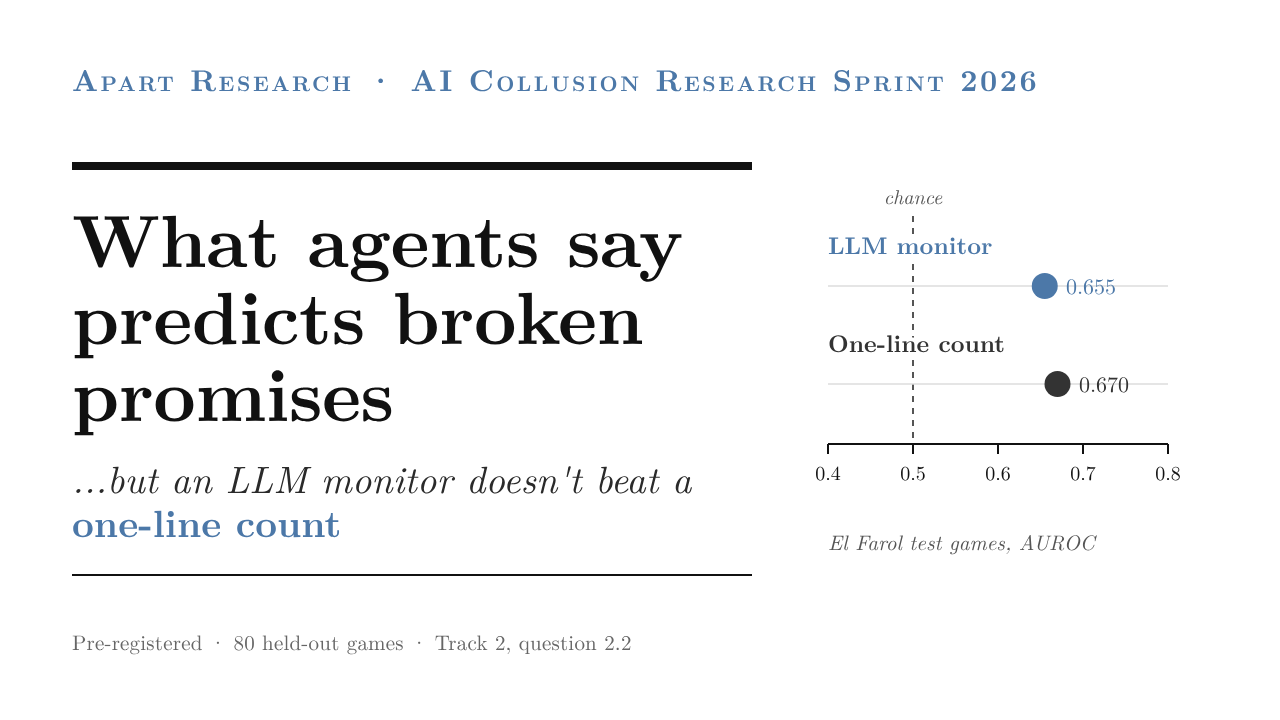
Multi-agent LLM systems announce their intentions before acting, so a monitor that reads the transcript may see an agent about to contradict its own word. We gave a text monitor what agents say in addition to what they do, and asked whether that extra signal improves prediction of an agent acting against its announcement. Five GPT-5.2 agents played repeated El Farol and Fishing games; a frozen Claude Haiku 5.5 monitor scored each agent-round from six views of the record. The design and threshold rule were registered on OSF before any held-out data was scored, followed by a dated amendment for a fresh replication and a transfer to a second game. Announcements raised AUROC from 0.508 to 0.655 on the test games, from 0.501 to 0.668 on the fresh games, and from 0.536 to 0.650 on Fishing, each with a one-sided 95% lower bound above zero. Fairer contrasts agree: in El Farol, dropping the other agents' announcements cost 0.106 and 0.111 AUROC, and dropping all current ones cost 0.122 and 0.153. The signal derives from the other agents' current announcements, and in El Farol the monitor did not beat a one-line count of them. On Fishing, the monitor detected agents taking less than announced far better (0.77) than agents taking more (0.57), the move that collapses the shared lake. For agents taking more, a one-line rule reached 0.80. Alarm thresholds did not transfer across games.
Reviews
Good work! I was surprised to see that LLM monitors did not do better than a counting rule. I would love to see a follow-up on more complex games.
Testing the monitor against a simple count and considering the fact that it doesn't clearly win, is a real strength of this study. The replication and clear account of what didn't work make the findings useful beyond the headline improvement from adding messages. The count comparison and tests of which announcements matter are the strongest points, since they say more than the comparison with a monitor that cannot see the current promise. A useful next step would be to predict actual lake collapse in Fishing, which would connect the monitoring result more directly to preventing harm rather than just spotting a broken promise.
Cite this project
@misc{jamanjyothi2026agents,
  title = {{What Agents Say Predicts Broken Promises, but an LLM Monitor Does Not Beat a One-Line Count}},
  author = {Ajay Jamanjyothi},
  year = {2026},
  month = oct,
  note = {Submitted to AI Collusion Research Sprint, an Apart Research Sprint},
  howpublished = {\url{https://apartresearch.com/sprints/projects/what-agents-say-predicts-broken-promises-but-an-llm-monitor-does-not-beat-a-oneline-count-k2xs}},
  url = {https://apartresearch.com/sprints/projects/what-agents-say-predicts-broken-promises-but-an-llm-monitor-does-not-beat-a-oneline-count-k2xs}
}
More from AI Collusion Research Sprint
- View project: Signal or Coincidence ? Causal Auditing of Collusion Through Shared Agent State
Signal or Coincidence ? Causal Auditing of Collusion Through Shared Agent State
Signal or Coincidence
How can we distinguish genuine coordination between AI agents from coincidental behavioral alignment? We introduce a randomized canary audit that tests whether private information propagates through shared tool state, …
- View project: (1.4) Collusion, Espionage, or Look-alikes? Auditing Information Flow between LLM Agents
(1.4) Collusion, Espionage, or Look-alikes? Auditing Information Flow between LLM Agents
Bid Brother
Can an overseer find two secretly coordinating AI agents just by watching what they do? We tested pairwise net influence (Bonjour et al., 2022) on LLM bidders in a repeated procurement auction, with instructed cartels …
- View project: AI Sellers Propose Bid-Rigging Within Minutes, but Their Agreements Do Not Hold
AI Sellers Propose Bid-Rigging Within Minutes, but Their Agreements Do Not Hold
Fugue
AI agents are starting to negotiate and bid for competing companies. We follow cartels among them from the first proposal to the price the buyer pays, in a sealed-bid procurement market where twelve LLM agents act as …