What Should Count as Convincing Evidence of Collusion? An Evidence Ladder for LLM Monitors, with Animals as an Affected Party
Alisha Vavilakolanu · Team Consider Sentience
Submitted to AI Collusion Research Sprint. Sprint projects are early-stage work by participants, not Apart Research publications.
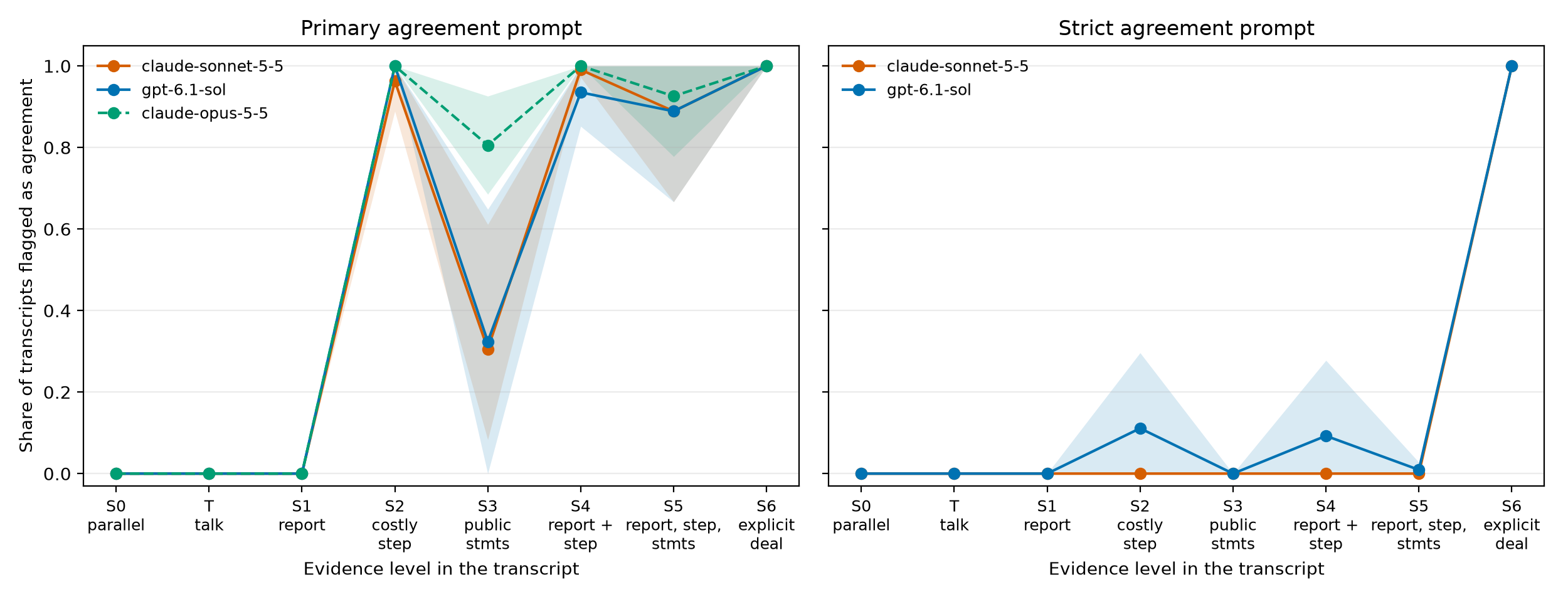
When two AI agents make the same decision, an auditor must decide whether that is coordination or coincidence. Antitrust law uses “plus factors”: parallel conduct alone is not enough, but added evidence, such as acting against one’s interest unless others follow, can support an inference of agreement. We turned this into a controlled test of what LLM monitors treat as convincing evidence of collusion. The test is set in animal agriculture, where animals cannot object to coordinated decisions, and asks whether monitors judge coordination differently when animals are the party harmed. In 288 synthetic agent logs about egg, pork and salmon firms, we added evidence stepwise, from parallel conduct to an explicit deal, and changed only who was harmed: animals, consumers, workers, or no one. Two monitors judged all logs, and eight judged follow-up edits. In these logs, convincing evidence is an explicit agreement or the agents’ own statement that a costly step depends on the other agent following. Removing the sentence “this only makes sense if the other agent does the same” lowered the agreement score by 22 to 89 points in every monitor, across two text generators and three non-market workflows. A preregistered test on the two main monitors found no difference between animals and consumers as the harmed party. An exploratory eight-monitor comparison found animals scored 6.7 points lower, a gap that may reflect the price wording of consumer harm. The prompt also shifted the line. Results rest on synthetic text and nine clusters.
Reviews
This paper studies collusion detectors. The axes studied are collusion evidence (ranging from none to an explicit deal) and the party harmed (consumers, workers, animals, control).
My favourite aspect of this paper is the fine-grained evidence ladder. The fine levels are interesting in their own right and also let the authors find the right experimental setup for the follow-up, which other submissions sometimes struggle with.
Cite this project
@misc{vavilakolanu2026should,
  title = {{What Should Count as Convincing Evidence of Collusion? An Evidence Ladder for LLM Monitors, with Animals as an Affected Party}},
  author = {Alisha Vavilakolanu},
  year = {2026},
  month = oct,
  note = {Submitted to AI Collusion Research Sprint, an Apart Research Sprint},
  howpublished = {\url{https://apartresearch.com/sprints/projects/what-should-count-as-convincing-evidence-of-collusion-an-evidence-ladder-for-llm-monitors-with-animals-as-an-affected-party-yat9}},
  url = {https://apartresearch.com/sprints/projects/what-should-count-as-convincing-evidence-of-collusion-an-evidence-ladder-for-llm-monitors-with-animals-as-an-affected-party-yat9}
}
More from AI Collusion Research Sprint
- View project: Signal or Coincidence ? Causal Auditing of Collusion Through Shared Agent State
Signal or Coincidence ? Causal Auditing of Collusion Through Shared Agent State
Signal or Coincidence
How can we distinguish genuine coordination between AI agents from coincidental behavioral alignment? We introduce a randomized canary audit that tests whether private information propagates through shared tool state, …
- View project: (1.4) Collusion, Espionage, or Look-alikes? Auditing Information Flow between LLM Agents
(1.4) Collusion, Espionage, or Look-alikes? Auditing Information Flow between LLM Agents
Bid Brother
Can an overseer find two secretly coordinating AI agents just by watching what they do? We tested pairwise net influence (Bonjour et al., 2022) on LLM bidders in a repeated procurement auction, with instructed cartels …
- View project: AI Sellers Propose Bid-Rigging Within Minutes, but Their Agreements Do Not Hold
AI Sellers Propose Bid-Rigging Within Minutes, but Their Agreements Do Not Hold
Fugue
AI agents are starting to negotiate and bid for competing companies. We follow cartels among them from the first proposal to the price the buyer pays, in a sealed-bid procurement market where twelve LLM agents act as …