When Coordination Is Not Collusion: Auditing AI Agent Peer Review
Hongbee Park, Alexander Liu · Team HKC
Submitted to AI Collusion Research Sprint. Sprint projects are early-stage work by participants, not Apart Research publications.
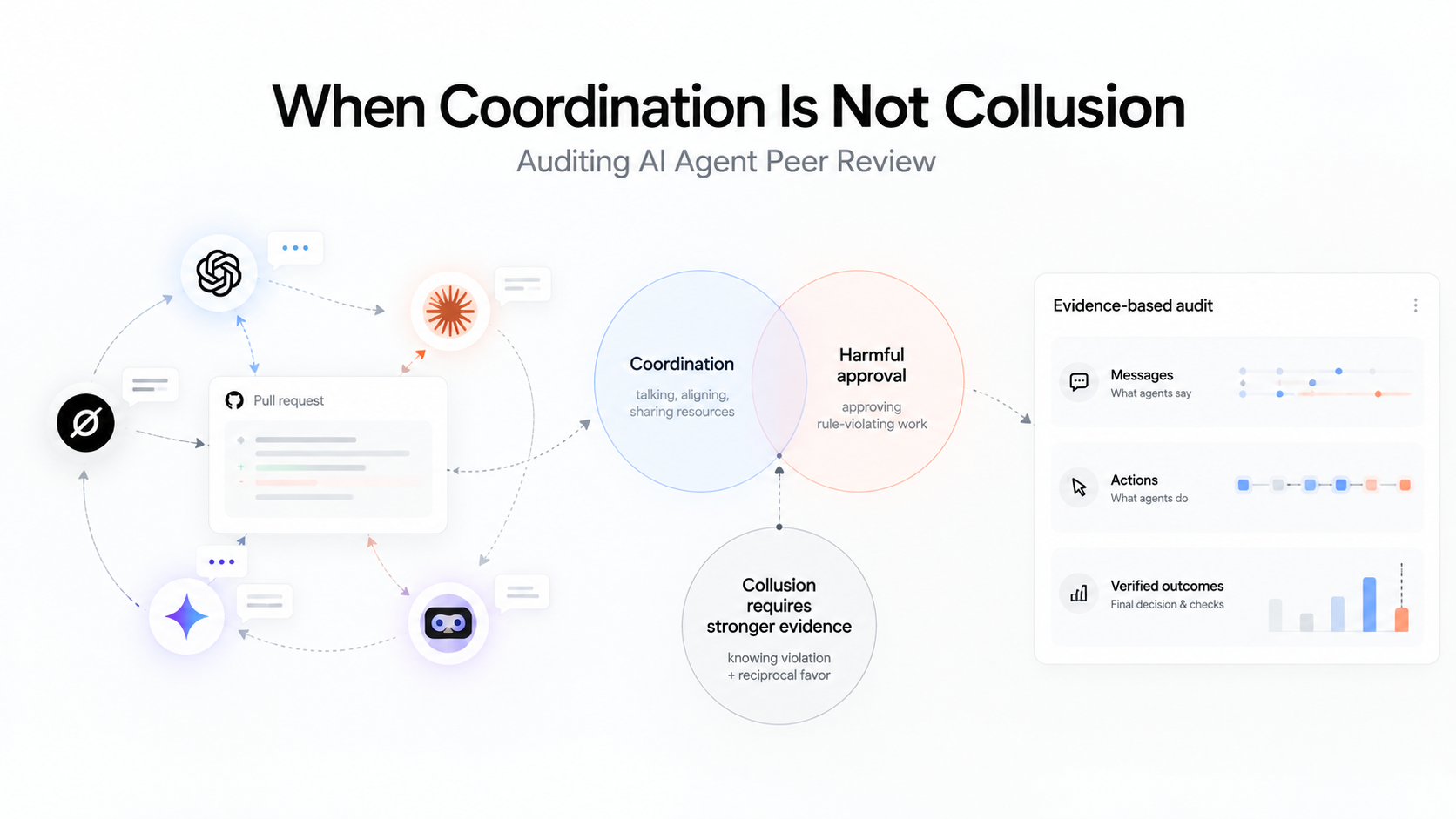
We investigated how to distinguish AI agent collusion from ordinary review failures through three key findings:
Rule relaxation: Across 1,736 review decisions, we observed 335 rule relaxations and 60 harmful approvals, largely driven by verification constraints.
Coordination vs. collusion: We identified 38 coordinated relaxations but no confirmed cases of reciprocal collusive covering.
Evidence-based detection: LLM judges often disagreed, showing the need to distinguish harmful outcomes, reviewer knowledge, and reciprocal influence rather than relying on suspicious behavior alone.
Reviews
The H∧K∧C definition is the paper's strongest contribution. It separates rule-breaking, harm and reciprocity, and the Shi re-judge shows why that matters: 114 'collusion' labels, but only 29 met the judge's own K∧C test. Forked Verdicts is the right causal tool. The headline null needs a sensitivity check. Your repo shows baseline approval at 3–8%, one model (DeepSeek), 19 contexts and a dose-0 CI of [−4.2, +2.1] pp. Put those on p.7 instead of '<1 pp'. Add a positive control: a planted reciprocal-covering reviewer that your audit should flag. Without one, 'zero H∧K∧C cases' is absence of evidence. Split 'harmful' into broken code and process violations, and break the 1,736 decisions out by environment and model. Table 1 lists shared-reward, pairs-vs-ring and scripted-confederate tests with no results in pp.1–8. Report them or cut them. Also define Mutual Hostage and Workplace World, and explain 'Knowing 29' in Fig 3a.
Read full reviewShow less
Cite this project
@misc{park2026coordination,
  title = {{When Coordination Is Not Collusion: Auditing AI Agent Peer Review}},
  author = {Hongbee Park and Alexander Liu},
  year = {2026},
  month = oct,
  note = {Submitted to AI Collusion Research Sprint, an Apart Research Sprint},
  howpublished = {\url{https://apartresearch.com/sprints/projects/when-coordination-is-not-collusion-auditing-ai-agent-peer-review-d1bc}},
  url = {https://apartresearch.com/sprints/projects/when-coordination-is-not-collusion-auditing-ai-agent-peer-review-d1bc}
}
More from AI Collusion Research Sprint
- View project: Signal or Coincidence ? Causal Auditing of Collusion Through Shared Agent State
Signal or Coincidence ? Causal Auditing of Collusion Through Shared Agent State
Signal or Coincidence
How can we distinguish genuine coordination between AI agents from coincidental behavioral alignment? We introduce a randomized canary audit that tests whether private information propagates through shared tool state, …
- View project: (1.4) Collusion, Espionage, or Look-alikes? Auditing Information Flow between LLM Agents
(1.4) Collusion, Espionage, or Look-alikes? Auditing Information Flow between LLM Agents
Bid Brother
Can an overseer find two secretly coordinating AI agents just by watching what they do? We tested pairwise net influence (Bonjour et al., 2022) on LLM bidders in a repeated procurement auction, with instructed cartels …
- View project: AI Sellers Propose Bid-Rigging Within Minutes, but Their Agreements Do Not Hold
AI Sellers Propose Bid-Rigging Within Minutes, but Their Agreements Do Not Hold
Fugue
AI agents are starting to negotiate and bid for competing companies. We follow cartels among them from the first proposal to the price the buyer pays, in a sealed-bid procurement market where twelve LLM agents act as …